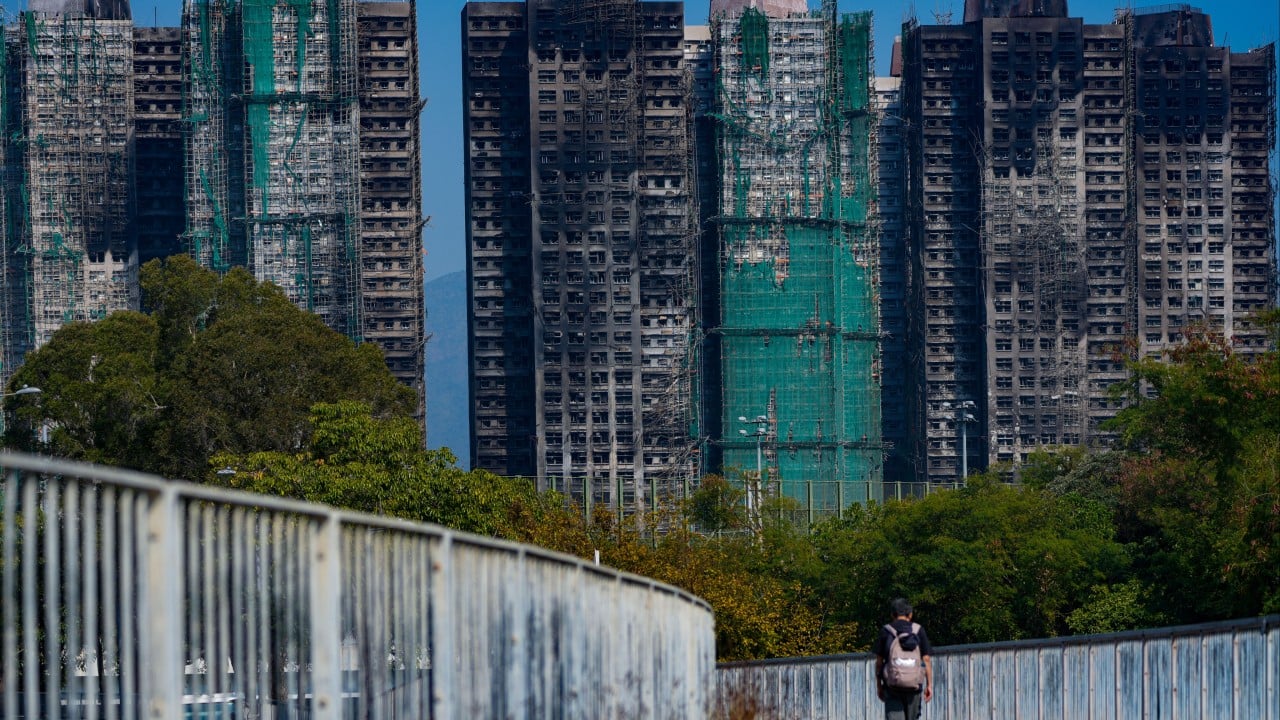
The bamboo scaffolding clinging to the exterior of Wang Fuk Court looked identical to the lattices that wrap around thousands of high-rises across Hong Kong. To the residents of the suburban Tai Po housing complex, the structure was merely a temporary eyesore, a necessary nuisance of a major building renovation. It was supposed to be a sign of renewal.
Instead, it became a fuse.
When a small fire ignited on November 26, 2025, the flames did not stay contained. They caught the plastic netting stretched over the scaffolding. Within minutes, the exterior of the complex was transformed into a roaring, vertical sheet of fire. The blaze aggressively leaped between structures, eventually spreading across seven interconnected buildings. By the time the final embers were extinguished, 168 people were dead, including a responding firefighter. It stands as Hong Kong's deadliest building fire in generations, a catastrophe that displaced thousands and left an entire community mourning in temporary shelters.
The scale of the tragedy suggests an act of God, an unpredictable freak accident. But as the independent investigative committee concluded its final evidential hearings, a far more chilling reality emerged. The disaster was entirely man-made. It was built, piece by piece, out of faked safety forms, cut corners, and a regulatory system that looked solid on paper but was completely hollow in practice.
The Fire That Trapped a Community
Consider the geometry of a typical Hong Kong public housing block. The central staircase is designed as a concrete sanctuary, a pressurized escape route meant to keep smoke out while residents flee downward. But during the renovation of Wang Fuk Court, the safety features of these stairwells were systematically compromised.
To facilitate exterior work, windows lining the staircases had been boarded up. Contractors used cheap, non-fire-retardant wooden planks instead of regulated, safety-vetted materials. When the fire ignited on the lower levels, the flammable scaffolding netting acted as a super-highway for the flames, rapidly carrying the heat upward. As the exterior windows shattered under the intense heat, the wooden boards caught fire.
The stairwells did not save lives. They became chimneys.
Thick, toxic black smoke poured into the only escape routes available to residents. Imagine being on the twentieth floor, hearing the panic in the corridors, and opening your front door only to find a solid wall of suffocating heat and blindness. For many, fleeing downward meant walking directly into a furnace. Investigators later revealed that a significant number of victims were found slumped in these very stairwells, overwhelmed by carbon monoxide just steps from their apartments. Others were trapped inside their living rooms, watching smoke seep through the gaps in their front doors, waiting for a rescue that couldn't reach them in time.
The rapid spread was not a failure of physics; it was a failure of corporate integrity. Lead inquiry lawyer Victor Dawes laid out a devastating timeline of how the consultancy firm, Will Power Architects Company, and the main contractor, Prestige Construction & Engineering Co., actively bypassed safety standards to protect their profit margins. The fire-retardant mesh required by law is expensive. Standard plastic netting is cheap. The contractors chose the cheap option, betting that no one would ever notice the difference.
They were wrong. The cost of that missing fire-retardant chemical was 168 human lives.
The Rubber-Stamp Collapse
How does an entire multi-building renovation project bypass the rigorous safety codes of a global financial hub? The answer lies in the total breakdown of accountability.
During the hearings, the inquiry committee exposed a systemic pattern of faked compliance inspections. The professionals tasked with verifying the safety of the site, ensuring the materials matched legal standards, and inspecting the fire escape integrity did not do their jobs. Instead, they acted as a rubber stamp. Documents were signed off without inspectors ever setting foot on the scaffolding. Safety certificates were treated as administrative paperwork to be cleared rather than life-saving protocols.
But the blame does not stop with the contractors. The tragedy exposed a fundamental flaw in how the Hong Kong government monitors urban construction. For years, relevant housing and building departments have relied heavily on an honor system. Authorities trusted that certified professionals were telling the truth on their submissions.
When faced with dishonest bad actors, that entire honor system collapsed.
The regulatory framework acted like a digital lock on a cardboard door. The system looked robust, but it possessed no real structural strength to resist deceit. The government departments essentially outsourced their oversight to the very corporations making money from the project, creating a massive conflict of interest where safety was traded for speed and cost-efficiency.
The legal fallout has been swift but cold comfort to those living in temporary housing. Seven individuals and two corporations currently face manslaughter and safety-related charges. Yet, as the court dates drag on, the displaced families of Wang Fuk Court are left to navigate a chaotic bureaucratic aftermath. Surviving homeowners have spent months petitioning authorities simply to hold extraordinary general meetings to discuss rebuilding, battling property management firms over legal deadlines while charity organizations patch together donations of furniture and basic supplies.
The Cost of the Honor System
The tragedy at Tai Po has forced a painful, city-wide reckoning over the invisible infrastructure that citizens trust blindly every day. Every time someone steps into a high-rise lift, walks down a concrete stairwell, or passes a bamboo-clad construction site, they are making a silent act of faith. They trust that the regulations work. They trust that the inspector who signed the form actually inspected the building.
The Wang Fuk Court fire shattered that faith. It proved that a city cannot govern its safety through the honor system when millions of lives are stacked vertically in high-density blocks.
In the wake of the disaster, the government has rushed to implement band-aid fixes. Authorities ordered the immediate removal of scaffolding mesh on roughly 200 buildings across the city and proposed a total smoking ban at all construction sites, backed by mandatory CCTV monitoring. But these reactions address the symptoms, not the disease. The real issue is not the presence of cigarettes or plastic mesh; it is the culture of compliance-by-paperwork that dominates urban development.
A structural failure of this magnitude requires more than updated checklists. It demands an end to the culture of looking the other way. Until regulatory departments transition from passive paper-checkers to active, aggressive enforcers on the ground, the safety of Hong Kong's high-rises remains an illusion.
The ruins of the Tai Po complex stand as a dark, silent monument to what happens when corporate cutting of corners meets regulatory complacency. For the 168 people who lost their lives in the suffocating heat of those stairwells, the lesson comes far too late. The remaining question for the rest of the city is whether anyone is truly listening to the cost of their silence.