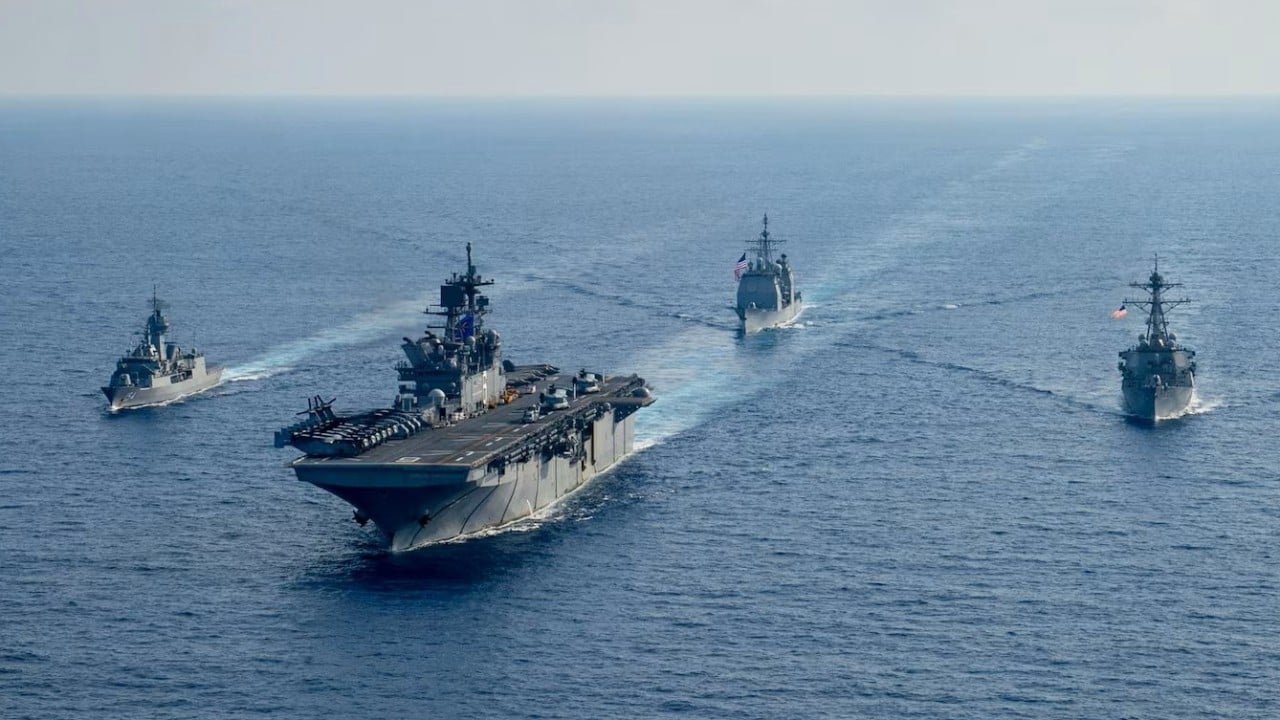
The United States and China have concluded another round of military maritime safety talks in Hawaii, capturing headlines with optimistic buzzwords like "candid and constructive." Do not be fooled by the diplomatic gloss. These meetings, held under the Military Maritime Consultative Agreement, are designed to establish basic rules of conduct for warships and aircraft encountering each other in contested spaces like the South China Sea and Taiwan Strait. Yet, while the official communiqués emphasize that communication prevents miscalculation, the reality on the water tells a far more dangerous story. These talks are failing to curb aggressive behaviors because they treat structural geopolitical hostility as a series of simple traffic management problems.
For two days in Honolulu, representatives from the US Indo-Pacific Command, Pacific Fleet, and Pacific Air Forces sat across from officials of China's People's Liberation Army. They evaluated the Rules of Behavior for Safety of Air and Maritime Encounters. They discussed professionalism. Then, almost before the ink dried on the joint press releases, Beijing issued a fierce public counter-salvo, declaring its total opposition to any close-in reconnaissance, harassment, or operations conducted under the banner of freedom of navigation.
This immediate rhetorical pivot exposes the deep rift at the heart of these talks. To Washington, maritime safety is a technical matter of keeping ships from hitting each other while both sides operate legally in international waters. To Beijing, those same international waters are an internal security zone where American presence is viewed as an existential threat.
The mechanism behind these encounters is structured around a dangerous paradox. The MMCA was established in 1998 to prevent a crisis, yet it has repeatedly been frozen by China whenever a crisis actually occurs. When a Chinese fighter jet collided with an American EP-3 reconnaissance plane in 2001, or when Beijing cut military ties following political visits to Taiwan, the lines went dead. It is a safety valve that functions perfectly fine until the pressure builds, which is exactly when it is needed most.
The Fiction of Professionalism under Structural Hostility
Frontline pilots and ship captains do not operate in a vacuum. A Chinese fighter pilot who buzzes an American surveillance aircraft within a few dozen feet is not acting out of a lack of professional training. They are executing a top-down strategy intended to raise the cost of entry for foreign militaries in the Western Pacific.
Consider a hypothetical example of how this operational tension manifests. An American destroyer conducts a standard Freedom of Navigation Operation near a militarized reef. The ship adheres strictly to international law, maintaining a steady course and broadcasting its position. A Chinese naval vessel approaches, maneuvering aggressively across the American ship's bow to force a change in course. If the American captain swerves, China wins a tactical psychological victory. If the captain holds the line, the risk of a catastrophic collision spikes.
No amount of dialogue in a Hawaiian conference room can resolve this fundamental contradiction. The MMCA meetings review past incidents, but they lack any enforcement mechanism. They rely entirely on voluntary adherence to non-binding codes like the Code for Unplanned Encounters at Sea. When the strategic goal of one party is to actively deter the other from being there at all, safety protocols become a secondary concern.
The Expansion of the Grey Zone
While bureaucrats debate the distance between hulls, the nature of maritime confrontation has shifted entirely. The PLA Navy is no longer the sole actor pushing the boundaries of aggressive maneuvering. Beijing now heavily deploys its coast guard and a vast maritime militia composed of weaponized fishing vessels to enforce its sovereignty claims.
These grey-zone forces operate in a deliberate legal vacuum. Because they are technically civilian or law enforcement vessels, they claim immunity from the military-to-military rules discussed at the MMCA. Yet they employ water cannons, laser blindings, and intentional ramming tactics against regional neighbors and Western allies alike.
[Traditional Military Protocol] <--- Disconnect ---> [Grey-Zone Maritime Militia]
    - Strict Rules of Conduct                            - Deniable civilian hulls
    - Binary escalation logic                            - Asymmetric escalation
    - Managed via MMCA channels                         - Unaddressed by safety talks
By keeping these paramilitaries out of the formal safety frameworks, China maintains a tool for coercion that bypasses the very communication channels praised in Honolulu. The US military is left trying to apply 20th-century naval safety rules to a 21st-century asymmetric siege.
The High Cost of Diplomatic Theatre
The real danger of these continuous, low-yield meetings is the false sense of security they project to the international community. It allows political leaders on both sides to claim they are responsibly managing the competition while the underlying triggers for war remain completely unaddressed.
The United States continues to fly and sail wherever international law allows, asserting a global maritime order. China continues to expand its anti-access and area-denial capabilities, viewing the American presence as an obstacle to its regional dominance. These two positions are fundamentally irreconcilable.
As long as both capitals treat these safety talks as a cosmetic exercise to calm global markets rather than a tool to dismantle aggressive operational mandates, the countdown to the next real world crisis continues. The next time a wingtip clips or a hull scrapes in the South China Sea, the phone lines in Honolulu will not stop the escalation. The crews on the water will be entirely on their own.