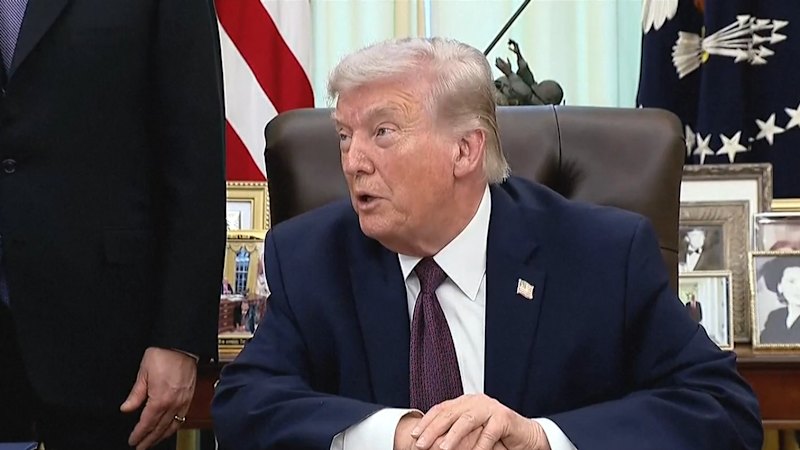
The war will be over in two weeks, or maybe three, according to the man in the Oval Office. President Donald Trump, speaking from the White House on March 31, 2026, declared that the United States would be "leaving" Iran "very soon," insisting that once the military "detour" ends, global oil prices will crater. It is a seductive narrative of quick victory and economic relief. But behind the podium, the physical reality of the conflict paints a starkly different picture. While the President talks of leaving, the Pentagon is sending thousands more troops, an aircraft carrier strike group, and elite airborne units into the heart of the Middle East. This is not the profile of a military packing its bags; it is the blueprint for a prolonged, high-stakes occupation of the global energy supply chain.
The Strategic Gap Between Rhetoric and Readiness
The primary claim fueling the President's latest pronouncement is that the United States has already "finished the job" by degrading Iran's nuclear and conventional capabilities. Operation Epic Fury, launched on February 28, 2026, certainly achieved its immediate kinetic goals. The 86-year-old Supreme Leader is dead, the nuclear sites at Natanz and Fordow are smoldering ruins, and the Iranian Navy has been reduced to a collection of burnt hulls. Don't forget to check out our recent post on this related article.
Yet, the "mission accomplished" veneer hides a massive operational hole. Iran's Revolutionary Guards, though battered, have shifted to a "ghost navy" strategy, planting mines and using mobile missile batteries to shutter the Strait of Hormuz. This 21-mile-wide choke point is the jugular of the global economy. By telling other nations they must now "fend for themselves" in these waters, the administration is betting that the mere threat of U.S. airpower is enough to keep the oil flowing. It isn't.
The Surge No One is Calling a Surge
The numbers do not lie. Even as the President speaks of an exit within "two or three weeks," the USS George H.W. Bush and its 6,000 sailors just deployed to the region. They are joined by the 82nd Airborne Division and 2,500 Marines from the USS Tripoli. These are not "withdrawal" forces. Airborne units are designed to seize and hold territory, specifically airfields and oil infrastructure. If the U.S. truly intends to leave in 14 days, why are they just now landing the boots required to stay for 14 months? To read more about the history of this, Associated Press provides an excellent summary.
The administration's true aim appears to be a pivot from "active bombing" to "indefinite containment." By destroying the central government's ability to wage conventional war, the U.S. has created a vacuum. Someone must now police the wreckage to ensure the "new, rational leadership" the President mentions actually takes hold.
The Oil Gambit and the Gasoline Lie
The President’s promise that gasoline prices will "tumble down" the moment the U.S. leaves Iran ignores the structural damage done to the energy market. Crude oil prices have spiked 40 percent since the war began. The Strait of Hormuz remains effectively closed to non-American-aligned shipping.
The strategy currently in play is a high-stakes form of resource leverage. By floating the idea of "taking the oil" at Kharg Island, as the President did in a recent interview, the U.S. is signaling a shift toward direct control of Iranian exports. This isn't about leaving; it's about a hostile takeover of a nationalized industry.
Allies in the Cold
The "America First" doctrine has reached its logical, brutal conclusion in this conflict. The public attacks on the United Kingdom and France for their "cowardly" refusal to join the naval blockade show a fractured NATO. Italy and France have already pushed back against specific U.S.-Israeli operations, leading to a situation where the U.S. is essentially running a unilateral war while demanding multilateral payment.
The warning to allies to "go get your own oil" suggests that the U.S. is prepared to let the global economy fragment into protected trade zones. In this scenario, the U.S. military becomes the world's most expensive security guard, but only for those who pay the premium or follow the Washington line.
Why a Deal Isn't the Goal
The most revealing moment of the President's Tuesday briefing was the admission that a "deal is not a prerequisite" for leaving. This is a complete reversal of the "Maximum Pressure" campaign's stated goals. For years, the objective was a new nuclear treaty. Now, the objective has shifted to pure destruction.
By declaring the war over without a signed agreement, the administration avoids the political mess of a formal occupation or a messy peace treaty. They can claim victory, bring the "fighting" to an end, and keep the "stabilization" forces in place indefinitely. It is the Iraq model, rebranded for a faster, more impatient political cycle.
The Iranian Revolutionary Guards have already responded to this "exit" talk by targeting 18 American tech giants, including Google, Apple, and Tesla. They know that as long as the U.S. maintains its current posture, the war hasn't ended—it has just moved from the battlefield to the boardroom and the digital infrastructure of the West.
The brutal truth is that you cannot bomb a country into a "rational" partner and then walk away in a fortnight. The vacuum created by the collapse of the Islamic Republic will require decades, not weeks, to manage. The "two-week" timeline is a political countdown, not a military reality. The U.S. is not leaving the Iran war; it is simply entering the more expensive, more dangerous second act.
Watch the troop manifests, not the Truth Social posts. The surge is here, and it’s staying.