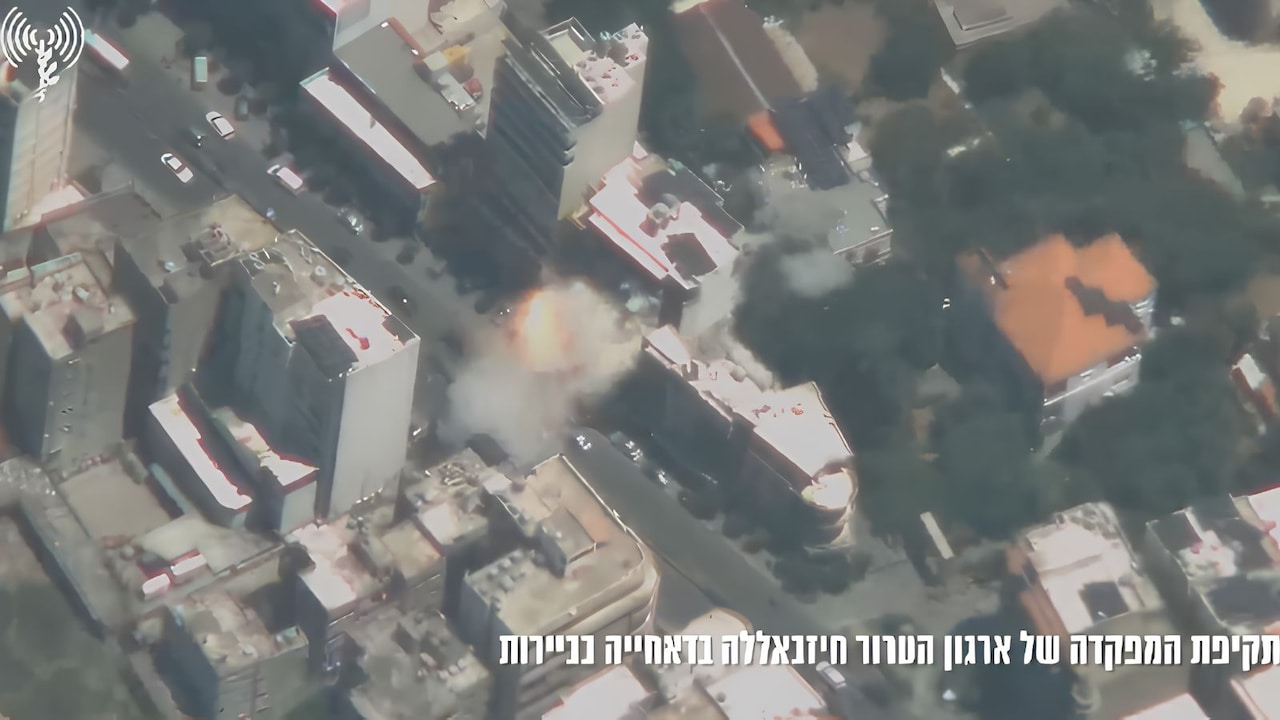
The Israeli Air Force fighter jets that pierced the morning sky over Beirut on Sunday did not alter the strategic math of the Middle East, despite the fiery headlines. By dropping ten precision munitions on a Hezbollah infrastructure site in the densely populated Dahieh district, Israel executed its first major strike on the Lebanese capital since the collapse of the short-lived April ceasefire. The Israeli Defense Forces quickly declared the operation a successful retaliation for a morning drone flurry that targeted northern Israel. However, intelligence sources confirm the targeted headquarters was entirely evacuated before the bombs struck. This was a political performance masquerading as a military necessity, revealing a deeper crisis of deterrence that neither side can break.
The strike underscores a grim reality. Air superiority cannot substitute for a coherent geopolitical strategy. For decades, the cycle of violence between Jerusalem and Beirut has followed a predictable script of action, reaction, and escalation. Yet, as the smoke clears over Haret Hreik, the structural foundations of the conflict remain completely unchanged.
The Mechanics of a Empty Victory
Military operations are designed to destroy capability or degrade the will of an adversary. Sunday’s strike accomplished neither. The targeted site, labeled by the IDF as a command center used to plan operations against Israeli civilians and soldiers in southern Lebanon, was a hollow shell. Intelligence had leaked, or the operational patterns had become so transparent that Hezbollah leadership simply cleared out before the F-15s rolled down the runway.
What remains is the tactical data. Two aircraft deployed high-explosive, precision-guided munitions directly into an urban infrastructure point. The use of such heavy ordnance in a metropolitan area demonstrates Israel's willingness to absorb international condemnation to prove a point. The point, however, was directed more at audiences in Tel Aviv and Washington than the militants hiding in the underground bunkers of Lebanon.
Prime Minister Benjamin Netanyahu and Defense Minister Israel Katz issued a joint statement following the raid, asserting that Israel will not tolerate fire directed at its territory. This rhetoric is designed to project strength at a moment when domestic pressure is mounting over the displacement of residents from northern border towns. By striking Dahieh, the government signaled that the capital of Lebanon is not immune to consequences. But a signal that destroys empty concrete does little to halt the drone teams operating from mobile launchers in the valleys of the south.
The Geopolitical Collision Course
The timing of the strike reveals a complex diplomatic layer that turns this tactical skirmish into a high-stakes poker game involving Washington and Tehran.
Negotiators have been working quietly to salvage a broader memorandum of understanding between the United States and Iran, aiming to establish formal parameters to de-escalate regional proxy wars. Sunday's bombing immediately threw those efforts into jeopardy. Iranian Parliament Speaker Mohammad Bagher Ghalibaf seized on the event, publicizing statements that Western powers lack either the willpower or the structural capacity to enforce security understandings.
The strategy from Tehran is obvious. By backing Hezbollah’s persistent cross-border attrition, Iran tests the boundaries of Western diplomatic resolve. Every rocket fired from southern Lebanon serves as an Iranian leverage point on the global stage. When Israel responds with overwhelming force in Beirut, it inadvertently plays into this paradigm by allowing Iran to position itself as the defender of Lebanese sovereignty against unprovoked aggression.
Regional Escalation Cycle:
[Hezbollah Drone Launches]
       │
       ▼
[Israeli Air Force Striking Beirut Suburbs]
       │
       ▼
[Iranian Diplomatic Threats & Missile Warnings]
       │
       ▼
[Stalled International Ceasefire Negotiations]
The Red Line That Faded Away
The true failure of modern military intervention in this theater is the dilution of the "red line."
When the IDF executed Operation New Order in September 2024, utilizing dozens of bunker-buster bombs to assassinate longtime Hezbollah Secretary-General Hassan Nasrallah, it was viewed as an existential blow to the organization. The sheer scale of the intelligence penetration and military execution suggested that the rules of engagement had been permanently rewritten. The assumption among Western intelligence analysts was that the group would take years to reconstitute its command structure.
Observable reality proves otherwise. Naim Qassem stepped into the vacuum, and the operational core of the group adapted. The cross-border skirmishes did not stop; they merely adjusted to the new tactical environment.
The current framework of deterrence relies on an unstable equation. Israel strikes to show it can. Hezbollah fires to show it survives. This dynamic creates a dangerous baseline where symbolic strikes must continually grow in violence to maintain their communicative value. If dropping ten bombs on an empty building in Beirut is the standard response to a drone interception, the next iteration of this cycle will require hitting inhabited ministries or critical civilian infrastructure to achieve the same psychological effect.
The Broken Road to a Ceasefire
The fundamental disconnect lies in the diplomatic arena. Washington has continuously attempted to broker a 21-day implementation window based on historical UN resolutions, primarily focused on pushing armed militants north of the Litani River.
Hezbollah has flatly rejected these terms. From their perspective, agreeing to a unilateral withdrawal under the pressure of Israeli airstrikes amounts to political suicide within Lebanon's delicate sectarian ecosystem. The organization derives its domestic legitimacy from its role as a resistance force. If it retreats, it loses its raison d'être.
Consequently, the Lebanese government is trapped in an impossible position. The National News Agency reported casualties and significant civilian terror from Sunday's raids, yet the central government in Beirut possesses zero authority to disarm the militia or prevent the IAF from violating its airspace. The state is a bystander in its own destruction.
The illusion that air campaigns can force a political settlement without a clear, sustainable diplomatic architecture is crumbling. Every sortie flown over Beirut provides temporary political cover for leaders in Jerusalem, but it leaves the fundamental threat intact. Rockets will continue to cross the border, drones will continue to test the Iron Dome, and the residents of northern Israel will remain displaced. The military machine has proven it can flatten any coordinate in the Middle East with pinpoint accuracy, but it has yet to prove it can build a lasting peace out of the rubble.