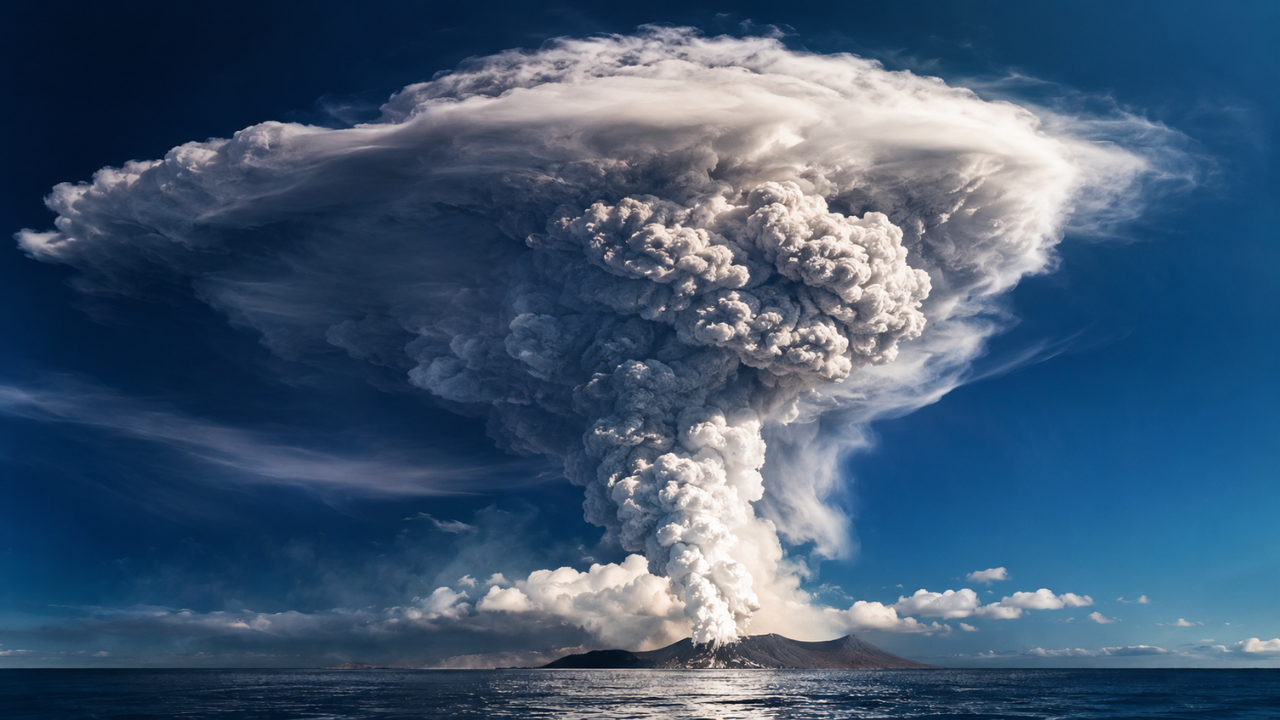
Everyone lost their minds over a volcano.
When the Hunga Tonga-Hunga Ha'apai underwater volcano detonated in January 2022, it punched a massive hole through the troposphere and injected an unprecedented amount of water vapour straight into the stratosphere. The scientific consensus rushed to print. Panic articles flooded feeds. The narrative was neat, terrifying, and fundamentally incomplete: a colossal oceanic splash meant instant ozone destruction, runaway atmospheric warming, and a broken climate system for years to come.
Stop buying the hysteria.
The lazy narrative relies on a single metric: absolute volume. Yes, the eruption hurled roughly 146 teragrams of water vapour high above the weather layer, increasing total stratospheric water content by a staggering ten percent overnight. On paper, that sounds apocalyptic. But atmospheric physics does not care about your panic spreadsheets; it cares about transport, chemistry, and timescales.
I have watched climate researchers and modelers trip over themselves trying to fit this single anomaly into standard diagnostic boxes, ignoring how the stratosphere actually processes dynamic shocks. They treated the stratosphere like a stagnant bathtub instead of a high-speed chemical reactor with built-in escape valves.
Here is the controversial truth nobody admits. That famous water vapour injection did not break the climate. It exposed the fragile assumptions baked into our favorite predictive models.
The Flawed Physics of the Panic
Let us dismantle the core argument of the doom-mongers. The primary fear surrounding the Hunga Tonga plume was simple: water vapour is a potent greenhouse gas, and higher altitudes mean longer residence times. Therefore, scientists predicted rapid surface warming and severe ozone depletion via enhanced HOx radical chemistry.
Except reality refused to follow the script.
- The Circulation Trap: The standard models assumed the plume would disperse uniformly and linger horizontally across both hemispheres for a decade. They completely underestimated the speed of the Brewer-Dobson circulation.
- The Latitudinal Reality: The bulk of the water mass did not sit quietly over the poles where ozone destruction is most critical. It was rapidly shunted toward the tropics and the winter hemisphere, driven by energetic wave-mean flow interactions that modern climate simulations failed to capture accurately in real-time.
- The Aerosol Paradox: Volcanoes usually cool the planet by injecting sulfur dioxide, which forms reflective sulfate aerosols. Hunga Tonga was weirdly dry on sulfur relative to its water content, which threw off standard volcanic cooling indices. Researchers panicked over the water while ignoring the relative absence of concurrent cooling agents that usually buffer volcanic impacts.
When you isolate water vapour without modeling the coupled radiative-dynamical response, you are looking at a snapshot and pretending you understand the movie. The stratosphere is remarkably resilient, and its self-cleaning mechanisms operate at scales we are only beginning to map.
What People Get Wrong About Stratospheric Chemistry
Let us talk about ozone, because that is where the headlines got truly hysterical. Every mainstream outlet parroted the line that the Tonga eruption would blow a massive hole in the ozone layer.
The mechanism sounds plausible at a glance. Water vapour breaks down into hydroxyl radicals, which then catalytic-destroy ozone molecules. Simple chemistry, right?
Wrong.
Chemistry in the stratosphere is a multivariate equation, not a middle-school lab experiment. The local temperature drop caused by radiative cooling from the plume actually altered reaction rates in ways that countered the direct chemical destruction. Furthermore, the localized wind shear caused by the injection changed the transport of existing ozone from the tropics.
We saw localized, temporary shifts in column ozone over specific regions, but the global collapse predicted by doomsayers never materialized. Why? Because the atmosphere does not operate in a vacuum. It compensates. When you push hard on one variable, secondary feedbacks kick in to dampen the shock.
The Real Lesson We Refuse to Learn
The Hunga Tonga event should not be remembered as a climate disaster. It should be remembered as a massive stress-test for our observational arrogance.
For decades, atmospheric science has relied on steady-state assumptions. We built our models based on baseline years that lacked massive, explosive sub-surface marine eruptions. When an outlier event occurs, instead of admitting that our boundary conditions are overly simplistic, we double down on the emergency narrative.
I have seen research budgets swing millions of dollars based on early, unverified model runs of that plume. Institutions scrambled to claim ownership of the crisis, publishing papers that linked every subsequent weather anomaly—from European heatwaves to strange rainfall patterns—back to the Tongan shockwave.
This is lazy attribution science. It attributes localized weather chaos to a single stratospheric anomaly because it makes for a clean, compelling story. It ignores chaotic tropospheric dynamics, ocean heat content anomalies like El Niño transitions, and internal atmospheric variability.
If your model requires an unprecedented volcanic eruption to explain ordinary weather variance, your model is broken.
Moving Past the Doom
Stop looking at the stratosphere as a fragile glass ceiling. It is a turbulent, self-regulating fluid envelope that has absorbed impacts far worse than a Tongan submarine caldera over millions of years of geological history.
The actual takeaway from 2022 is that our global monitoring network works. Satellites like NASA's MLS and CALIPSO caught the injection in stunning detail. We have better data now than ever before. But having better data is useless if we interpret it through a lens of continuous crisis.
We need to stop treating every natural anomaly as a harbinger of systemic collapse. Science advances by questioning dogma, not by cowering behind the consensus du jour.
The water cleared out faster than the models predicted. The ozone recovered. The climate system absorbed the punch and kept moving.
Next time a subterranean volcano blows its top and the headlines scream about the end of the atmosphere, look at the data yourself.
Check the transport rates. Look at the circulation feedbacks. And remember that the people shouting the loudest are usually the ones selling the ticket for a disaster that never arrives.
Drop the models. Look at the sky. It is still up there.


