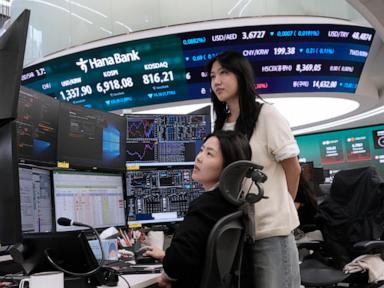
The coffee in Tokyo is always hot at six in the morning, but the terminal screens are ice.
Kenji wipes a speck of dust from his monitor with a thumb that has known forty years of market opens. Outside his high-rise window, the city is waking up to a gray Tuesday, commuters folding umbrellas against a persistent drizzle. Inside, the air smells of old paper and copper wiring. Red numbers are bleeding across the glass. Asian shares are sliding, dragging down regional indices in a synchronized descent that feels less like trading and more like gravity taking its toll.
Across the East China Sea and down through the trading floors of Singapore and Sydney, a quiet panic is settling into the bones of the morning.
Look at the crude charts. Brent is hovering. It refuses to drop below the psychological floor of one hundred dollars a barrel. To an algorithm sitting in a server farm in Virginia, that is a data point. A coordinate on a graph. To Kenji, who remembers the oil shocks of his youth and the bitter taste of rationing, that number is a physical weight pressing down on every container ship, every diesel generator, every loaf of bread transported to a neighborhood market.
Numbers do not bleed. People do.
To understand why markets tumble when crude stays high, you have to stop looking at the indices and start looking at a bakery in Yokohama.
(Note: The following is a hypothetical scenario designed to illustrate the real transmission mechanism of commodity shocks.)
Imagine Sato. Sato runs a small shop inherited from his father. He turns on the large industrial ovens every single night at two in the morning. Those ovens run on electricity generated largely by imported liquid natural gas and oil derivatives. When the baseline cost of energy spikes and stays stubbornly elevated above a hundred dollars, Sato's monthly utility bill does not just tick upward; it balloons. He absorbs the first month's increase. He cuts his own salary for the second. By the third month, looking at a stack of red-inked invoices and the sliding value of his stock portfolio, he has to make a choice. He raises the price of bread.
Multiply Sato by three million small business owners across Asia.
That is the invisible transmission belt of a commodity price lock. High energy acts as a tax on everything that moves, grows, or is manufactured. When energy refuses to cheapen, margins compress until they snap. Investors see this compression coming months before it hits Main Street. They pull capital out of equities, seeking shelter, and the collective rush toward the exit causes the red cascade Kenji watches on his monitors.
Markets are fundamentally emotional creatures wearing a mathematical disguise. They are made of people terrified of being wrong, people remembering last year's losses, people watching a barrel of oil refuse to budge and calculating the exact moment when consumer demand breaks entirely.
Why does one hundred dollars matter so much? Why not ninety-nine, or one hundred one?
Human psychology loves round numbers. We are storytelling primates who cling to milestones. A century of dollars per barrel functions as a tripwire in the collective consciousness of global commerce. Below it, central banks breathe easier, whispering about soft landings and controlled inflation. Above it, the specter of stagflation—that terrifying economic ghost where growth stalls while prices soar—returns to haunt the boardroom.
History whispers warnings if we are willing to listen. Every major economic tremor of the past half-century has left grease stains on the ledger. When supply lines tighten and energy becomes a luxury, the shockwaves ripple outward with mathematical cruelty. Emerging economies in the region, striving to build infrastructure and lift millions into middle-class stability, find their import bills skyrocketing overnight. Foreign currency reserves drain away just to keep the lights on. Factories in export-heavy hubs find that the cost of shipping a metal box across the ocean now eats the profit margin whole.
The trader in Tokyo knows this dance. He has seen the steps before.
He takes a slow sip of his lukewarm canned green tea. The screen flashes again. Another hundred points shaved off the Nikkei.
There is a strange sort of quiet that accompanies a market drop. It is not the noise of a car crash or the shouting of a crowded floor. Modern trading is largely silent, conducted through fiber-optic pulses moving at the speed of light. The violence is entirely abstract until you walk outside.
Walk outside with Kenji at noon.
The rain has stopped, leaving the asphalt slick and reflecting the gray glare of overcast skies. Delivery trucks idle at the curb, their tailpipes chugging exhaust into the damp air. The driver leans against the fender, checking his phone, his face lined with fatigue. He does not care about the Federal Reserve's rate path or the technical resistance levels of Brent crude. He only knows that filling his tank costs more than it did last week, and his weekly paycheck hasn't budged to match it.
This is where the abstraction ends. The macroeconomics of falling shares and stubborn oil prices are just the weather report for this man's life.
We try to insulate ourselves from uncertainty by building complex financial instruments, hedging bets, and inventing new ways to slice risk into manageable pieces. Yet, at the end of every complex chain of derivatives and futures contracts sits a person paying too much for fuel, a baker turning up an oven, a commuter watching the price board at the station.
The screen on Kenji's desk keeps updating. The red numbers will eventually turn green, because markets always breathe in and out, contracting in fear and expanding in greed. But today, the breath is held. The anchor holds firm at one hundred dollars, dragging the horizon down just a little bit further, reminding everyone that the global economy is only as strong as the weary human beings keeping it upright.