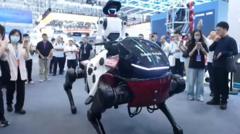
Every tech blog on the internet is currently drooling over viral footage of a bipedal machine allegedly outpacing Usain Bolt over 100 meters. The lazy consensus is predictable: Silicon Valley PR teams pop champagne, commentators scream about the robot apocalypse, and venture capitalists throw billions more at fragile metal skeletons that can run in a straight line on a pristine lab track.
It is theatre. It is expensive, highly curated, single-purpose circus performance. And it completely misses the point of what physical intelligence actually requires.
I have spent the last decade watching engineering teams burn through nine-figure budgets trying to build mechanical sprinters. They optimize for a single vanity metric, ignoring the crushing reality of physics, power delivery, and practical utility. A humanoid machine sprinting down a flat runway proves nothing about how that same machine handles a crumbling staircase, a muddy trench, or an unexpected shove from a distracted warehouse worker.
Let us dismantle the delusion.
The Straight-Line Fallacy
Usain Bolt did not break world records merely by moving his legs quickly. He generated up to 2,600 watts of peak power, driving his spikes into a compliant polyurethane surface with dynamic sensory feedback adjusting every single millisecond through a biological nervous system.
When a humanoid robot replicates a sprint, it usually relies on external tethers, massive off-board battery cooling systems, or pre-programmed gait trajectories that shatter the moment the surface deviates by two millimeters.
- The Energy Trap: High-speed bipedal locomotion requires absurd power-to-weight ratios. Current battery tech cannot support a heavy humanoid running at Olympic speeds for more than a few minutes without thermal runaway or total power depletion.
- The Fragility Factor: To make a machine light enough to sprint, you must strip away structural protection. The moment that robot trips—and physics dictates it will—millions of dollars of actuators, LIDAR sensors, and titanium framing turn into scrap metal.
- The Closed-Loop Mirage: Lab tracks are controlled environments. Real-world terrain features variable friction, debris, wind shear, and dynamic obstacles. A sprinter configuration is a dead-end engineering path for general-purpose utility.
Why Speed Is a Vanity Metric
The obsession with human athletic benchmarks is a psychological crutch for engineers who lack real-world deployment problems to solve.
If you are running a logistics warehouse, a construction site, or a disaster response zone, you do not need a machine that runs the 100-meter dash in nine seconds. You need a machine that can carry a fifty-pound box of drywall up a rickety ladder, stabilize itself on gravel, and operate continuously for eight hours without catching fire.
We are chasing the wrong target because the right target is boring. Building an actuator that can maintain torque under high thermal load for a thousand hours does not go viral on social media. A robot jogging on a treadmill does.
"A machine optimized for a 100-meter sprint is about as useful in a real manufacturing plant as a Formula One car driving through a hardware store."
The Physics of Failure
Let us look at the actual mechanics. Biological muscles act as both motors and variable springs, storing and releasing elastic energy effortlessly. Electric motors require heavy gearboxes, harmonic drives, and complex sensor feedback loops to mimic that compliance.
When a humanoid robot hits the ground at sprinting speeds, the shock loads transmitted back through the limbs destroy the gear teeth. To prevent this, engineers add dampening materials, which in turn bleed off energy and reduce efficiency.
You end up in an impossible engineering loop: more speed requires more power, more power requires heavier components, heavier components increase impact force, and higher impact force destroys the structure.
Bolt solved this through millions of years of evolutionary trial and error. Silicon Valley is trying to brute-force it with expensive brushless motors and closed-loop PID controllers, pretending the laws of thermodynamics do not apply to venture-backed hardware.
What Actually Matters in Physical Automation
If we stop treating robotics as a sci-fi cosplay convention and start treating it as industrial engineering, the priorities shift entirely.
- Reliability over Peak Performance: A robot that walks slowly at two miles per hour for five thousand operational hours without a maintenance failure destroys the ROI of a robot that runs fast and breaks on Tuesday.
- Edge-Case Recovery: Success is not measured by how well a machine executes a choreographed routine. It is measured by how gracefully it recovers when it slips on an oil spill.
- Task Versatility: Hands matter more than feet. Grasp intelligence, tactile sensing, and dexterous manipulation are infinitely harder and more valuable than linear leg movement.
Stop watching the highlight reels. The companies winning in the physical automation market are not the ones building mechanical sprinters. They are the ones building boring, robust, dull-looking units that quietly show up, do the dirty work, and never make the evening news.