The water did not arrive with a roar. It came up through the floorboards like an uninvited guest who already had a key.
Consider a hypothetical family—let us call them Elena and David—living in a modest, split-level home three miles inland from the Gulf Coast. For thirty years, the creek behind their yard was a gentle boundary where their children caught crawfish and skipped flat stones. Then came a Tuesday in late September when the rain did not stop, not because the storm was a historic monster, but because the warm autumn air held too much moisture and the saturated ground simply refused to swallow another drop. By midnight, Elena was standing on her kitchen counter in wool socks, watching family photo albums float past the refrigerator like miniature barges.
Multiply that kitchen by a hundred million, and you begin to grasp the quiet emergency reshaping human civilization.
For decades, our global conversation around a warming planet focused almost entirely on a single mission: stopping the fever. We talked about solar panels, electric cars, carbon taxes, and net-zero pledges. Those efforts—known in policy circles as mitigation—are the equivalent of slamming the brakes when you see a wall ahead.
Braking is essential. Without it, the crash is fatal.
Yet what happens when the car is already moving at seventy miles per hour on wet asphalt, and physics guarantees that you cannot stop before hitting the barrier? You brace for impact. You reinforce the bumper. You deploy the airbags.
In the vocabulary of survival, that bracing is called climate adaptation. And the uncomfortable truth—one that scientists, city planners, and insurance actuaries have been shouting into the wind—is that we have spent far too long arguing about the brakes while ignoring the fact that the impact has already begun.
The Architecture of a Shifting Baseline
To understand why climate adaptation has become the defining challenge of our lifetimes, you have to strip away the abstract graphs of global average temperatures and look at how human societies are built. Everything around you—the pitch of your roof, the diameter of the storm drains beneath your street, the asphalt mix on the highway, the planting calendar of the farm that grew your breakfast—was engineered for a climate that no longer exists.
Engineers call this assumption stationarity. It is the comforting mathematical belief that the weather patterns of the past century will look roughly like the weather patterns of the next century. If a river flooded once every hundred years between 1900 and 2000, we built bridges high enough to survive that specific watermark and called it a day.
Stationarity is dead.
When the atmosphere warms by just over one degree Celsius above pre-industrial levels, it holds roughly seven percent more water vapor. That simple law of thermodynamics turns ordinary rainstorms into biblical deluges and transforms routine summer heatwaves into silent, invisible killers. According to the World Meteorological Organization, weather-related disasters have increased fivefold over the past fifty years. While better early warning systems have thankfully driven down the death toll in many regions, the economic and structural damage has skyrocketed into the trillions.
I still remember the first time I walked through a neighborhood three weeks after a "thousand-year" flood—the second one that county had experienced in six years. The smell hits you first. It is a thick, sweet-and-sour stew of river silt, rotted drywall, diesel fuel, and wet insulation that clings to the back of your throat for days. Stacks of ruined lives sat on every curb: waterlogged cribs, warped oak dining tables, swollen encyclopedias. Talking to the homeowners, what struck me was not anger, though there was plenty of that, but a profound sense of disorientation. They had followed every rule. They had paid their mortgages, maintained their gutters, and bought homes outside the official flood maps. They did not realize the maps themselves were relics of a vanished world.
That disorientation is precisely what climate adaptation seeks to cure. If mitigation is about reducing greenhouse gas emissions to prevent future warming, adaptation is the practical, gritty, localized work of adjusting our physical infrastructure, economies, and daily habits to survive the warming already locked into the atmosphere.
Even if every smokestack on Earth went cold tomorrow morning, the carbon dioxide already lingering above us would continue warming the oceans and destabilizing weather patterns for decades. Waiting for emissions to hit zero before we adapt is like refusing to buy an umbrella because you are busy lobbying the clouds to disperse.
Why the Bill Always Comes Due
The real problem lies elsewhere, buried deep inside the spreadsheets of municipal budgets and federal relief agencies. Human beings are wired to respond to immediate crises rather than slow-moving probabilities. We happily spend ten dollars cleaning up after a disaster rather than spending one dollar preventing it.
Yet the math of adaptation is brutally clear. The Global Commission on Adaptation found that investing $1.8 trillion globally in five key areas—early warning systems, climate-resilient infrastructure, improved dryland agriculture, mangrove protection, and water resources—could generate $7.1 trillion in total net benefits. Every single dollar spent on resilience saves anywhere from two to ten dollars in avoided losses, economic disruption, and human suffering.
Consider what happens next when a city ignores that math.
Take heat, the least photogenic of all climate threats. Hurricanes tear off roofs and generate dramatic footage for the evening news; extreme heat quietly stops human hearts behind closed curtains. In the summer of 2022, scorching temperatures across Europe claimed more than sixty thousand lives. In cities built of dark asphalt and heat-trapping concrete—what urban planners call the urban heat island effect—temperatures can run up to seven degrees Celsius hotter than the surrounding countryside.
When a power grid fails during a historic heat dome, a modern metropolis turns into a vertical oven within hours. Elevators stop working, trapping elderly residents on the twentieth floor. Tap water stops flowing once electric pumps lose power. Hospitals overwhelm.
Adaptation to heat does not require science fiction. It looks like painting roofs white to reflect sunlight, planting dense canopies of native trees along sidewalks to drop street-level temperatures by several degrees, replacing dark pavement with permeable, reflective surfaces, and establishing neighborhood cooling centers backed by solar microgrids. In Ahmedabad, India—a sprawling city where summer temperatures routinely push past forty-five degrees Celsius—officials introduced South Asia's first comprehensive Heat Action Plan in 2013. By combining early warning text alerts, hospital preparedness training, cool-roof initiatives for low-income slums, and adjusted working hours for outdoor laborers, the city has prevented thousands of heat-related deaths every single year.
It was not glamorous. There were no ribbon-cuttings for futuristic towers. Just paint, shade, data, and political will.
Working With the Water Instead of Fighting It
For centuries, our instinct whenever nature threatened our borders was to pour more concrete. If the sea rose, we built a taller seawall. If a river swelled, we straightened its channel and piled dirt higher along its banks.
We are slowly learning that nature has infinite patience and a much larger budget than any department of public works. Hard concrete walls reflect wave energy downward, scouring away the seabed at their base until the wall itself collapses. Straightened rivers shoot floodwater downstream at terrifying speeds, turning a manageable swell into a battering ram for the next town in line.
The most exciting frontier in climate adaptation today flips that old arrogance on its head. Instead of fighting natural systems, engineers are hiring them.
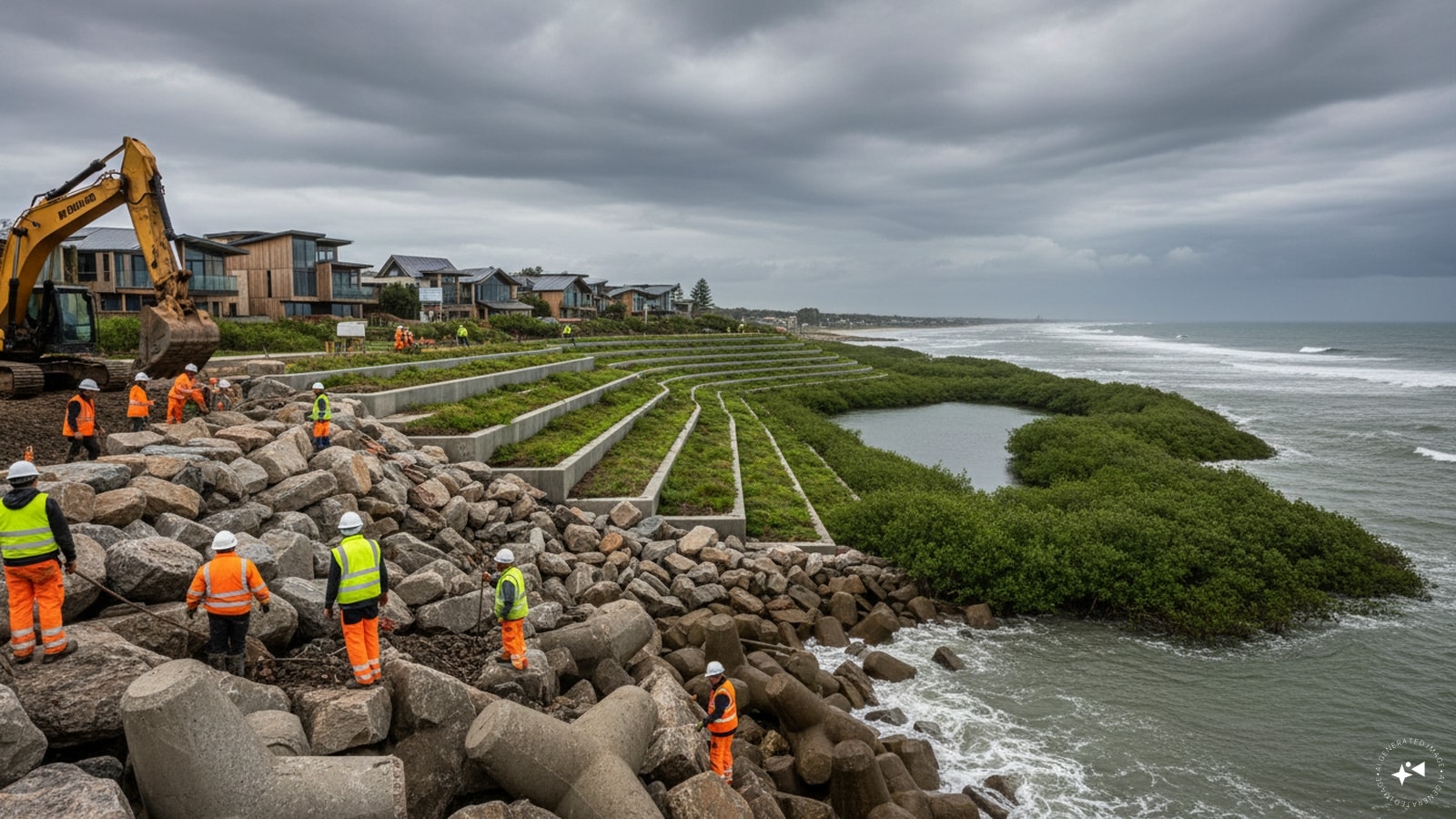
Think of a coastline not as a static line drawn in ink on a map, but as a living shock absorber. Along tropical and subtropical shores, mangrove forests—tangled, salt-tolerant trees standing on stilt-like roots—act as nature's ultimate seawall. A healthy belt of mangroves just a few hundred meters wide can reduce the height of incoming storm waves by up to sixty-six percent. In Vietnam, the Red Cross partnered with local communities to plant thousands of hectares of mangroves along vulnerable coastal dikes. The project cost roughly $1.1 million, yet it saved an estimated $7.3 million annually in dike maintenance while protecting thousands of lives during subsequent typhoons.
In the Netherlands—a nation where a third of the land sits below sea level and water management is practically a national religion—engineers reached a similar revelation in the late twentieth century. After centuries of building higher dikes, they launched a multi-billion-dollar initiative called Room for the River. Instead of squeezing rivers into narrower corridors, they intentionally bought out farmland, lowered floodplains, dug side channels, and gave the water designated places to spill safely when snowmelt and heavy rains peaked.
You can see a smaller, urban cousin of this philosophy emerging in cities from Copenhagen to Shanghai through the concept of "sponge cities." Modern cities are wrapped in waterproof armor—roads, parking lots, rooftops—that forces rainwater to rush straight into overwhelmed sewer pipes. A sponge city tears up unnecessary concrete and replaces it with sunken rain gardens, bioswales, permeable pavements, and restored urban wetlands. When a cloudburst hits, the city drinks the water like a dry sponge, filtering pollutants through soil and roots while recharging underground aquifers for the dry months ahead.
The Invisible Stakes in Your Dinner Bowl
It is easy to think of climate adaptation as something that happens on coastlines or inside city halls, far removed from our daily routines. Then you walk down the grocery aisle.
Every bite of food you eat depends on a fragile truce between human ingenuity and predictable weather. Staple crops like wheat, maize, and rice were bred over thousands of years to thrive within narrow bands of temperature and rainfall. When a sudden late-spring frost kills apple blossoms in Michigan, or an unprecedented drought parches olive groves in Spain, or erratic monsoons drown rice paddies in Pakistan, the shockwaves ripple straight into global food prices and household budgets thousands of miles away.
Here, adaptation becomes deeply personal, written in the calloused hands of farmers navigating rules that change every season.
Let us imagine a smallholder farmer in East Africa—we will call her Grace—tending three acres of maize that feed her family and pay her children's school fees. For generations, her grandfather knew to plant within days of the first steady March rains. Lately, March arrives dry and dusty, tempting her to wait, only for a violent torrent in April to wash away her freshly sown seeds, followed by a scorching dry spell in June that stunts the surviving stalks.
For Grace, climate adaptation is not a policy paper debated in Geneva. It is switching to drought-tolerant, early-maturing seed varieties developed by agricultural researchers—seeds that can produce a harvest with thirty percent less water. It is digging half-moon-shaped earthen bunds across her sloped fields, an ancient technique revived across the Sahel that traps precious rainwater around plant roots instead of letting it run off into gullies. It is planting nitrogen-fixing trees among her crops to shade the soil and hold moisture, and receiving hyper-local weather forecasts on a basic mobile phone so she knows the exact forty-eight-hour window to plant.
Across the globe, winegrowers in Bordeaux are planting heat-tolerant grape varieties traditionally found in Portugal. Ranchers in the American West are installing solar-powered water pumps and rotational grazing systems to keep grasslands alive during multi-year megadroughts. Scientists are even scouring the wild cousins of our domesticated crops—scraggly, bitter plants growing on rocky cliffs and salty marshes—to unlock genetic traits for heat and salt resistance that we bred out centuries ago in our quest for higher yields.
The Hard Truth About Who Gets Left Behind
It would be comforting to pretend that adaptation is simply an engineering puzzle waiting for clever solutions. It isn't. It is a moral test, and right now, we are failing the curve.
There is a bitter geography to climate vulnerability. The nations and neighborhoods that contributed the least to filling the atmosphere with heat-trapping gases are paying the highest, earliest price. A child born in sub-Saharan Africa or a low-lying island nation in the Pacific faces vastly higher risks from climate disruption than a child born in Zurich or Seattle, despite their countries generating a tiny fraction of historical emissions.
Even within wealthy nations, adaptation often follows the contours of wealth. Billionaires can hire private firefighting crews to spray fire-retardant foam on their estates in Malibu, or build elevated concrete fortresses along the Miami coast. Meanwhile, lower-income families live in flood-prone valleys, poorly insulated apartments without air conditioning, and neighborhoods stripped of tree cover decades ago through discriminatory housing policies.
When wealthy coastal towns build massive seawalls without regional planning, they often deflect wave energy onto neighboring, less affluent communities. When real estate developers buy up inland, high-elevation neighborhoods in coastal cities—a phenomenon researchers call climate gentrification—longtime working-class residents are priced out of the very high ground they have called home for generations.
I find myself wrestling with this contradiction often. Adaptation is the most pragmatic, hopeful tool we have, yet done carelessly, it can widen the exact inequalities that make societies fragile in the first place. True resilience cannot be gated. A city is only as strong as its most exposed neighborhood, its most vulnerable hospital, its oldest power substation.
And we must be honest about limits. You cannot adapt your way out of an unmitigated climate catastrophe. No seawall can hold back three meters of sea-level rise forever. No air conditioner makes a region livable if outdoor temperatures regularly exceed the human body's physiological limit to cool itself through sweat. Adaptation buys us time, saves lives, and preserves livelihoods, but without aggressive cuts to fossil fuel emissions, it eventually becomes an endless, exhausting retreat.
The Quiet Revolution Already Underway
Yet if you look closely past the headlines of disaster, you can see something extraordinary taking root. Across every continent, architects, biologists, Indigenous elders, hydrologists, and ordinary neighbors are quietly rewriting the operating manual for human civilization.
They are restoring oyster reefs in New York Harbor to calm storm surges and filter millions of gallons of murky water. They are revoking building permits in dangerous floodplains and turning demolished subdivisions back into wild, public river parks. They are teaching schoolchildren how to read local flood gauges and equipping rural clinics with battery-backed solar roofs so vaccines never spoil when storms knock out the grid.
Return for a moment to Elena and David, standing on their kitchen counter in the dark as muddy water swirled around their ankles.
In the aftermath of that flood, they faced the same agonizing choice millions of families now confront: rebuild exactly as before and pray the odds hold, or accept that the world outside their front door has permanently changed. They chose the harder path. With the help of a municipal buyout-and-relocation grant, they walked away from the creek. Today, that low-lying block is no longer a row of vulnerable houses; it is a lush, terraced wetland park where herons wade among native reeds, absorbing stormwater every autumn so the neighborhoods further up the hill stay dry.
Elena and David moved two miles away, to a modest home sitting forty feet higher on a limestone ridge, fitted with a metal roof rated for hurricane winds, a rainwater cistern in the yard, and solar panels feeding a battery wall in the garage.
Last September, another fierce storm stalled over the coast, dumping eighteen inches of rain in twenty-four hours. The wind howled against their shutters. The neighborhood grid flickered and went dark for two days. Inside, the lights stayed warm, the refrigerator hummed quietly, and down in the valley, the new wetland park swelled peacefully with floodwater, holding the storm in its open arms without a single home lost.