The map of the Korean Peninsula is drawn in jagged ink and quiet dread. If you stand on the northern edge of Gyeonggi Province on a clear autumn morning, the air does not smell like peace. It smells like diesel exhaust, cold mud, and the heavy, sweet scent of crushed grass left behind by sixty-ton armor tracks.
Listen. That low thrum vibrating through the soles of your boots is not an earthquake. It is the rhythmic, mechanical heartbeat of an alliance measured in steel.
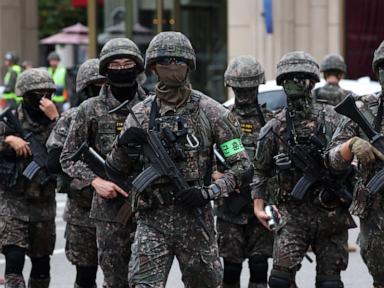
For decades, the ritual has repeated with the cold predictability of the tides. Thousands of troops deploy. Radar screens flood with simulated threats. Fighter jets tear open the cloud cover with a scream that rattles windowpanes in villages whose residents have learned to sleep through the war overhead. It is called deterrence. It is designed to look like an avalanche frozen mid-fall, meant to show any adversary that the cost of crossing the line is total annihilation.
But power is never purely mechanical. It breathes. It listens. It reacts to the erratic pulse of distant capitals.
Consider what happened when the order arrived.
Down in the command bunkers, monitors flickered. Telephones rang with a sharp, insistent urgency that cut through the low-frequency hum of tactical computers. The message was brief, jarring, and entirely outside the standard operating manual. The massive joint military exercises, designed to push deeper into the calendar and test every gear of the bilateral defense machinery, were stopping. They were stopping early.
Not because of bad weather. Not because of a mechanical breakdown in the supply lines.
Because of a single sentence uttered thousands of miles away, shaped by a president who viewed the map not through the careful lens of geopolitical tradition, but through the transactional lens of a ledger.
To understand why that sudden halt sent a cold shiver down the spine of career diplomats in Seoul and Washington alike, you have to look past the press releases. You have to look at the human cost of the pause.
Imagine Captain Park. (This is a hypothetical scenario grounded in the lived reality of frontline officers.) Park has spent six months sleeping four hours a night on a cot that smells of damp wool. He is the logistics officer responsible for moving three hundred armored personnel carriers through narrow mountain passes without a single accident. His men are exhausted, their knuckles raw from wrenching frozen bolts, their minds sharpened to a razor edge by the relentless pressure of live-fire simulations.
When Park received the word that the exercise was truncating—that the grand display of unity was being reined in to appease a political pivot—he did not cheer. He felt a deep, hollow sinking in his chest.
Trust is a fragile instrument. In military alliances, it is forged slowly, drop by drop, through sweat, shared risk, and the unwritten promise that tomorrow, the line will be held exactly where it was drawn today. When a drill is abruptly curtailed to signal a diplomatic opening, the politicians call it flexibility. The soldiers on the ground call it whiplash.
The underlying tension of the peninsula has always been a delicate dance between provocation and reassurance. Every time the iron starts moving, Pyongyang screams betrayal, branding the exercises as an invasion rehearsal wrapped in defensive flags. Every time the iron stops, Seoul and Washington worry that the shield is thinning, leaving a gap where miscalculation can crawl through.
Trump’s criticism of the drills was blunt and unfiltered. He looked at the price tag—the fuel, the deployment costs, the sheer logistical weight—and asked a question that startled the foreign policy establishment: What are we actually buying?
It is a fair question, stripped of diplomatic varnish. Millions of dollars burn away in weeks of simulated combat. But the establishment’s counter-argument is equally stark, born of historical memory. You do not buy the exercise to win a mock battle. You buy the muscle memory. You buy the absolute certainty that when a crisis hits at three in the morning, an American pilot and a South Korean commander do not need to pause and introduce themselves. They speak the same tactical language because they have spent years sweating through the exact same mud.
When the announcement came down that the exercises were winding down ahead of schedule, the immediate reaction was a scramble for narrative control. Was this a concession to North Korea? Was it an olive branch meant to entice Pyongyang back to the negotiating table? Or was it simply a cost-cutting measure disguised as statecraft?
The truth, as it usually does, bled across all three categories.
Diplomacy is often conducted in grand halls with mahogany tables and crystal chandeliers, but its consequences are always paid for in the mud. When high-level players move their pieces on the board without warning the men standing on the squares, the foundation fractures.
Think about the villagers in Yeonpyeong. They know the sound of artillery not as an abstract concept of state sovereignty, but as a violent concussive wave that shakes the dust off family photographs. When military exercises swell, their anxiety rises. When exercises suddenly vanish because an American leader tweeted or spoke out against their expense, their anxiety does not vanish—it morphs into uncertainty.
Uncertainty is more dangerous than hostility. Hostility has a vector. It points at you, and you can prepare to block it. Uncertainty is a fog that rolls in from nowhere, obscuring friend and foe alike.
The early conclusion of those exercises laid bare the underlying vulnerability of modern alliances. They are tethered to the shifting whims of domestic politics thousands of miles away. A president can alter the strategic posture of a region with an off-the-cuff remark, leaving local allies to scramble and pick up the pieces of a fractured deterrence strategy.
Look closely at the horizon. The dust from the armored tracks has finally settled. The diesel smoke has drifted out over the Yellow Sea and vanished into the gray salt air. The soldiers have packed their gear, heading back to barracks that feel both safer and stranger than they did a week ago.
The diplomats are still talking, trading statements crafted to smooth over the rough edges of a public pivot. But out on the ridge, where the wind cuts down from the north with the bite of an oncoming winter, the silence feels less like peace and more like holding your breath.
And somewhere in the dark, the map remains unchanged, waiting for the next word to drop.