The rules of the sea changed at 10:00 a.m. Eastern on Monday, not with a treaty, but with a social media post. President Donald Trump’s directive to the U.S. Navy to "immediately eliminate" any Iranian fast attack craft approaching the newly established American blockade of the Strait of Hormuz has effectively turned the world’s most vital energy artery into a kill zone. This is no longer just a standoff. It is an active attempt to rewrite the international law of the sea through kinetic force.
By ordering the interdiction of every vessel that has paid a "toll" to Tehran for passage, the administration is targeting the very concept of sovereign transit. Iran had been charging upwards of $1 million per ship for safe passage through the waterway, a move the White House labeled "extortion." Now, the U.S. Navy is not just hunting Iranian warships; it is hunting the financial records of every commercial tanker in the Gulf. If you paid for safety, you are now a target for seizure. If you liked this article, you might want to check out: this related article.
The Prize Law Resurrection
The strategy being deployed by U.S. Central Command (CENTCOM) is a brutal revival of "prize law," a maritime concept largely dormant since the era of world wars. Instead of the high-risk, low-reward mission of escorting every individual tanker—a process that leaves destroyers vulnerable to "swarm" tactics—the Navy is shifting to selective interference.
Under this framework, U.S. destroyers are positioned to board and seize merchant vessels that have "aided the enemy" by paying Iranian transit fees. It is a cynical, efficient calculation. By seizing a handful of ships and diverting them to neutral ports for "adjudication," the U.S. creates a massive financial deterrent that no insurance underwriter in London or Singapore can ignore. For another look on this story, see the recent update from The Washington Post.
The risk, however, is the "eliminate" order. Iranian fast attack craft (FACs) are not traditional warships. They are small, fiberglass-hulled boats often armed with twin 23mm cannons or anti-ship missiles. In the tight, shallow waters of the Strait, these boats use the "mosquito" strategy, darting between commercial traffic to make targeting difficult. By promising to destroy them on sight, Trump has removed the "buffer of hesitation" that usually governs naval encounters. The rules of engagement have shifted from "defensive response" to "pre-emptive elimination."
The 120 Dollar Barrel Shadow
While oil markets briefly dipped below $100 after Trump claimed Iran was "desperate for a deal," the underlying math remains terrifying. The Strait of Hormuz carries roughly 20% of the world’s seaborne crude and liquefied natural gas (LNG). Since the air war began on February 28, traffic has plummeted by 70%.
The global economy is currently operating on a knife's edge. QatarEnergy has already declared force majeure on all exports, a move that has sent Asian LNG spot prices up by 140%. Europe, already reeling from the loss of Russian energy years ago, is now facing a second, more acute shock as Qatari gas is physically blocked from the market.
The real crisis is not just oil; it is the global food supply.
The Gulf Cooperation Council (GCC) states—Saudi Arabia, the UAE, Qatar, and Kuwait—rely on the Strait for nearly 80% of their caloric intake. The blockade has triggered what retailers are calling a "grocery supply emergency." Staple foods are being airlifted in at costs 120% higher than last month. We are seeing the birth of a stagflationary spiral that could dwarf the 1970s energy crisis because it hits both the gas tank and the dinner table simultaneously.
The Minesweeper’s Dilemma
Behind the bellicose rhetoric about "eliminating" boats lies a far more tedious and dangerous reality: sea mines. Iran has reportedly seeded the Strait with unanchored contact mines. These "dumb" weapons do not care about blockades or presidential warnings.
The U.S. Navy has begun minesweeping operations, but this is a slow, methodical process that requires ships to remain nearly stationary or move at low speeds—making them "sitting ducks" for shore-based anti-ship cruise missiles (ASCMs) like the Noor or Ghadir. Trump’s promise that the Strait would reopen "naturally" after the conflict ignores the reality that a single missed mine can keep insurance rates at prohibitive levels for years.
To make the blockade "effective" under international law, the U.S. must prove it has total control over the space. If an Iranian boat manages to strike a tanker within the "protected" zone, the entire legal and strategic justification for the American presence collapses.
The End of the Neutral Bottom
For centuries, the "neutral bottom" was a sacred tenet of global trade—the idea that a ship from a neutral country carrying non-contraband goods should be left alone during a war. That principle is now dead in the water.
By demanding that NATO and China assist in the reopening of the Strait, the administration is forcing a binary choice: you are with the blockade, or you are a target of it. China, which accounts for a massive portion of the oil and LNG flowing through Hormuz, has so far remained silent, though its "shadow fleet" continues to attempt midnight runs.
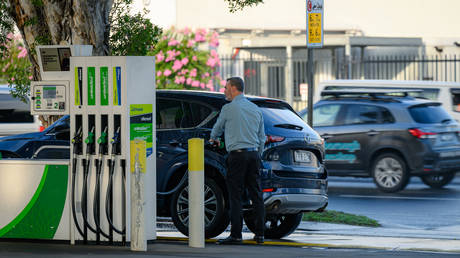
The "Islamabad Talks" failed because neither side was willing to blink on the nuclear enrichment issue. Trump is now using the world's most critical chokepoint as a bargaining chip, betting that the economic pain in Tehran will exceed the political pain of $6-a-gallon gas in the United States.
The strategy relies on a single assumption: that the Iranian Revolutionary Guard Corps (IRGC) will value its own survival over its ability to crash the global economy. History suggests that is a dangerous bet. The IRGC’s doctrine is built on "asymmetric deterrence"—the idea that if they cannot have the Gulf, no one can.
As the first destroyers begin their boardings, the world isn't just watching a naval maneuver. It is witnessing the dismantling of the post-WWII maritime order. The Strait of Hormuz is no longer an international waterway; it is a private toll road where the currency is now blood and high-grade crude. The next few days will determine if this gamble forces a deal or if the "elimination" of a few small boats triggers a fire that the global economy cannot extinguish.