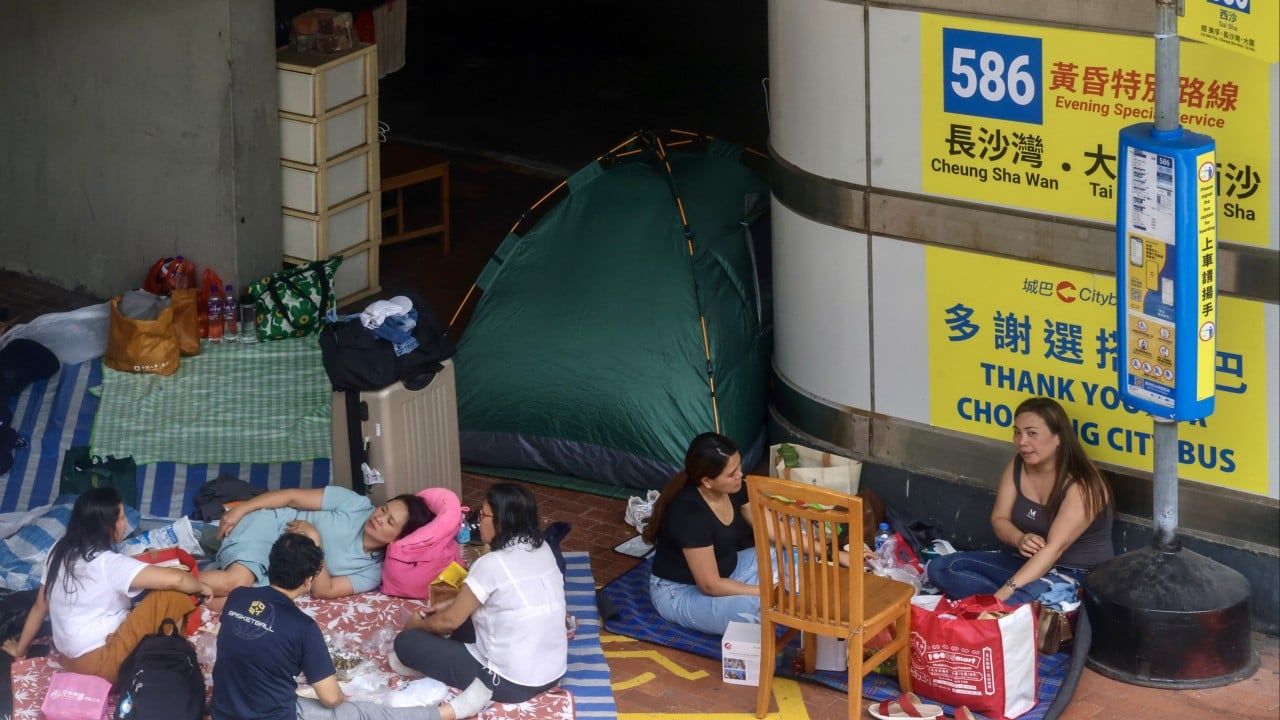
If you walk through Central Hong Kong on any given Sunday, you'll witness a striking sight. Thousands of women sit on flattened cardboard boxes, filling pedestrian flyovers, parks, and the concrete gaps beneath corporate skyscraper headquarters. They are eating home-cooked adobo, styling each other's hair, singing, and laughing.
To the casual tourist, it looks like a massive weekly street festival. To many local residents, it's an inconvenient roadblock. But let's look at what is actually happening. These women are the city's foreign domestic helpers, and those cardboard camps are a survival strategy.
Hong Kong relies on roughly 400,000 migrant domestic workers, mostly from the Philippines and Indonesia. They cook, clean, and raise the city's children. They make up roughly 5% of the total population, meaning about one in ten households employs a helper. Yet, despite being the economic backbone that allows local couples to work corporate jobs, these women are legally and socially starved of basic personal space.
The Reality of the Mandatory Live-In Policy
Why do thousands of women choose to spend their only day of rest sitting on concrete sidewalks in the humid heat? Because they literally have nowhere else to go.
By law, Hong Kong requires foreign domestic helpers to live with their employers. This mandatory live-in policy is supposedly designed to ensure accommodation, but in practice, it turns the home into an inescapable workplace. There's no clocking out when your bedroom is a mattress on the kitchen floor or a folding cot in the hallway.
Hong Kong Helper Demographics & Economics (Approximate Data)
-----------------------------------------------------------
Total Workforce: 400,000 workers
Primary Nationalities: Filipino, Indonesian
Average Monthly Salary: HKD $5,310 (~USD $680)
Legal Requirement: Mandatory live-in condition
In a city infamous for having some of the smallest, most expensive apartments on earth, space is a luxury. When a local family rents a tiny 400-square-foot flat, the helper's privacy is the first thing sacrificed. According to a survey by the Mission for Migrant Workers, many helpers sleep in closets, above washing machines, or on top of refrigerators.
Imagine spending six days a week living under constant surveillance, sometimes with actual CCTV cameras monitoring your sleeping area. You work 12 to 16 hours a day. When Sunday finally arrives, staying in the apartment means you're still on call. If the baby cries, you're expected to pick it up. If the sink fills with dishes, you feel the pressure to wash them.
The sidewalk isn't a preferred party venue. It's the only place where nobody can ask them to scrub a toilet.
The Two-Week Trap That Silence Built
It's easy to wonder why workers don't just speak up or leave bad employers. The truth is, the legal system is heavily tilted against them. The most glaring example is the "two-week rule."
If a helper terminates her contract or gets fired, she has exactly 14 days to find a new employer or face deportation. Think about the pressure that creates. If you complain about terrible sleeping conditions, lack of food, or verbal abuse, you risk immediate termination. Once fired, the clock starts ticking. If you don't secure a new contract within two weeks, you're sent back to your home country, often carrying massive debts from employment agency fees.
This rule creates a culture of silence. High-profile cases, like the horrific abuse of Erwiana Sulistyaningsih in 2014, exposed how bad things can get when a worker feels trapped. While physical torture is rare, systemic overwork and psychological exhaustion are completely standard.
The financial reality keeps them trapped too. The minimum allowable wage for domestic helpers sits around HKD $5,310 per month. While that's significantly higher than what they would earn in rural parts of Indonesia or the Philippines, it leaves very little breathing room in an expensive city like Hong Kong. Most of this money is sent directly home to pay for children's tuition or medical bills. They don't have the disposable income to hang out in air-conditioned cafes or rent leisure spaces on their day off. Cardboard on a sidewalk is free.
Reclaiming the Concrete
What happens on Sundays isn't just passive resting. It's a radical act of spatial reclamation.
When tens of thousands of women occupy places like Statue Square, Central, or Victoria Park in Causeway Bay, they are transforming hostile urban architecture into a living room. They build temporary walls out of cardboard boxes. They create makeshift beauty salons, dance studios, and church fellowship halls.
For twelve hours, they aren't just employees; they are individuals with hobbies, friendships, and agency. They share news from home, trade advice on dealing with difficult bosses, and send boxes of goods back to their families.
Yet, this temporary sanctuary is constantly threatened. Local businesses frequently complain about the crowds. Property management companies install public benches with middle armrests to prevent people from lying down, and some areas are blocked off under the guise of cleanliness or crowd control.
During the pandemic, these workers faced heavy fines for violating group gathering rules, even though they had no private homes to go to. The city gladly accepts their labor inside the home but tries to erase their presence outside it.
The Structural Hypocrisy
Hong Kong's refusal to accommodate these workers outside of hours is a glaring structural failure. The government has repeatedly shut down attempts to abolish the live-in rule, claiming that allowing helpers to live out would put too much pressure on the city's public transport and housing markets.
Basically, the city wants the economic benefit of cheap childcare and eldercare without providing the infrastructure to support the human beings delivering it. Without these workers, thousands of local women wouldn't be able to enter the workforce, causing immediate damage to Hong Kong's economy.
If the government won't scrap the live-in rule, they must provide safe, dedicated indoor spaces for helpers to spend their days off. Relying on concrete sidewalks and overhead bridges isn't a sustainable solution for a city that brands itself as a world financial hub.
NGOs like the Fair Employment Agency and Help for Domestic Workers do incredible work advocating for basic rights, but real change requires policy reform.
Practical Steps to Take Right Now
Change starts with how residents treat the workers in their own homes and neighborhoods. Here are immediate actions that can improve the situation.
- Audit Your Own Household Rules: If you employ a helper, explicitly define her working hours. When her day off starts, ensure she is completely off-duty and under no pressure to perform light tasks around the house.
- Respect Private Space: Provide a clear, dignified sleeping area with actual privacy. If space is tight, use partitions, blackout curtains, and clear boundaries to give her a space that is truly hers.
- Support Migrant NGOs: Support organizations like the Mission for Migrant Workers or Enrichment, which provides financial literacy training for domestic helpers.
- Stop Demanding Public Cleansing: Push back against local neighborhood campaigns that try to ban helpers from gathering in public parks or plazas on weekends.
The women sitting on cardboard boxes in Central aren't an eyesore or a tourist attraction. They are human beings surviving a rigid system, doing the best they can with the concrete they're given. Treat them like the essential urban citizens they are.