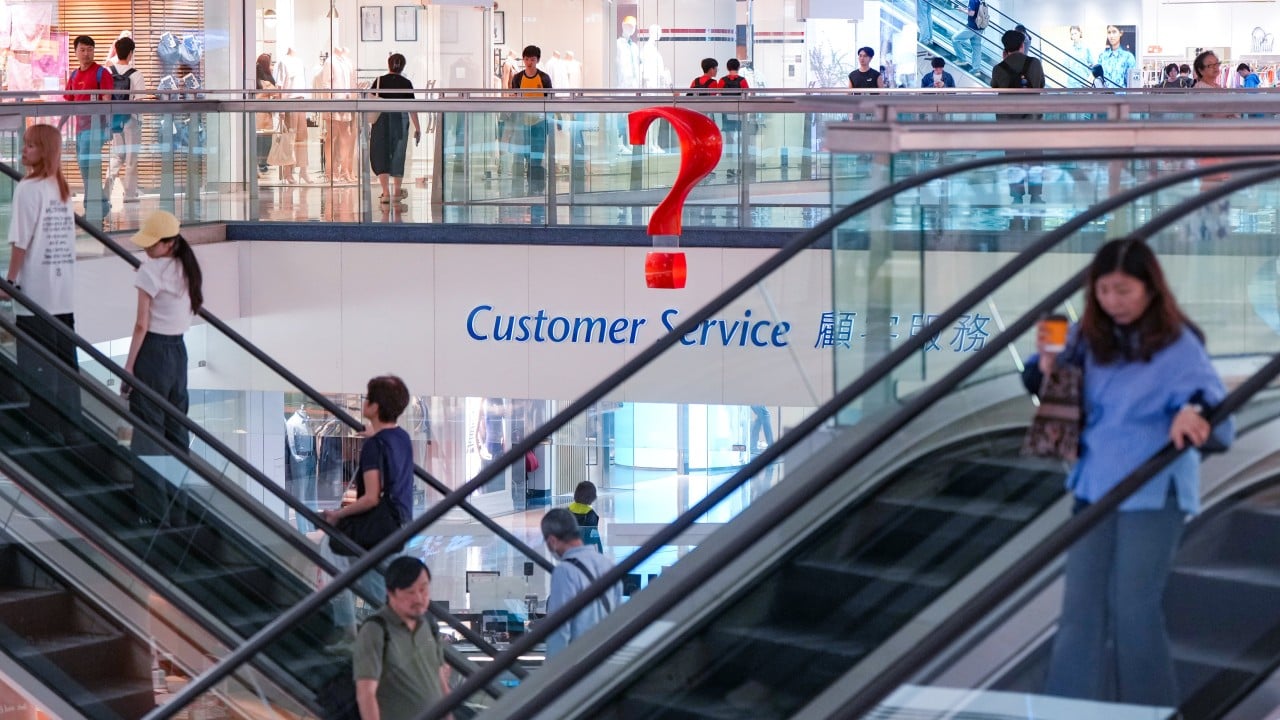
Corporate boardrooms and legacy media columns are drowning in a bizarre brand of cognitive dissonance. They point to Hong Kong’s advance first-quarter GDP growth numbers, a staggering 5.9% spike driven by global artificial intelligence electronics demand and surging cross-boundary financial activity, and then they shudder. The current media narrative is completely uniform: "The numbers look great, but business unease is rising."
This thesis is lazy, reactionary, and fundamentally misunderstands how market transformations work.
I have spent two decades watching corporate executives mistake their own inability to adapt for a systemic economic crisis. When legacy operators feel uneasy while macroeconomic indicators are accelerating, it does not mean the data is a lie. It means the economic engine is changing parts, and the slow drivers are getting thrown from the vehicle.
The widespread anxiety among old-guard Hong Kong business owners is not a harbinger of doom. It is the clearest signal yet that a structural purge is working exactly as intended.
The Flawed Premise of the Corporate Panic
The consensus view treats "business confidence" as an unmitigated good and "unease" as an automatic sell signal. This is an elementary mistake.
The merchants, restaurateurs, and property landlords crying foul in traditional commercial hubs are suffering from local displacement, not macroeconomic starvation. For decades, running a business in Hong Kong was an exercise in pure rent-seeking. If you owned property in Causeway Bay or held a franchise license for a mid-tier western restaurant chain, you were virtually guaranteed a steady stream of capital from high-spending tourists and expatriates.
That specific ecosystem has collapsed. Visitors from the mainland are no longer arriving with empty suitcases ready to fill them with luxury Swiss watches and European leather goods. Instead, they are visiting cultural landmarks, exploring nature trails like the East Dam, and spending pragmatically on experiential travel.
The underlying data shows that retail sales value jumped 19.3% in early 2026 compared to the previous year's baseline. Total merchandise exports skyrocketed by 32% in the first part of the year. Money is moving through the territory at a blistering pace.
The money is simply refusing to stop at the cash registers of businesses that refuse to evolve. The unease is entirely localized within businesses trapped in a 2015 business model.
Dismantling the Capital Flight Myth
Listen to the chatter in hotel bars and you will hear endless laments about the death of Hong Kong as a global financial intermediary. Critics claim that international capital has packed its bags for Singapore or London permanently.
Let us look at the actual mechanics of direct investment instead of relying on emotional anecdotes from departing executives.
According to the UNCTAD World Investment Report, foreign direct investment inflows into Hong Kong rank third globally, trailing only the United States and Singapore. Furthermore, the Hong Kong Trade Development Council records over 11,000 companies operating in the city with parent companies based entirely outside the territory. The United States and Japan each account for 1,500 of those firms, while the United Kingdom holds 770.
If a terminal, existential exodus were underway, these numbers would be cratering. They are not. The nature of the capital is shifting from speculative western equity to structural institutional infrastructure.
Consider the plumbing of global finance. Hong Kong remains the absolute leviathan of offshore Renminbi clearing, managing roughly 76% of all global RMB payments through SWIFT. As the global financial architecture fragments, the demand for a highly liquid, legally predictable, offshore clearing house for non-dollar trade is hitting historic highs.
Imagine a scenario where a multinational electronics manufacturer needs to clear billions in cross-border trade without touching western clearing infrastructure. They do not look to western capitals. They route through Central.
The old-school hedge fund manager who used to trade speculative Chinese internet stocks from an office in Exchange Square might be feeling obsolete. But the institutional entities structuring sovereign debt, cross-boundary wealth management, and physical trade logistics are busier than ever. The distress of the former does not equal the decline of the latter.
The Brutal Reality of the High Rent Purge
For thirty years, Hong Kong’s real estate market acted as a massive tax on real entrepreneurship. Exorbitant commercial rents strangled innovation. Why take a risk on a new technology venture or an avant-garde service concept when your baseline overhead requires $100,000 USD a month just to keep a storefront open?
The current unease among property landlords is the best thing that could happen to the long-term viability of the city. Commercial property values and retail rents are undergoing a violent, overdue correction.
This pain is a necessary cleansing mechanism. The reduction in fixed overhead costs is allowing a completely different class of operators to enter the market.
- Legacy operations built entirely on high margins and low volume are suffocating.
- Agile, tech-enabled service providers utilizing lower fixed costs are scaling up.
- Cross-border e-commerce networks are replacing traditional physical distribution nodes.
I have seen companies blow millions trying to preserve outdated supply chains and retail footprints just because "that is how we have always done it in Asia." The executives throwing tantrums in the media are the ones who refused to adjust their cost structures when the writing was on the wall. The business anxiety we are witnessing is the direct result of a legacy elite losing its pricing power over the local economy.
Redefining the Search for Value
When retail groups complain that mainland tourists are spending less per capita during holiday periods, they are asking the wrong question. They are asking: "How do we get old customers to spend money the way they used to?" The correct question is: "How do we capture the transaction volume of the new economic corridors being built right in front of us?"
Hong Kong has transitioned into the premier logistics and capital node for the global AI hardware boom. The 35.8% surge in merchandise exports recorded in March was not driven by trinkets or fast fashion; it was propelled by massive global demand for advanced electronic products and components destined for AI data centers and tech infrastructure.
The city is no longer a colonial-style trading outpost serving as a window to a closed economy. It is an active, integrated component of the Greater Bay Area’s industrial strategy.
If your business relies on intermediating simple trade between East and West, your margins are going to zero. If your business utilizes Hong Kong’s world-class aviation logistics—which handles more international air cargo than almost any other airport on earth—to manage specialized high-tech components, you are looking at unprecedented volume.
The Downside of the New Landscape
An objective view requires acknowledging the dark side of this transition. The current structural shift is explicitly Darwinian.
If you do not speak the language of mainland integration, or if your capital structure is entirely dependent on legacy US-dollar denominated real estate leverage, this environment is deeply hostile. The unemployment rate has ticked down slightly to 3.7%, but the labor market is experiencing intense internal churn. Mid-level administrative and traditional financial services roles are evaporating, replaced by demand for specialized tech logistics engineers, compliance experts in digital assets, and cross-border tax specialists.
The risk is not an economic collapse; the risk is a permanent bifurcated economy where those who fail to align with the new structural realities are left behind permanently. The anxiety is real, but it is a symptom of class displacement, not macroeconomic failure.
Stop Waiting for the Past to Return
The institutional investors sitting on the sidelines waiting for "business confidence" to hit peak optimism before deploying capital are completely missing the cycle. By the time the local chamber of commerce stops complaining and proclaims that the vibe has returned, the asset prices will have already reset, the market share will be locked up by newer operators, and the entry yield will be gone.
The 5.9% quarterly GDP growth rate is a definitive statement. The trade volumes are factual. The infrastructure is operating at capacity. The unease you are reading about is simply the noise of a legacy corporate class realization that nobody is coming to save their outdated business models. The structural rotation is finished. Position your capital accordingly.