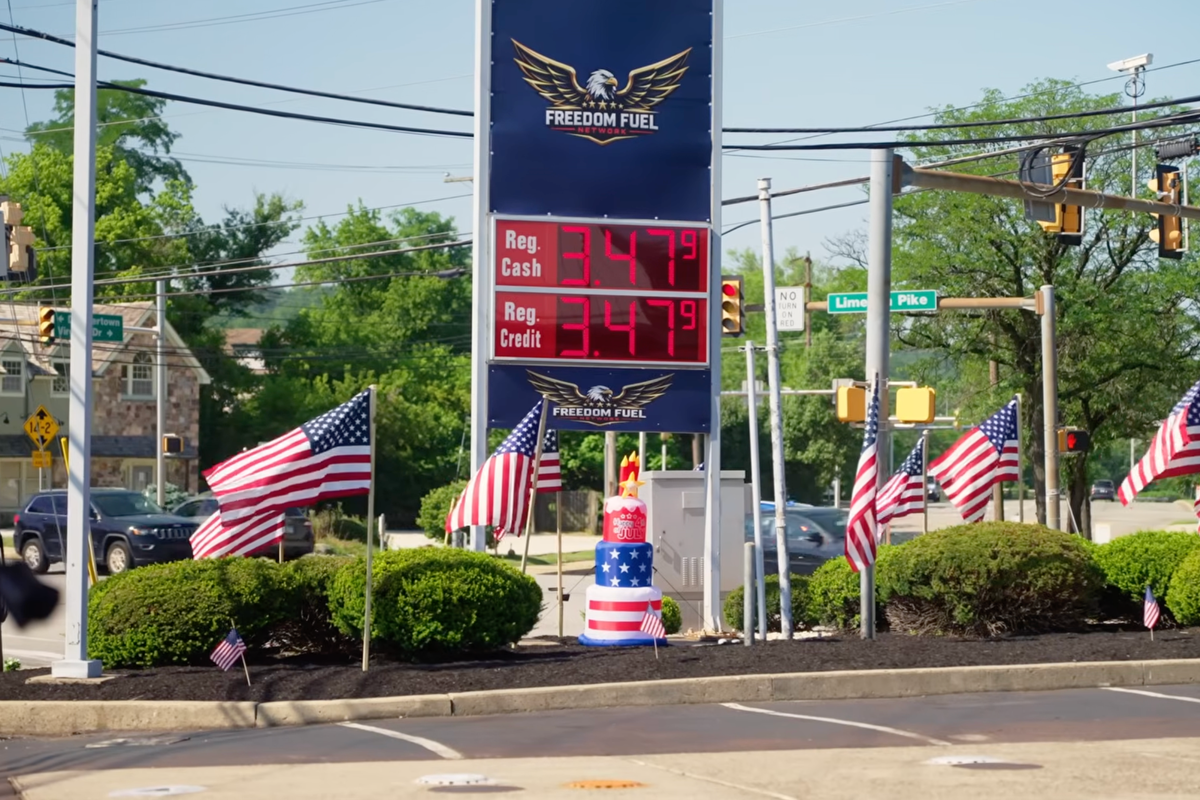
The asphalt of a roadside gas station always smells the same. It is a sharp, chemical scent of heavy hydrocarbons, baked by the sun and mixed with the oil drippings of a thousand idling sedans. For most drivers, that smell is just background noise to a mundane chore. You pull up, you swipe your card, you squeeze the trigger, and you watch the numbers spin past your eyes faster than your budget likes. You do not think about where the dark fluid came from. You certainly do not think about who owned it fifty miles down the pipeline before it filled your tank.
You just want a fair price. If you liked this piece, you might want to look at: this related article.
For months, Freedom Fuel offered something that felt like a minor miracle in an era of relentless inflation. While national averages hovered at painful heights, this independent fuel brand was slashing prices, drawing long lines of budget-conscious motorists eager to save a few precious dollars on their daily commute. It felt like a win for the little guy. High-profile figures took notice. Donald Trump publicly praised the company for taking the lead, pointing to their aggressive discounting as proof of entrepreneurial grit fighting back against rising costs at the pump. The narrative was clean. A scrappy disruptor was giving the consumer a break.
Then the pumps stopped looking so heroic. For another angle on this development, see the latest coverage from BBC News.
A federal lawsuit tore the shiny veneer right off the corporation, alleging that the cheap fuel driving those bargain-basement prices was not shrewdly sourced or cleverly discounted through market wizardry. It was allegedly stolen. Not in the sense of a midnight heist with rubber hoses and stolen trucks, but through a massive, industrial-scale diversion of petroleum products, leaving rightful owners out millions and turning unsuspecting drivers into unwitting accomplices in a white-collar conspiracy.
Consider what happens when a bargain is too good to be true. We want to believe in the discount. We are primed to trust the underdog who promises relief from the corporate giants. When a politician stands at a podium and cheers for lower prices, nobody stops to ask if the crude in the ground has a clean title. We just smell the savings and press the nozzle harder.
Let us step back into the mechanics of how fuel actually moves across a continent. It is a world of invisible geography. Crude oil is sucked from deep earth, pushed through sprawling networks of subterranean arteries, refined at massive facilities, and then loaded onto barges, railcars, and tanker trucks. It is an ocean of liquid energy moving through closed loops. Most of us imagine this system as a steady, orderly river.
In reality, it is a complex web of logistics where ownership changes hands dozens of times before a drop ever reaches a retail nozzle. Contracts overlap. Inventories blend in massive storage tanks. It is a system built entirely on paper trails and electronic ledgers. When those ledgers are manipulated, or when product is siphoned from the stream through fraudulent transfers and phantom paper trails, the theft happens in plain sight. To a tanker driver pulling up to a rack, the fuel looks the same. To a motorist filling a Honda Civic, the combustion is identical.
The crime lives entirely in the paperwork. And paperwork is notoriously boring until the investigators show up with subpoenas.
The lawsuit against Freedom Fuel details a scheme where petroleum products were allegedly diverted from rightful supply chains, bypassing normal financial accountabilities to be sold at steep discounts to retail locations. When you do not pay for the underlying commodity, your profit margins are suddenly quite flexible. You can afford to undercut the competition by thirty cents a gallon. You can afford to look like a champion of the working class. You can afford the political praise.
This is where the human element curdles. The drivers waiting in those snaking queues at Freedom Fuel stations were not villains. They were nurses working double shifts, delivery drivers trying to keep their profit margins afloat, and parents stretching grocery money to cover the commute to work. They felt a brief, sweet surge of relief. Every dollar saved at that pump was a dollar that could go toward school supplies or a utility bill. They were living inside a genuine economic squeeze, looking for any exit hatch they could find.
And they were used. Their collective desperation became the camouflage for an alleged fraud.
We rarely talk about the emotional weight of economic deception. We treat corporate crime as a spectator sport played in glass-walled courtrooms in Manhattan or Delaware, measured purely in columns of figures and dry legal briefs. But white-collar crime has a physical address. It ripples outward into the real world.
When stolen fuel enters the retail market, it distorts the local economy in ways that honest business owners cannot survive. Picture a family-owned station down the road, operating on razor-thin margins, trying to pay honest wholesale prices for their inventory. They watch their loyal customers abandon them for the neon signs of a competitor offering prices that defy basic arithmetic. The independent owner panics, cuts staff, bleeds personal savings, and eventually locks the doors for good. They did not lose because they lacked grit. They lost because they were competing against inventory that cost zero dollars to acquire.
That is the hidden cost of the cheap pump. It hollows out the neighborhood while smiling at you from a roadside billboard.
Public figures who champion these enterprises often operate in a bubble of optics. They see a crowd cheering, they see a low price, and they attach their brand to the moment. They do not have time to audit the supply chain of a regional gas station chain. But that speed of endorsement leaves a messy stain when the truth catches up. It forces us to confront how easily our hunger for good news can be weaponized against our better judgment. We desperately want heroes, so we accept the first person who tells us they have found a shortcut around a painful problem.
The legal battle over Freedom Fuel will drag on for months, perhaps years. Lawyers will argue over jurisdiction, civil statutes, and the exact volume of product moved through questionable channels. Balance sheets will be dissected. Depositions will be read into the record. Executives will issue carefully worded statements blaming third-party logistics or claiming total ignorance of the downstream supply chain mechanics.
None of that paperwork will change the feeling of the driver who realizes that the discount they relied on was built on a foundation of theft.
There is a quiet disillusionment that comes with discovering you were part of someone else's scheme. It makes you look at the mundane details of daily life with a sudden, sharper suspicion. The grocery store special, the unbelievable online deal, the local business promising revolutionary savings—a small voice in the back of your mind starts asking questions. Who actually paid for this discount? Where did the margin come from?
We pull up to the pump because we have to. We need the fuel to move our lives forward, to get to the office, to visit family, to keep the machinery of our personal worlds turning. We grab the heavy, greasy handle and we look away from the flashing numbers, hoping against hope that this time, the transaction is as simple as it looks.