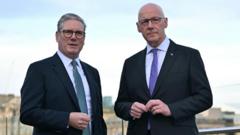
The scheduled face-to-face meeting between UK Prime Minister Keir Starmer and Scottish First Minister John Swinney is not a social call. It is a calculated collision of two deeply different political survival strategies. Starmer needs to prove that his "reset" with the devolved nations is more than a rhetorical flourish, while Swinney is fighting to keep the Scottish National Party (SNP) relevant after a bruising general election that saw their Westminster influence evaporate. For the first time in nearly a decade, the power dynamic has shifted. London is no longer merely reacting to Edinburgh; it is attempting to absorb its grievances into a broader UK-wide agenda.
This meeting is the first real test of whether "respectful cooperation" can survive the brutal reality of fiscal constraints and constitutional deadlock.
The End of the Shouty Era
For years, the relationship between Downing Street and Bute House was defined by theatrical hostility. Boris Johnson and Nicola Sturgeon used each other as convenient foils, each gaining domestic points by painting the other as a villain. That era is over. Starmer’s strategy is far more dangerous for the SNP because it is quiet. By agreeing to meet Swinney early and often, Starmer is attempting to de-escalate the constitutional drama that has been the lifeblood of the independence movement.
If the UK government is seen to be listening, the SNP’s primary argument—that Scotland is ignored by a "Tory" Westminster—begins to crumble. Swinney knows this. He enters the room with a dual mandate: he must appear constructive to a Scottish public weary of constant bickering, but he cannot afford to look like he is being managed by London.
The Grangemouth Shadow
The closure of the Grangemouth refinery is the most pressing concrete issue on the table. It is a symbol of the industrial challenges both leaders face. Thousands of jobs are at risk, and the transition to "green energy" remains a theoretical comfort to workers facing immediate redundancy. Swinney will demand a joint investment package to save the site or pivot it toward future fuels.
Starmer’s response will reveal his true hand. If he offers a significant financial lifeline, he reinforces the "strength of the Union" argument. If he demurs, citing the tight fiscal rules set by Chancellor Rachel Reeves, he gives Swinney the ammunition needed to claim that "Labour austerity" is no different from the previous administration.
A Treasury Locked Tight
Money is the friction point that no amount of diplomatic "resetting" can smooth over. The Scottish Government is currently grappling with a massive black hole in its own budget, partly due to public sector pay deals and the rising cost of social security. Swinney wants more borrowing powers and a revision of the fiscal framework that governs how Scotland is funded.
He is unlikely to get them.
Starmer and Reeves have made it clear that the UK's financial stability takes precedence over devolved demands. This creates a trap for Swinney. If he leaves the meeting with nothing but a handshake and a promise of "future dialogue," he will be savaged by the harder wings of his own party who view any cooperation with Labour as a betrayal.
The Ghost of Section 35
While the focus is on the economy, the legal scars of the last few years remain. The use of Section 35 orders by the previous UK government to block Scottish legislation—most notably on gender recognition—was a turning point in devolution history. Starmer has signaled a less confrontational approach to legal disputes, but he has not promised to stay Westminster's hand.
Swinney needs to know where the "red lines" are. He is operating a minority government in Holyrood, and his ability to pass laws depends on stitching together deals with the Greens or even the Scottish Conservatives. If Starmer maintains a veto over Scottish legislation, the "respectful" relationship is a facade.
The Strategy of Inclusion
Starmer is not just meeting Swinney; he is meeting every regional mayor and devolved leader in a blitz of consultative governance. This is an attempt to "normalize" Scotland's place within the UK structure. By treating Swinney as one of many regional stakeholders rather than the leader of a quasi-independent state, Starmer is subtly downgrading the status of the Scottish Government.
It is a clever play. It forces Swinney to compete for attention and resources with the likes of Andy Burnham in Manchester or Anas Sarwar’s potential future administration in Edinburgh. This dilution of the SNP’s unique standing is a core part of the Labour long game.
Divergence on Migration and Energy
There are fundamental policy gaps that no amount of "good vibes" can bridge. Scotland faces a demographic crisis that Swinney believes can only be solved with a bespoke Scottish visa system to attract workers. Starmer, wary of being seen as "soft" on borders by the English electorate, has consistently rejected this.
Then there is Great British Energy. Starmer’s flagship energy company is to be headquartered in Scotland, a move intended to secure the North Sea transition. However, the SNP views this as a "land grab" of Scottish resources. Swinney will push for more direct control over how this entity operates, arguing that Scottish wind and water should benefit Scottish communities first.
The Looming 2026 Deadline
Every word spoken in this meeting is a rehearsal for the 2026 Scottish Parliament election. For Labour, the goal is to show they are already the "government in waiting" for Scotland, capable of delivering results through cooperation. For the SNP, the goal is to prove that only they can stand up to a Westminster government that is essentially "Tory-lite" in its spending habits.
The stakes for Swinney are existential. His party is divided, and the momentum for independence has stalled. He needs a win—a tangible, headline-grabbing concession from Starmer—to prove that he hasn't just been invited to the table to be told what's on the menu.
Starmer, conversely, is in no rush. He has a massive majority and five years to play with. He can afford to be polite, to listen, and then to say "no" with a smile. The veteran journalist sees this for what it is: a tactical masterclass in political containment. Swinney is walking into a room where the walls are painted with friendship but the floor is a legal and fiscal minefield.
The meeting will likely end with a joint statement about "shared priorities" and "constructive engagement." But the real story is in the silence that follows. If the Grangemouth refinery closes despite these talks, or if the Scottish budget remains starved of the oxygen Swinney craves, the "reset" will be remembered as nothing more than a change in tone before the same old tune.
The SNP’s survival depends on their ability to make the public angry. Starmer’s survival in Scotland depends on his ability to make them bored of the conflict. In this meeting, the man who manages to set the emotional temperature of the room wins the next decade of Scottish politics.
Watch the body language. Watch the follow-up briefings. The real negotiations haven't even started yet.