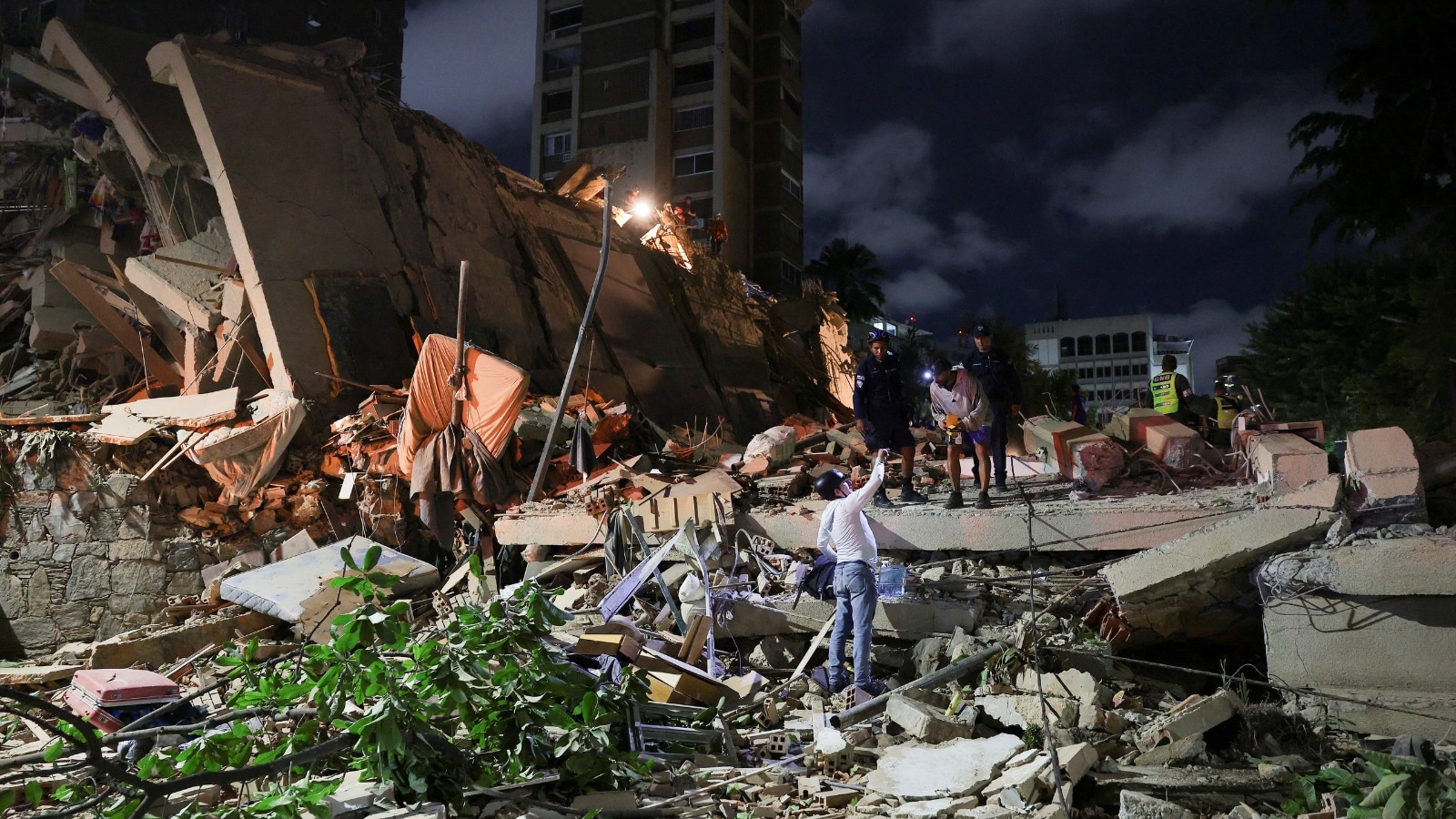
The World Bank recently put a price tag on the twin earthquakes that tore through north-central Venezuela on June 24. The number is 19.6 billion dollars. It represents direct physical damage, a figure that equals roughly 18 percent of the nation's entire gross domestic product.
But that figure is a polite mathematical fiction. The reality on the ground is far darker, caught in a vise between underestimated destruction, a sudden geopolitical transition, and an international aid apparatus that moves with glacier-like speed. While the Multilateral Lender's Global Rapid Damage Estimation framework attempts to lay out a baseline for recovery, the structural reality suggests that Venezuela is looking at a permanent economic setback rather than a temporary rebuilding phase.
The disaster struck a society already teetering on the edge of collapse. With poverty rates exceeding 76 percent and nearly eight million citizens having fled the country over the past decade, the twin shocks of 7.2 and 7.5 magnitude did not just topple concrete; they shattered the remaining foundations of a hollowed-out economy. By examining the gap between official assessments and economic realities, it becomes clear that the path to reconstruction is blocked by structural deficits that no single loan can fix.
The Shock Wave and the Understated Baseline
When the two earthquakes hit the north-central coast just 39 seconds apart, the physical destruction was immediate. Entire residential blocks in La Guaira crumbled, and infrastructure across the Distrito Capital fractured under the stress. The World Bank's report states that 47 percent of the total damage occurred within residential buildings, leaving infrastructure at 27 percent and non-residential properties at 26 percent.
These calculations overlook a fundamental variable. The model used by the World Bank only measures replacement value for existing structures. It deliberately excludes the cost of clearing millions of tons of debris, stabilizing mountainsides, and upgrading construction types to withstand future seismic events. The United Nations Office for Disaster Risk Reduction came to a vastly different conclusion just a week prior, estimating direct physical damage at 37 billion dollars.
This 17.4 billion dollar discrepancy reveals the limitations of remote-based modeling. While the World Bank relied heavily on satellite imagery and remote sensing data to construct its report, United Nations teams on the ground integrated localized assessments of commercial properties, hospitals, and telecommunications networks. The UN discovered that the telecommunications sector alone suffered five billion dollars in losses. A broken fiber-optic network or an unmapped water main rupture does not always show up clearly on a satellite photograph, yet its absence paralyzes local commerce.
Furthermore, the official figures completely omit the concept of business interruption. When a factory collapses, the damage is not merely the cost of the bricks and machinery. It is the permanent loss of production, the broken supply chains, and the sudden unemployment of hundreds of workers. The World Bank explicitly states that its assessment excludes these ongoing macroeconomic drains, meaning the actual economic toll is accumulating every single hour the rubble remains untouched.
The Geopolitical Stranglehold on Reconstruction Funds
Rebuilding requires capital, and Venezuela has none. The economic crisis is worsened by the political shifts that took place earlier this year. In January, a military operation led to the ouster of Nicolas Maduro, installing an interim administration led by Delcy Rodriguez. While Washington and its allies eased diplomatic blockades following the regime change, the financial mechanics that followed have left the country in a state of paralysis.
Washington assumed control of Venezuela's external oil revenues. The rationale was to prevent corruption and ensure the funds were used for democratic stabilization. However, the bureaucracy governing these accounts has proven to be incredibly slow. The cash generated by the country’s oil fields sits frozen in overseas accounts while local authorities lack the liquidity to buy basic earth-moving equipment.
The International Monetary Fund and the World Bank have restored official contact with Caracas, yet their initial offerings are minor drops in a massive bucket. The IMF recently released 346 million dollars from the country's reserves. Compare that to the minimum 19.6 billion dollars needed just to replace what was lost. The mathematical deficit is clear.
The interim government has pledged to build 4,000 homes by the end of the year. This is an impossible promise to fulfill. More than 18,000 people are officially homeless, and unofficial estimates suggest that in La Guaira, one out of every five homes has been completely destroyed. Without direct access to oil revenues or an immediate multi-billion-dollar injection of foreign capital, the promises made by the interim administration remain nothing more than political rhetoric designed to maintain social order.
Why Rebuilding Better Is A Financial Impossibility
International development agencies frequently use the phrase "building back better" when discussing post-disaster recovery. The idea is simple: replace fragile structures with modern, earthquake-resistant engineering. But in a country where the poverty rate stands at 76 percent, this concept falls apart under financial scrutiny.
To upgrade Venezuela’s infrastructure to modern seismic standards, the total cost would surge to anywhere between 40 billion and 50 billion dollars. The World Bank admits that under current investment parameters, reconstruction will remain incomplete even over a ten-year horizon. The country does not have a decade to spare.
+-------------------------------------------------------------+
| PROJECTED RECONSTRUCTION COSTS VS. AVAILABLE ALLOCATIONS   |
+-------------------------------------------------------------+
| World Bank Base Damage Estimate:         $19.6 Billion      |
| United Nations Physical Damage Estimate: $37.0 Billion      |
| Estimated Cost to "Build Back Better":   $50.0 Billion      |
| IMF Initial Reserve Release:             $0.346 Billion     |
+-------------------------------------------------------------+
As the graphic shows, the resources available do not match the scale of the damage. Without massive external intervention, the government will be forced to cannibalize existing, non-disaster investment projects to fund basic repairs. This means money will be stripped from agricultural development, electrical grid maintenance, and water treatment facilities in unaffected states to fix the immediate destruction in Caracas and La Guaira.
This reallocation creates a secondary crisis. The parts of the country that escaped the earthquake will see their own infrastructure decay due to a total lack of maintenance funding. The labor supply is already projected to shrink by at least one percent this year due to death, injury, and the inevitable flight of more refugees escaping the ruins. A shrinking workforce cannot support a prolonged, self-funded reconstruction campaign.
The Human Toll Beneath the Macroeconomic Ledger
The true scale of this crisis cannot be measured solely by bank balances. More than 5,000 people died in the initial collapse. Nearly 17,000 were injured, and thousands more remain missing under the weight of uncleared concrete. The hospitals tasked with treating the survivors were themselves severely damaged, with dozens of medical facilities reporting structural failures that forced doctors to treat patients in makeshift outdoor tents.
The United Nations recently issued an urgent appeal for 300 million dollars just to provide basic humanitarian aid to 1.3 million affected citizens. This money is not for steel beams or asphalt; it is for clean water, antibiotics, and temporary plastic shelters. The fact that the global community is struggling to raise even this baseline humanitarian funding reveals a broader truth. The world is experiencing donor fatigue, and Venezuela's complex political status makes international capital highly risk-averse.
The internal migration pressure is mounting. Citizens who lost their homes in La Guaira are migrating inland toward Caracas, overloading a municipal infrastructure that was already suffering from chronic power outages and water shortages before the earthquakes struck. This concentration of displaced people in the capital creates an environment ripe for disease outbreaks and social unrest.
The Structural Deadlock
Venezuela finds itself trapped in an economic loop. It cannot access its own oil wealth because the international systems managing the funds are frozen by diplomatic caution. It cannot attract private foreign investment because its infrastructure is broken and its workforce is diminished. It cannot rely on multilateral development banks because its baseline debt structure remains highly unstable.
The 19.6 billion dollar estimate provided by the World Bank should be viewed as a warning label, not a budget sheet. If international financial institutions and foreign governments continue to treat this disaster as a traditional rebuilding project, the efforts will fail. The country requires a massive restructuring of its sovereign obligations and an immediate release of frozen energy revenues. Without those specific interventions, the reconstruction will fail before the first foundation stone is laid.


