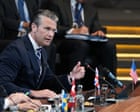
The coffee in the glass-walled conference rooms at NATO headquarters in Brussels tastes the same whether the world is at peace or on the brink of fracture. It is hot, slightly bitter, and served in porcelain cups that bear the understated compass logo of the alliance. For generations, those cups have been held by men and women who spoke in the measured cadence of institutional permanence. They talked of frameworks. They debated communiqués.
Then Pete Hegseth walked into the room.
When the American Defense Secretary stood before his European counterparts on a grey Thursday morning, the contrast was not merely political. It was cultural. It was the friction between a continent that view treaties as sacred text and a reformed Washington administration that views them as ledger books. Behind the closed doors of the North Atlantic Council, the language of decades-long diplomacy dissolved. Hegseth did not offer assurances. He issued a report card.
The headline that rippled out of the room was stark: the United States is launching an aggressive, six-month review of its entire military footprint across Europe. But the numbers tell only half the story. The true shift is psychological. The protective umbrella that has covered Europe since the ashes of 1945 is being pulled back, not by an enemy, but by the provider.
The Clipboard at the End of the Runway
To understand why the mood in Brussels turned toxic, one must look back to the spring. Imagine a hypothetical young American pilot sitting in the cockpit of an F-16 on a tarmac in Gloucestershire, England. The engines are humming. The mission parameters are set to strike missile launchers inside Iran. But before the tires can leave the asphalt, an invisible wall of European bureaucracy goes up.
Most continental allies refused overflight rights. They denied basing access. They cited domestic laws, arcane treaties, and regional sensitivities.
Hegseth brought that specific resentment into the room. He told the British Defence Secretary, Dan Jarvis, that it was unacceptable for allies to be standing at the end of a runway with a clipboard to decide what flies. To the American delegation, this was not a theoretical legal debate. It was an existential betrayal. American troops were taking the risks while European capitals, whose interests were directly threatened by Iranian escalation, watched from behind a shield of fine print.
The word Hegseth used was "shameful."
It hit the room like an ice bath. For decades, European ministers have been coddled with reassuring rhetoric about unbreakable bonds. Now, they were being told that the road goes both ways. If the United States is expected to guarantee the safety of European borders, Europe cannot lock its airspace when America calls for aid.
The Two-Way Street
The numbers driving this confrontation are massive, yet they translate into a simple human reality: who pays when the bill comes due?
For years, Washington has complained about "free riding." Under the current structure, the collective defense budget is heavily skewed. The Trump administration has made it clear that the old baseline of spending 2% of Gross Domestic Product on defense is yesterday's news. The new target discussed for the upcoming Ankara summit is a staggering 3.5% by 2035.
Consider the baseline mathematics of defense. To reach those numbers, European governments will have to make choices that affect regular citizens. It means choosing between artillery shells and healthcare. It means choosing between fighter jet maintenance and high-speed rail lines. For thirty years, Europe enjoyed a peace dividend, spending its money on robust social safety nets while relying on the American taxpayer to fund the heavy armor.
Now, the Pentagon is cutting the cord.
The cuts are already concrete. Washington is shrinking the pool of strategic bombers and warships available to NATO in an emergency. The number of U.S. fighter jets designated for the alliance is set to drop by a third. Think of it as a neighborhood watch where the wealthiest guy on the block suddenly decides to take his security cameras and his guard dogs home. The remaining neighbors are left looking at each other, wondering who is going to stay up through the night.
A Review with Winners and Losers
The new six-month Pentagon review is explicitly designed to create anxiety. Hegseth openly stated that some countries will pass with flying colors, while others will fail.
What does failure look like? It means the withdrawal of American troops, the reassignment of reconnaissance aircraft, and the removal of the F-16 squadrons that act as a tripwire against Russian ambition.
Mark Rutte, the NATO Secretary General, tried to put a brave face on the public scolding. The former Dutch Prime Minister smiled, shrugged, and told reporters that Hegseth was simply trying to keep the pressure on. He called the truth-telling prudent. But behind that performance lies a frantic scramble. European defense ministers are well aware that their industrial base cannot currently produce the ammunition, the drones, or the missile defense systems required to replace the American supply chain overnight.
The UK felt the tremor immediately. John Healey, the previous British defense chief, resigned just days prior because the government would only commit to spending nearly 2.7% of GDP by 2030, failing to match the aggressive upward trajectory demanded by Washington. His replacement, Jarvis, admitted the alliance faces a moment of deep challenge. To compensate, the UK announced a fresh package of drone and air defense funding for Ukraine, a desperate attempt to prove utility to an impatient superpower.
The Terminal Anchor
The transatlantic relationship was built on a promise: an attack on one is an attack on all. It was an emotional covenant forged in the dark days of the twentieth century.
But covenants require maintenance, and emotions don’t buy spare parts for a Patriot missile battery. The American posture has shifted permanently toward the Pacific, driven by the rise of China. Washington looks at a wealthy, stable Europe and sees an adult child who refuses to move out of the basement.
The era of the blank check is dead.
As the defense ministers packed their briefcases and prepared for the high-stakes leaders' summit in Ankara, the atmosphere in the corridors of Brussels was lighter on hope and heavier on arithmetic. The security of a continent no longer hinges on the poetry of shared values. It hangs on a spreadsheet, an ultimatum, and the sudden, terrifying realization that the protector is tired of carrying the weight alone.


