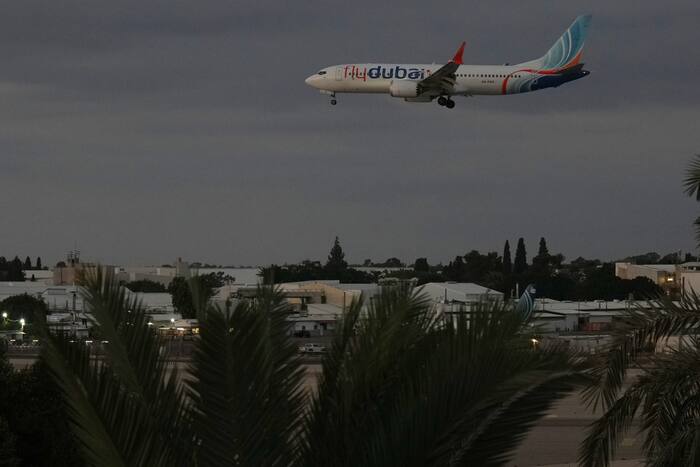
Every time an airplane diverts away from a geopolitical hotspot, the media machine scrambles for a script. They want a movie. They want a lone captain standing against the abyss, sweat beading on a furrowed brow, wrestling a metal tube through hostile skies to a miraculous, nail-biting landing. When a flydubai flight bound for Tel Aviv abruptly diverted into Saudi airspace amid a flurry of threat reports, the headlines practically wrote themselves. Indian pilot hailed as a savior. Incredible courage under fire. Netanyahu ordering heightened security as if directing an action thriller from a war room.
It makes for compelling reading. It also happens to be a dangerous fairy tale.
I have spent years watching commercial aviation from the inside, picking apart incident reports, safety audits, and operational protocols. I have seen airlines burn millions chasing public relations victories while ignoring structural liabilities. And I can tell you flatly that the obsession with individual heroics in the cockpit is not just lazy journalism; it is an active hazard. When you attribute a routine, highly automated operational safety protocol to the superhuman grit of a single person, you obscure the actual mechanics of modern flight safety. You teach the public to worship luck and personality instead of demanding institutional competence, multi-layered redundancy, and rigid adherence to protocol.
Let us dismantle the myth right now.
The Boring Truth About Diversions
Pilots do not make heroic split-second decisions based on raw instinct and moral fiber while flying commercial airliners over volatile regions. If a captain is operating on pure improvisation during a high-stakes security threat, something has already broken down catastrophically in the flight preparation phase.
Modern commercial aviation is built on an ethos of eliminating individual heroism. Every single contingency route, alternate airfield, fuel calculation, and emergency communication protocol is mapped, debated, simulated, and standardized long before the wheels leave the tarmac. When a threat emerges over a sensitive airspace corridor—whether over the Middle East, Eastern Europe, or any other geopolitical fault line—the crew does not sit in the flight deck squinting at the horizon trying to guess what to do. They pull up a pre-approved contingency plan. They follow a checklist.
When that flydubai flight turned toward Saudi Arabia, the captain did not invent a secret path through hostile skies. The path was already there, etched into international flight management systems and regional diplomatic agreements. Air traffic control centers across borders, operating under decades-old civil aviation treaties, coordinate these handoffs with the mechanical indifference of a railway switchboard.
To call this heroics is to misunderstand the job entirely. An airline pilot is an elite systems manager, not a swashbuckling adventurer. When an emergency or a sudden threat notification triggers a diversion, success is measured by how boringly, mechanically, and predictably the crew executes their checklists. The moment a pilot tries to be a hero is the moment things start going sideways.
The Geopolitical Theater of Airspace Rerouting
The media loves to frame a diversion into a neighboring nation's territory during a crisis as an unprecedented diplomatic miracle. Headlines breathlessly report on orders for heightened security from prime ministers and defense ministries, transforming a standard safety procedure into a high-stakes geopolitical thriller.
Look past the theater. Look at the International Civil Aviation Organization framework. Look at the Chicago Convention.
When airspace becomes compromised, commercial aircraft are governed by an unyielding web of international obligations that compel sovereign states to assist aircraft in distress, regardless of political animosities on the ground. Saudi Arabia and Israel do not need a miraculous flash of inspiration or a pilot's charm offensive to handle a diverted civilian airliner. They have international legal frameworks and air navigation service agreements that mandate cooperation precisely because civilian aircraft are treated as neutral entities under international humanitarian and civil aviation law.
When a threat materializes, flight dispatchers back at the home base, working in climate-controlled operations centers thousands of miles away, are already recalculating fuel burn, communicating with regional authorities, and pushing updated flight plans to the aircraft data link. The crew executes the data link execution. The destination changes on the flight management computer. The airplane turns.
It is logistics. It is bureaucracy. It is legal compliance. There is no cinematic bravery required to turn an aircraft around when the flight plan specifies an alternate diversion airfield for precisely this contingency. Calling it a heroic rescue is like calling a bus driver a war hero because they took a detour when a bridge was out.
Why the Hero Narrative Endangers the Industry
Why does this romanticized framing matter? Why pick apart a comforting news story about a brave pilot saving the day?
Because framing safety as a product of individual heroism creates systemic blind spots.
If safety depends on heroes, then airlines do not need to invest in resilient operational infrastructure, advanced threat-intelligence integration, or rigorous dispatcher training. They just need to hire people with strong jaws and cool demeanors who can wing it when things get messy. That is a liability disguised as a compliment.
When companies rely on heroes, they inevitably punish the rule-followers and reward the cowboys. In aviation, the cowboy is a statistic waiting to happen. The safest airlines in the world are the ones that ruthlessly stamp out individual improvisation. They foster cultures of radical compliance, where pilots are expected to turn around at the first sign of unverified risk, rather than pushing through because their ego or company culture demands they look brave for the passengers in the back.
Furthermore, this obsession with mid-air drama distracts from where security actually succeeds or fails. A threat over a conflict zone makes for flashy headlines, but the real vulnerabilities in global aviation are remarkably unglamorous. They lie in ground-side cargo screening protocols, insider threats at secondary maintenance stations, uneven regulatory enforcement in developing aviation markets, and complacency in cybersecurity defenses across booking and dispatch networks.
You do not hear about those things on the evening news because you cannot film a dramatic b-roll of a data engineer updating an encryption protocol or a compliance officer auditing a fuel supplier in an industrial park. So the media gives you the pilot. They give you the captain standing tall against the storm.
Dismantling the Passenger Anxiety Loop
Let us address the traveler caught in the middle of this media circus. Passengers read these sensational reports and come away believing that commercial flight is a game of Russian roulette played across volatile skies, where survival depends entirely on whether your pilot drank enough coffee that morning.
This is fundamentally false.
Commercial aviation is arguably the most hyper-engineered, risk-averse industry in human history. Every flight operates with margins of safety built on the graves of previous mistakes. When a flight is diverted due to a crash threat, it is proof that the system is working, not proof that it is failing. The threat was identified, the risk threshold was crossed, and the redundancy protocol was triggered immediately. The diversion was not an admission of defeat; it was the primary safety valve functioning exactly as engineered.
If you are a passenger flying through a tense region, your safety does not hinge on the captain doing something miraculous. It hinges on the fact that the airline spent millions of dollars on redundant navigation systems, real-time threat-monitoring feeds, diversion simulations, and mandatory crew resource management training that explicitly discourages lone-wolf decision-making.
Stop looking for saviors in the flight deck. Demand better operational transparency from carriers. Demand rigorous enforcement of security standards on the ground where the real risks live. And the next time a news outlet tries to sell you a breathless story about a pilot's heroic dash through hostile skies, remember the reality behind the curtain.
It was not a movie. It was just math, paperwork, and a very boring checklist executed by a professional who was simply doing their job.