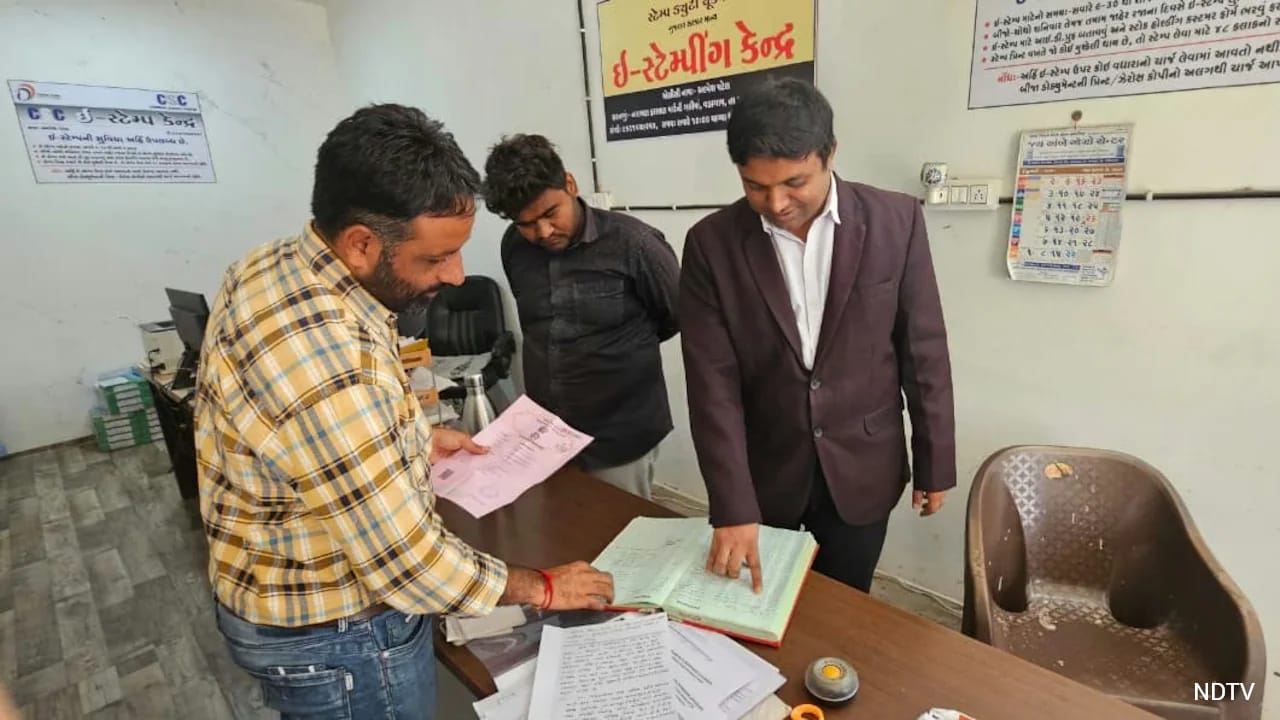
Government officials in Gujarat recently threw on plain clothes, posed as regular citizens, and busted a handful of authorized vendors for tacking extra fees onto e-stamp papers. The local press ate it up. Headlines celebrated the swift justice. Bureaucrats patted themselves on the back for protecting the common man from predatory middlemen.
It is complete nonsense.
These undercover stings are not a triumph of governance. They are pure administrative theater designed to distract the public from a broken, poorly incentivized retail infrastructure. When a state government forces private business owners to act as unpaid tax collectors, an informal surcharge isn't a crime wave. It is basic economics asserting itself against delusional price controls.
If you want to understand why e-stamp overcharging happens in Gujarat—and across nearly every Indian state running on the Stock Holding Corporation of India Limited (SHCIL) framework—you have to stop looking at the vendor's cash register and start looking at the unit economics of a 100-rupee piece of paper.
The Unit Economics of a Broken Monopoly
Let’s do the math that bureaucrats conveniently ignore when they stage these dramatic raids.
In India, e-stamping was introduced to kill the physical stamp paper mafia—the Telgi-style counterfeiting rings that bled state treasuries dry. On the backend, the system works. SHCIL acts as the Central Record Keeping Agency (CRA), generating cryptographically secure, verifiable certificates. Fraud at the printing level dropped to near zero.
Then came the last-mile delivery problem. How do you get millions of e-stamp certificates into the hands of homebuyers, small business owners, and litigants every single day?
The state outsourced the retail infrastructure to Authorized Collection Centers (ACCs)—typically small-scale cyber cafes, cooperative banks, and independent stamp vendors. And how does the state compensate these private operators for maintaining commercial real estate, paying commercial electricity tariffs, buying high-speed printers, maintaining uninterrupted broadband, and locking up working capital?
They pay them a microscopic commission. Often between 0.5% and 1.5% on low-denomination transactions, capped at absurdly low ceilings.
Imagine a scenario where you run a small retail storefront in Ahmedabad or Surat. A customer walks in needing a ₹100 e-stamp for a simple rental affidavit. Under the official commission structure, your gross revenue on that transaction is roughly ₹1 to ₹1.50.
Out of that single rupee, you must pay for:
- The physical A4 bond paper (which costs around ₹1.50 to ₹2.00 per sheet at wholesale).
- Laser printer toner and drum wear.
- Commercial rent in a high-foot-traffic area near a court or sub-registrar office.
- The time it takes to manually type the buyer's name, seller's name, article code, and consideration amount into a clunky government portal while the customer peers over your shoulder checking for typos.
You lose money on every single low-denomination transaction. Not a little money. You are literally subsidizing the state's revenue collection out of your own pocket.
When Gujarat officials pose as buyers and bust a vendor for charging ₹120 or ₹150 for a ₹100 e-stamp, they are arresting someone for refusing to operate at a guaranteed financial loss. They call it extortion. Any actual business operator calls it cost recovery.
Why Sting Operations Always Fail
I have spent over a decade analyzing regulatory compliance and last-mile fintech distribution across emerging markets. I have watched state governments run this exact playbook dozens of times. First comes the public outcry over "illegal surcharges." Next comes the dramatic enforcement drive—licenses suspended, fines levied, press releases issued.
Two weeks later, the exact same surcharge is back. Usually higher than before, because vendors now have to price in the regulatory risk of getting raided.
Why? Because price ceilings without margin support create artificial scarcity.
When the state cracks down on vendors for charging a convenience fee, the smartest, most compliant operators simply stop issuing low-value e-stamps. Suddenly, the printer is "broken." The internet is "down." The portal is "under maintenance."
The desperate citizen who needs an affidavit notarized before 4:00 PM doesn't care about the state's moral crusade against a ₹30 markup. They care about getting their legal work done. By shutting down the local vendor who charged ₹130, the Gujarat revenue department doesn't save the citizen ₹30. It forces that citizen to take an auto-rickshaw across town, burn half a day in a massive queue at a designated bank branch, and lose thousands of rupees in productive wages.
The sting operation solves the headline problem while actively making the citizen's life worse.
The Questions Nobody Asks About E-Stamping
When news like the Gujarat raids breaks, the public conversation gets trapped in predictable, shallow loops. Let’s dismantle the standard narrative by looking at what people actually search for—and what they are getting wrong.
Is it legal for an e-stamp vendor to charge extra?
Legally, no. Under the rules governing Authorized Collection Centers, the stamp duty amount printed on the certificate is the maximum retail price. Vendors are strictly prohibited from charging service fees, printing charges, or handling fees. This black-and-white legal reality is precisely why the law is an ass. When the legal framework forbids a merchant from recouping the cost of the paper the certificate is printed on, the law guarantees its own violation.
How can I get an e-stamp without paying extra charges?
You can bypass retail vendors entirely by generating e-stamps directly online through the SHCIL portal or state-integrated digital payment gateways, paying via UPI or net banking, and printing it yourself. Yet millions of people still walk into physical shops and willingly hand over extra cash. Why? Because the government's digital self-service portals are plagued by terrible user interfaces, confusing article codes, and zero error tolerance. If you make a single spelling mistake on a self-generated e-stamp, getting a refund from the state treasury is a bureaucratic nightmare that takes months. People pay the local vendor an extra ₹50 as an insurance policy against screwing up the form.
Why doesn't the government just cancel the licenses of corrupt vendors?
They do. And it creates a vacuum immediately filled by unregulated touts. When legitimate, licensed shopkeepers get driven out of the business by punitive raids and impossible margins, they hand their access credentials over to street-level brokers operating out of the backs of motorcycles outside court complexes. Instead of paying ₹130 at a registered shop with a receipt, the public ends up paying ₹250 to an unlicensed middleman with zero accountability.
The Real Cartel Is Bureaucratic Inertia
The lazy consensus in local journalism paints the small-time stamp vendor as a greedy villain preying on helpless citizens. It is an easy story to write. It requires zero investigation into how the state treasury actually structures its distribution contracts.
If Gujarat’s Revenue Department genuinely wanted to eliminate overcharging tomorrow, they wouldn't need a single undercover inspector. They could solve the problem with three structural changes that every private-sector logistics company figured out twenty years ago:
- Legislate a Transparent Convenience Fee: Stop pretending that printing, data entry, and retail real estate are free. Allow ACCs to charge a legally mandated, clearly displayed service fee—say, ₹20 to ₹30—on all e-stamp transactions below ₹1,000. Put it right on the receipt. When a fee is transparent and regulated, competition keeps it fair. When it is banned, it goes underground and inflates.
- Fix the Commission Floor: Scrap percentage-based commissions for low-value stamps. A percentage model makes sense when someone is buying a ₹50,000 stamp for a property deed. It is completely broken for a ₹50 or ₹100 affidavit. Pay vendors a flat minimum handling fee out of the state treasury for every certificate generated, regardless of denomination.
- Decouple Printing from Issuance: Stop forcing citizens to visit physical kiosks for basic documentation. Integrate APIs directly with law firms, real estate portals, and consumer apps, allowing verified digital signatures to replace the absurd obsession with printing digital certificates onto physical paper just to stamp them again with ink.
The Trade-Off Nobody Wants to Admit
Of course, adopting a transparent convenience fee comes with an ugly political cost. No state minister wants to stand at a podium and announce that the government is officially allowing vendors to charge ₹25 extra for a ₹100 stamp paper. Opposition parties would scream about hidden taxes on the poor. The headlines would be brutal.
It is much safer, politically, to keep the official price artificially locked at zero markup, starve the vendors of viable margins, and then stage a few high-profile sting operations every six months to look tough on corruption.
Both sides know the game. The bureaucrats get their photo-ops and press coverage. The vendors pay a few fines, keep their heads down for a fortnight, and quietly resume charging the exact same markup because the rent is still due on the first of the month.
The only person actually getting played in this entire arrangement is the citizen applauding the raids—right up until the moment they need a ₹100 stamp paper on a Tuesday afternoon and realize every honest shopkeeper in their neighborhood has shut their doors.