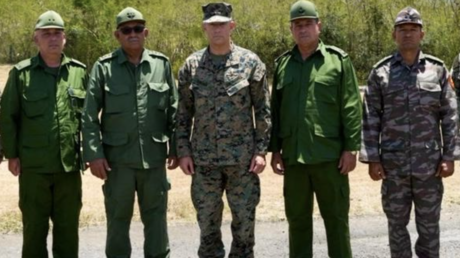
The top American military commander for Latin America just met face-to-face with Cuban generals on the dusty perimeter of the Guantanamo Bay Naval Station. While official statements frame the encounter as a routine effort to ensure operational security along the highly fortified border, the reality is far more volatile. This sudden face-to-face contact happens against the backdrop of an aggressive White House campaign that has pushed the island nation to the brink of collapse. For a Washington administration that openly declares Havana is its next target, this fence-line meeting is not a diplomatic breakthrough. It is a tactical assessment of a target.
General Francis Donovan, head of U.S. Southern Command, crossed the base perimeter on Friday to stand opposite Cuban Army Corps General Roberto Legrá Sotolongo. Ostensibly, they talked about perimeter security, force protection, and keeping communication lines open. Yet, the strategic context reveals a deeper, more perilous game. Cuba is currently enduring a punishing U.S. oil blockade that has choked its economy and triggered nationwide blackouts. Washington has also unsealed criminal indictments against former President Raúl Castro. By sending the region’s top combat commander to look the Cuban military in the eye, the United States is sending a clear message that the long-standing geopolitical stalemate is over. For an alternative view, read: this related article.
The Venezuelan Precedent
To understand why Cuban commanders are terrified, look at what happened in Caracas four months ago. In January, a lightning U.S. military raid captured Venezuelan President Nicolás Maduro, flying him to New York to face federal drug trafficking charges. That operation completely rewrote the rules of engagement in the Caribbean. For decades, Washington relied on economic sanctions and diplomatic isolation to pressure adversarial regimes. Now, the White House has demonstrated a willingness to deploy direct kinetic force to remove foreign leaders.
The administration has repeatedly warned that Cuba is next on its list. This is not empty rhetoric. The infrastructure to execute such a threat is already being positioned. While the Pentagon just announced that a fresh contingent of 1,300 sailors and Marines will rotate into the Caribbean to replace the departing 22nd Marine Expeditionary Unit, the permanent American naval presence hovering just off the Cuban coast remains a potent deterrent. Further coverage on the subject has been provided by The Guardian.
Shadows Over Havana
The Guantanamo meeting did not happen in a vacuum. It follows a highly unorthodox, quiet mission to Havana earlier this month by CIA Director John Ratcliffe. During that trip, Ratcliffe delivered a blunt ultimatum to the Cuban leadership. The administration offered an ultimatum: implement sweeping political and economic reforms, or face total ruin.
To ensure the point was taken, Ratcliffe brought a specialized paramilitary operator on the trip. This operative had personally participated in the January raid that captured Maduro—an operation that left dozens of Cuban security advisors dead in Venezuela. The CIA director made a point of introducing this operator to the Cuban delegation, a chillingly direct reminder of American reach and lethality.
The Logistics of Collapse
The strategy deployed against Havana relies on a pincer movement of economic strangulation and psychological warfare. Secretary of State Marco Rubio has spent months laying the public narrative, framing Cuba as a failed state that poses a direct national security threat just 90 miles from Florida.
- The Energy Stranglehold: A sweeping U.S. embargo restricts international oil shipments to the island by threatening punitive tariffs on any nation providing fuel.
- The Power Grid Failure: Deprived of crude, Cuba's electrical grid has suffered catastrophic failures, leaving major cities in near-perpetual darkness and stoking domestic unrest.
- The Legal Offensive: The Department of Justice unsealed indictments against the 94-year-old Raúl Castro over the 1996 shootdown of civilian exile aircraft, signaling that the leadership enjoys no sovereign immunity.
Cuban President Miguel Díaz-Canel has warned that any American intervention would trigger a bloodbath. Havana has quietly accumulated a stockpile of attack drones and continues to host Russian and Chinese intelligence-gathering facilities, assets that Washington views as unacceptable provocations.
Reading the Line
Historically, lower-level American and Cuban officers have met at the Guantanamo fence line to handle basic deconfliction, such as coordinating responses to wildfires or tracking escapees. Those local interactions kept a volatile border quiet. Raising the rank of the attendees to the chief of Southern Command changes the calculation completely.
General Donovan’s presence allowed the Pentagon to conduct a firsthand evaluation of Cuban military readiness and morale at the base's boundary. When a superpower isolates an island with an energy blockade, indicts its historical leadership, and sends its top general to inspect the front lines, it is not looking for a diplomatic exit ramp. It is verifying the vulnerabilities of an adversary before the pressure campaign reaches its logical, chaotic conclusion.


