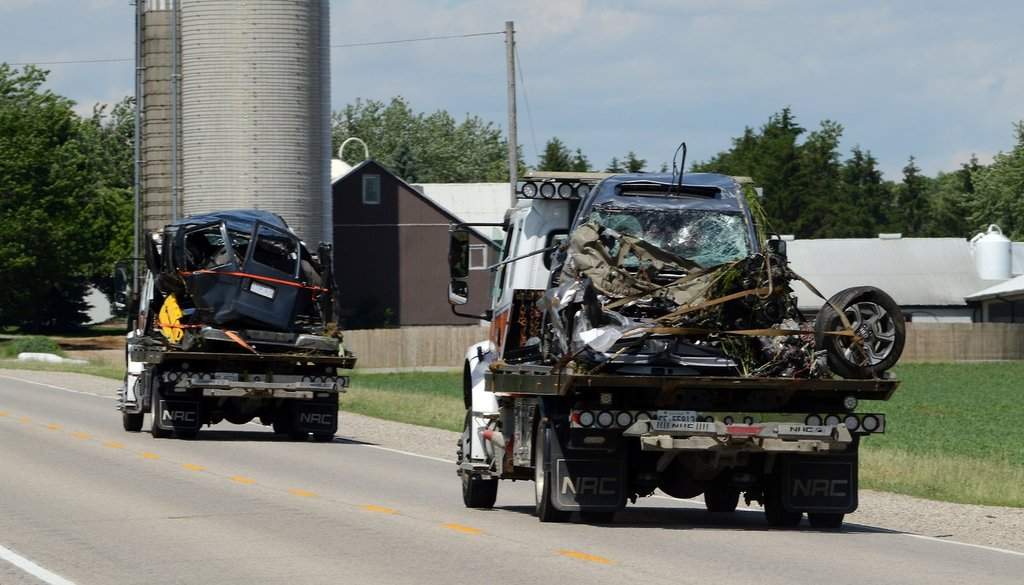
A devastating collision in rural Ontario has left six people, including an infant, fighting for their lives in the hospital. The Ontario Provincial Police (OPP) are currently investigating the multi-vehicle crash, which serves as a grim reminder of the escalating safety crisis on provincial secondary highways. While authorities frequently cite driver error, speeding, or weather conditions as the immediate causes of these catastrophic events, a deeper examination reveals a systemic failure in rural infrastructure design, delayed emergency response capabilities, and a regional transit gap that forces vulnerable families onto high-speed corridors.
The incident, which ground local traffic to a halt as emergency crews airlifted victims to regional trauma centers, highlights a pattern that traffic safety experts have warned about for years. Rural roads in Ontario account for a disproportionate number of severe injuries and fatalities compared to their urban counterparts. Drivers on these routes face a hazardous mix of high speed limits, undivided lanes, lack of physical median barriers, and minimal lighting. When a vehicle loses control or veers into oncoming traffic on these stretches, the margin for error is non-existent.
The Anatomy of Rural Highway Risk
To understand why a routine drive turns fatal on provincial routes, one must look at the physical geometry of the roads. Unlike 400-series highways, which feature wide shoulders, concrete median barriers, and controlled access points, standard provincial highways frequently rely on a single yellow line to separate opposing streams of traffic traveling at 80 to 100 kilometers per hour.
A head-on collision at these speeds creates an impact force that modern vehicle safety ratings are simply not designed to withstand.
Municipalities often push for lower speed limits following severe crashes, but enforcement over vast geographic areas remains a persistent challenge for understaffed rural OPP detachments. Furthermore, road design itself dictates driver behavior far more effectively than a posted sign. When a road feels wide and open, drivers naturally accelerate, oblivious to the hidden intersections, blind crests, and wildlife crossings that characterize rural Ontario geography.
The inclusion of an infant among the critically injured in this latest crash underscores the vulnerability of families relying on these corridors. Even when child safety seats are installed correctly, the lateral forces generated by a high-speed T-bone or head-on impact test the absolute limits of automotive engineering.
The Golden Hour Dilemma in Remote Regions
In trauma medicine, the "Golden Hour" represents the critical window during which a patient must receive definitive surgical care to significantly increase their chances of survival. In major urban centers like Toronto or Ottawa, a victim is often delivered to a specialized trauma unit within minutes. In rural Ontario, that timeline is routinely stretched to its absolute limit.
When a major collision occurs on a secondary highway, the logistical chain faces immediate strain:
- Detection delays: Passersby must spot the wreckage, find reliable cellular service—which remains spotty in northern and rural pockets—and alert dispatchers.
- Volunteer response times: Many rural townships rely heavily on volunteer firefighters who must travel from their homes or workplaces to the station before deploying to the scene.
- Transit distances: Ground ambulances must navigate long routes to reach the site, stabilize multiple critically injured patients, and then transport them to local community hospitals that often lack intensive care facilities.
For the six victims of the recent Ontario collision, survival depended on the deployment of air ambulance services. Helicopters can bypass road geography, but they are subject to strict weather limitations and require clear, secure landing zones established by first responders on the ground. When multiple patients require air transit simultaneously, regional resources are stretched to a breaking point, forcing paramedics to make agonizing triage decisions on the asphalt.
The Infrastructure Funding Gap
Local municipal councils have repeatedly signaled that they lack the tax base to properly maintain and upgrade roads that handle heavy regional transit. Provincial uploading of highways in the late 1990s shifted the financial burden of thousands of kilometers of roadway onto small townships. While some routes were clawed back by the province, the legacy of underfunded maintenance persists.
Widening shoulders, installing rumble strips, and adding dedicated turning lanes at problematic intersections have proven track records of reducing severe accidents. Yet, these projects are frequently delayed or downscoped due to budgetary constraints.
[Image diagram showing how rumble strips and widened shoulders prevent run-off-road and head-on collisions]
The provincial government routinely allocates billions to massive urban transit projects and highway expansions in the Greater Toronto Area, while rural corridors receive fractional funding for basic resurfacing. This funding disparity creates a two-tiered safety reality for Ontario motorists. Those living outside the major urban centers accept a significantly higher statistical risk every time they start their engines.
Commercial Traffic and Changing Vehicle Dynamics
The mix of vehicles utilizing rural highways has shifted dramatically over the past decade. The rise of e-commerce and regional distribution hubs means that sub-highways now see unprecedented volumes of heavy commercial trucks. When a multi-tonne transport truck shares an undivided two-lane road with a compact passenger car carrying a family, the physics are entirely lopsided.
Add to this the increasing average weight of consumer vehicles. The market shift toward heavy sport utility vehicles (SUVs) and electric vehicles (EVs) means that modern collisions involve substantially more kinetic energy than those of twenty years ago. When these massive vehicles collide at highway speeds, the debris fields are vast, and the extraction process requires specialized heavy hydraulic tools that rural fire departments may only possess in limited quantities.
Distracted driving also manifests differently on long, monotonous rural stretches. In an urban environment, a distracted driver might cause a minor fender bender at a stoplight. On an open highway, a two-second glance at a smartphone can result in a vehicle drifting across the center line, causing a catastrophic multi-vehicle event before the driver can react.
Real Solutions Beyond Traffic Tickets
Addressing this crisis requires moving past the standard police rhetoric of "drive to conditions." True systemic reform involves targeting the root causes of rural road vulnerability through targeted engineering and structural policy shifts.
Mandatory High-Friction Surfacing and Rumble Strips
Center-line rumble strips are an inexpensive, highly effective countermeasure against head-on collisions caused by fatigue or distraction. The physical and auditory vibration alerts a drifting driver instantly, providing an opportunity to correct course before entering oncoming traffic lanes. This simple modification should be legally mandated for every provincial highway undergoing resurfacing.
Strategic Roundabout Deployment
Traditional two-way stop intersections on high-speed rural roads are notorious hotspots for severe broadside collisions, particularly when drivers misjudge the speed of oncoming cross-traffic. Replacing these intersections with rural roundabouts forces a natural reduction in speed and eliminates the possibility of high-speed perpendicular impacts. Where roundabouts have been introduced on provincial routes, fatal accidents have plummeted.
Formal Re-evaluation of Commercial Routes
The province must reassess which secondary highways are approved for heavy commercial transit. If a route lacks adequate shoulder width, clear sightlines, and structural barriers, long-haul commercial trucks should be diverted to twin-lane divided corridors, even if it adds time to logistics schedules. Public safety along rural residential corridors must take precedence over corporate supply-chain optimization.
The six individuals currently fighting for recovery in Ontario hospitals are not mere data points for an annual road safety report. They are the latest casualties of an outdated, underfunded approach to rural transportation infrastructure that treats highway safety as a personal responsibility rather than a public policy mandate.