Incense lingers in limestone churches long after the liturgy ends. It clings to heavy woolen coats, mixes with the damp chill of stone floors, and settles into the quiet breathing of people who have gathered to say goodbye to someone they loved.
Silence.
Then comes the sharp, metallic crack that does not belong inside a house of prayer—a sound that splits time into a neat, agonizing before and after, turning a room built for mourning into a trap where seven lives end before the final prayers can even be spoken.
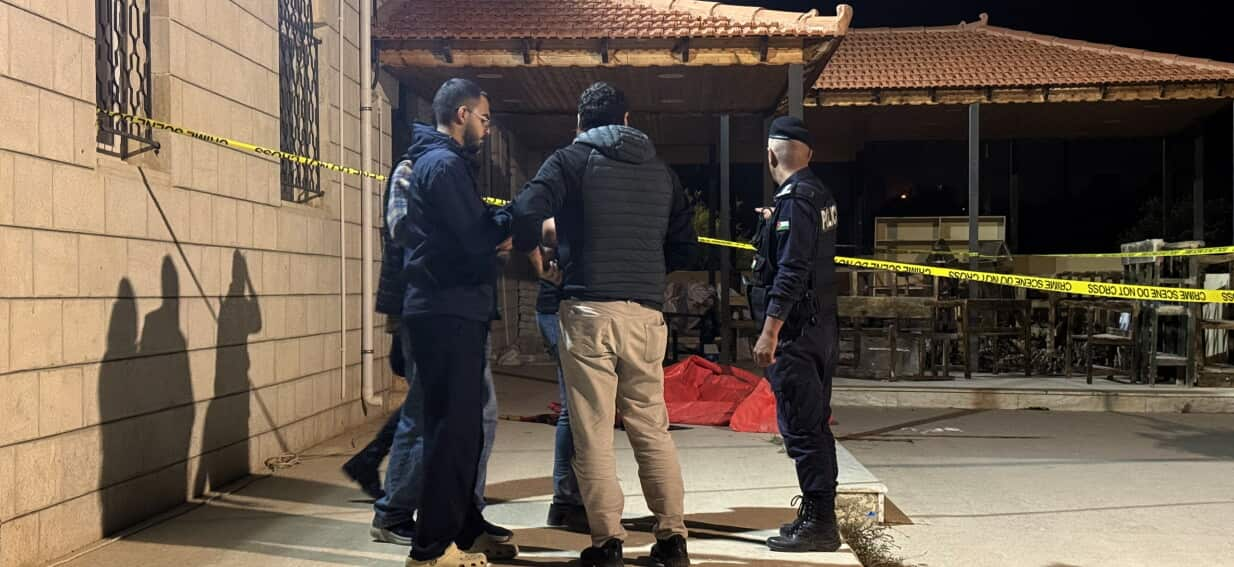
When gunfire erupted during a funeral at a church in Jordan, the immediate headlines reduced the tragedy to clean, digestible arithmetic. Seven dead. Gunmen open fire. An investigation launched. Those words do their job in a newsroom, yet they miss the tectonic shift that happens when violence crosses the threshold of a funeral—because a funeral is supposed to be the one place where human vulnerability is protected by an unspoken truce.
The Unspoken Truce of the Sanctuary
Every society draws invisible chalk lines around spaces where rage is meant to pause. Hospitals, classrooms, graveyards, and churches operate on a shared social contract: here, you lay down your weapons, because everyone inside is carrying something heavier.
Consider a hypothetical composite of the people sitting in those wooden pews that afternoon—let us call him Tariq, a retired schoolteacher in his late sixties who came simply to pay his respects to a lifelong neighbor. Tariq did not arrive expecting to calculate sightlines or wonder whether a heavy oak bench could stop a bullet. He arrived carrying tissues, a black tie knotted slightly crookedly in the morning rush, and the ordinary sorrow of outliving a friend.
That is the invisible stake of an attack on a religious gathering. The bullets do not only strike the seven people who fall; they shatter the muscle memory of safety for every person who walks into a church, a mosque, or a community hall afterward.
I have stood in rooms where tragedy has rewritten the architecture in a matter of seconds, and the first thing you notice afterward is not the noise—it is how suspicious the silence becomes. You stop looking at faces when you enter a room. You start looking at exits, heavy pillars, and the hands of strangers standing near the door.
Anatomy of a Shattered Afternoon
To understand why an attack on a Jordanian church funeral cuts so deeply, you have to look at the geography of stability in the Middle East. For decades, Jordan has occupied a delicate, fiercely guarded position as a regional anchor—a kingdom bordered by conflicts that have torn neighboring nations apart, yet largely defined at home by coexistence between its Muslim majority and its historic Christian minority.
Jordanian Christians make up roughly two to four percent of the population, a community whose roots stretch back to the earliest centuries of the faith. In towns like Madaba, Salt, Karak, and neighborhoods across Amman, churches and mosques often stand within earshot of one another, their bells and calls to prayer braiding into the daily rhythm of street life.
When gunmen breach that quiet during a funeral, the violence carries two distinct layers of shock:
- The violation of sacred grief: Attacking mourners strikes people at their most defenseless, transforming a ritual of closure into an open wound that families must carry without ever having finished burying their first dead.
- The assault on social trust: In a country that prides itself on communal harmony and strict internal security, public shootings feel like an intrusion from a chaotic world that Jordanians have worked tirelessly to keep outside their borders.
Think of a community's sense of safety like a stained-glass window set high in a stone wall. From the outside, it looks solid enough to hold back the wind. Inside, it turns harsh sunlight into something warm and bearable. One well-aimed stone does not just leave a hole; it sends hairline fractures racing through every surrounding pane, changing the light across the entire room.
What Actually Drives Violence Into Sacred Spaces
Whenever news breaks of a deadly shooting at a church in the Middle East, outside observers tend to reach immediately for sweeping geopolitical explanations. Sometimes those explanations fit. Often, they obscure a messier, harder truth.
Across Jordan, lethal gun violence in public spaces typically stems from one of two very different currents—and until investigators untangle the evidence, communities live inside the fog between them. On one side sits ideological extremism, the kind of calculated terror that targets religious minorities specifically to provoke sectarian fear and fracture national unity. Jordan has confronted and dismantled extremist cells for years, knowing full well that a single headline-grabbing attack can undo months of quiet diplomacy and tourism recovery.
On the other side sits something older and far more personal: localized blood feuds, tribal vendettas, and disputes over honor or property that boil over with lethal ferocity. In moments of unchecked vengeance, a funeral—where extended families gather in one predictable place at one predictable hour—can become a grimly convenient stage for settling a score.
Does the distinction matter to the mother wiping blood from her hands on the church steps? Not in the first hour. Seven bodies still lie beneath white sheets. Seven families still have to plan burials in the shadow of a burial that was never finished.
Yet for the country trying to prevent the eighth death, that distinction is everything.
Ideological terror requires intelligence networks, border vigilance, and counter-radicalization efforts aimed at dismantling underground cells before they acquire weapons. Tribal or personal vendettas demand something entirely different: tighter enforcement against illegal firearms, swift judicial accountability so families do not take justice into their own hands, and respected community elders stepping into the breach before anger hardens into gunfire.
The Heavy Cost of Invisible Armor
People often ask what happens to a congregation in the weeks after a shooting. They picture armed guards at the doors, metal detectors humming beside the baptismal font, and police cruisers idling with blue lights flashing along the curb.
Those measures arrive quickly, and they help. Security forces in Jordan have long demonstrated a swift, uncompromising response to threats against places of worship, tightening perimeters around churches during major services and holidays.
The harder reconstruction happens inside the human nervous system.
When a sanctuary is violated, survivors develop what trauma clinicians recognize as hypervigilance—an exhausting, involuntary habit of scanning every doorway and flinching whenever a heavy wooden door slams shut in the wind. Children who once fidgeted through long sermons suddenly watch their parents' faces for signs of panic. Elderly parishioners who walked to Sunday service for fifty years start staying home, not because their faith has weakened, but because their bodies refuse to sit with their backs to an open aisle.
If you have never experienced that shift, it is easy to underestimate how much energy it steals from ordinary life. Trust is invisible until it breaks, much like clean air or steady ground beneath your feet. Once it cracks, you spend half your waking hours bracing for a tremor that may never come—and that constant bracing is its own quiet casualty.
Rebuilding the Chalk Line
How does a community reclaim a room where seven people were killed?
Not by pretending the bullets never flew, and certainly not by abandoning the pews to fear. Across the region, whenever churches or mosques have been struck by gunfire, the most defiant answer has always looked deceptively simple: the doors unlock again, the broom sweeps away the shattered glass, and people walk back inside to sit shoulder to shoulder.
In Jordan, that resilience rests on a deep reservoir of shared civic identity. Neighbors of different faiths show up at mourning tents—the diwan—to drink bitter black coffee, offer formal condolences, and stand beside grieving families so the burden does not fall on one small community alone. Security agencies trace the weapons, track the shooters, and reinforce the legal boundary that says no grievance—political, ideological, or personal—grants permission to turn a house of worship into a killing floor.
Still, I cannot pretend there is an easy comfort to offer when seven lives vanish between one hymn and the next. The questions linger long after the forensic tape is rolled up and the news cameras pack their tripods for the next crisis. Who pulled the triggers, and what grievance or ideology convinced them that mourners were fair game? How many illegal weapons remain tucked away in trunks and closets, waiting for the next spark?
Those answers belong to investigators and courts in the days ahead.
For the rest of us, what remains is the memory of that interrupted liturgy—the unfinished farewell, the seven empty chairs at seven dinner tables tonight, and a stone sanctuary in Jordan where, next Sunday morning, someone will still have to walk up the steps, push open the heavy wooden doors, and light the incense again.