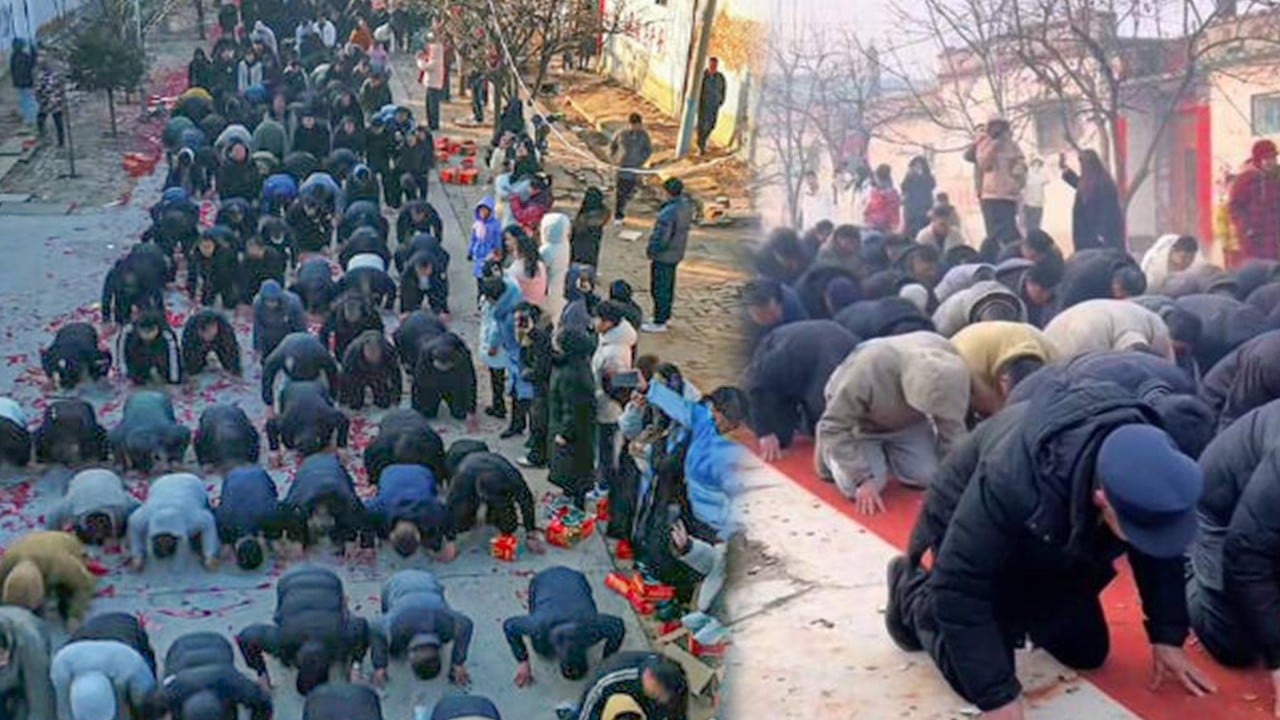
In a dusty village square in Gansu province, 600 men recently lined up in perfect, military-grade rows to perform a synchronized kowtow to their ancestors. The images, which flooded Chinese social media platforms like Weibo and Douyin, show a sea of bent backs—a physical manifestation of a lineage system that has survived empires, revolutions, and the breakneck speed of modern urbanization. While the spectacle was framed by local organizers as a celebration of "filial piety" and "cultural continuity," it triggered an immediate and ferocious backlash from a younger generation of Chinese women who see something far more exclusionary in the dirt.
The controversy is not merely about a ceremony. It is about who is allowed to exist in the official record of a family’s history. In these traditional lineage rites, daughters are effectively invisible. They are considered "spilled water"—members of another family the moment they marry. By gathering 600 men to the exclusion of every woman in the village, the event highlighted a widening chasm between the state’s desire for social stability through "traditional values" and the lived reality of women who are increasingly unwilling to be footnotes in their own bloodlines.
The Architecture of Exclusion
To understand why 600 men bowing is a flashpoint, one must look at the Zupu, or the genealogical record. These books are the DNA of rural Chinese social structure. For centuries, the Zupu has functioned as a private census, a property deed, and a moral compass. If your name is in the book, you belong to the land and the legacy. If it isn't, you are a guest.
Historically, women were omitted from these records entirely or mentioned only as "the wife of" a specific male. The Gansu ceremony was a living version of that omission. When 600 men bow, they are asserting a collective identity that explicitly denies women a seat at the table of heritage. This isn't just a matter of hurt feelings; it has tangible consequences for land rights, inheritance, and village political power. In many rural areas, "village rules" often supersede national law, and those rules are written by the men whose names appear in the Zupu.
The defense from the village elders is always the same: "This is our custom." They argue that the ceremony is about respecting the past, not attacking the present. However, custom is never static. It is a choice. By choosing to stage a massive, public display of male-only reverence, the village is sending a signal of resistance against the changing social tide of the country.
The Economic Engine of Tradition
There is a cynical, or perhaps merely practical, layer to these ceremonies that often goes unremarked. Many of these large-scale ancestral rites are funded by successful businessmen who have left the village for the cities. For these "prodigal sons," financing a massive kowtow is a way to "buy" social status back home. It is a performance of Guanshi, the intricate web of social influence.
By footing the bill for a 600-man ceremony, a wealthy donor secures his place at the top of the local hierarchy. He isn't just honoring his grandfather; he is ensuring that if he ever needs to build a factory on village land or call in a favor from the local government, the community is already in his debt. The exclusion of women is a feature, not a bug, of this system. In the traditional business world of rural China, the power brokers are almost exclusively men. The ceremony mirrors the boardroom.
A Generation Rejects the Script
The reaction online tells a different story. "Is it 2024 or 1924?" asked one viral comment. This isn't just "internet noise." It represents a fundamental shift in the Chinese psyche. China's female labor participation rate has historically been high, and women in urban centers are delaying marriage and childbirth at record rates. They are no longer dependent on the patriarchal lineage for survival, which makes the sight of 600 men claiming a monopoly on "ancestry" feel like an insult to their intelligence and their autonomy.
We are seeing the rise of "individualized" family trees. In cities like Shanghai and Shenzhen, some women are starting their own records, including their mothers and daughters, and even passing down their own surnames. This is a quiet revolution, but it is one that strikes at the heart of the "600 men" ideology. The Gansu ceremony was a desperate attempt to assert a dominance that is rapidly slipping away in the face of economic reality.
The State’s Tightrope Walk
The Chinese government finds itself in a difficult position. On one hand, the leadership has been promoting a return to "traditional family values" to combat a plummeting birth rate and a shrinking workforce. They want stable, multi-generational homes where the elderly are cared for by their children. Ceremonies like the one in Gansu seem to align with this "Confucian" revival.
On the other hand, the state cannot afford to alienate its female workforce. The anger directed at the Gansu ceremony forced censors to walk a fine line—allowing some debate while preventing it from spiraling into a broader critique of government policy. The tension is clear: you cannot build a modern, high-tech superpower on a foundation that treats half the population as "temporary members" of society.
The Myth of the Unbroken Chain
The organizers of these events often claim they are "restoring" an ancient, unbroken tradition. This is a historical fiction. Most of these lineage ceremonies were completely dismantled during the mid-20th century. What we are seeing today is a reconstruction, often influenced by modern aesthetics and a desire for viral content.
The "600 men" aren't just following tradition; they are performing a version of it that has been sanitized for the camera. The irony is that by making it a public spectacle, they invited the very scrutiny that is now tearing the tradition apart. When you move a private ritual into the public square, you subject it to the values of the public. And the modern Chinese public is no longer willing to accept that a man’s bow is worth more than a woman’s existence.
The False Choice of Heritage
The most common counter-argument from traditionalists is that "if women join, the tradition is lost." This is a hollow defense. Many villages in southern China, particularly in Guangdong and Fujian, have already begun to integrate women into their ancestral ceremonies. They have realized that if they don't include daughters, the traditions will simply die out as the youth move away and the elders pass on.
In these more progressive villages, women are allowed to offer incense and have their names recorded in the Zupu. The world hasn't ended. The ancestors haven't revolted. Instead, the tradition has become more resilient because it actually reflects the community it claims to represent. The Gansu village's refusal to adapt isn't a sign of strength; it’s a sign of fragility.
The Cost of Staying Still
If these rural communities continue to insist on male-only lineages, they will accelerate their own decline. Young women from these villages are already voting with their feet. They move to the cities, find work, and never look back. Why would they return to a place where they are officially considered "outsiders" in their own homes?
The 600 men in Gansu may have felt a sense of power and belonging as they bowed in unison. But as they looked up from the dirt, they were staring into a future where the very seats they are trying to protect will be empty. A lineage that excludes its daughters is a lineage that has chosen its own expiration date. The real debate isn't about "gender equality" in an abstract sense; it’s about whether these communities want to survive the 21st century.
The dust in the village square eventually settles, and the men go back to their daily lives. But the images remain online, serving as a permanent record of a culture at a crossroads. You cannot force a modern society into an ancient mold without something breaking. Right now, the cracks are showing, and they are wider than any single ceremony can fill.
Stop looking for a compromise where one side demands total invisibility from the other. Instead, look at the villages that are quietly changing their books. They are the ones who will have someone left to bow fifty years from now.