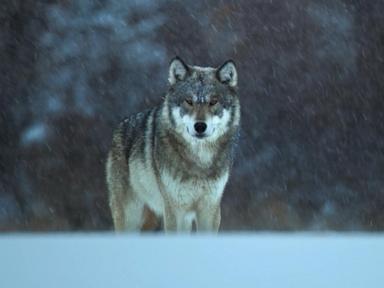
Cold.
It does not arrive all at once; it seeps through three layers of thermal merino wool, settles into the marrow of your shins, and convinces your fingers that they belong to someone else entirely. I have spent enough miserable dawns shivering inside canvas blinds in the northern Rockies, praying for the wind to shift so a stray scent wouldn't ruin six weeks of patience, to know the exact flavor of defeat that comes with wildlife filmmaking. You wait in the dark for ghosts that rarely show up. When they do, they are usually blurry gray smudges disappearing into the timberline half a mile away, leaving you with nothing to show for your frostbite except a memory card full of wind noise and empty snow. For an alternative view, consider: this related article.
That is the unspoken reality behind National Geographic’s first look at Wolves Up Close with Bertie Gregory.
Most press releases treat a wildlife trailer like a product launch. They give you the broadcast dates, the executive producer credits, and a few sanitized quotes about incredible access. They completely miss the blood, the absurdity, and the quiet psychological toll of trying to earn the trust of an apex predator that has spent three centuries learning that humans carry rifles. When you watch the early footage of Bertie Gregory—a BAFTA-winning cinematographer who has made a career out of refusing to use long lenses from the safety of a heated truck—you are not just looking at high-definition nature television. You are watching a high-stakes negotiation between two species that have misunderstood each other since the first campfire was lit. Further coverage on the subject has been shared by The Hollywood Reporter.
The Myth of the Monster in the Woods
Consider a hypothetical viewer sitting on a plush sofa in suburban Chicago, scrolling through their streaming queue on a Tuesday night. Let’s call him Marcus. Marcus knows wolves from fairy tales, from nineteenth-century engravings of teeth-baring beasts chasing sleighs across the Russian steppe, and from modern political shouting matches over livestock depredation. To Marcus, a wolf is either a bloodthirsty villain or a mystical spirit animal printed on a souvenir T-shirt. Neither version is real. Both are projections of human anxiety.
Here is the truth that breaks those myths apart.
Gray wolves (Canis lupus) are overwhelmingly risk-averse. Biologists who have tracked packs across North America and Europe for decades consistently document the same behavioral pattern: when a wolf smells a human, its primary instinct is not to attack, but to vanish. A broken leg or a punctured lung in the wild is a death sentence; there are no emergency rooms in the boreal forest, so wolves avoid confrontation with large, upright primates at almost any cost. Yet for centuries, human survival depended on believing the opposite. Because wolves competed with early pastoralists for sheep and cattle, we wrote stories that turned a cautious, family-oriented scavenger and hunter into an avatar of pure malice. By the mid-twentieth century, government-sponsored eradication programs had wiped gray wolves out of nearly the entire contiguous United States, reducing a population that once numbered in the hundreds of thousands to a few hundred survivors clinging to the northernmost fringes of Minnesota and Isle Royale.
That historical baggage is the invisible wall standing between Bertie Gregory and his subjects. You cannot simply walk into the wilderness with an IMAX-grade camera and expect a wild pack to perform. To get within twenty feet of a wolf without triggering its flight response requires dismantling generations of inherited fear, one freezing hour at a time.
What Happens When the Long Lens Goes Away
Standard wildlife filmmaking relies on optical illusion. A cameraman sits on a ridge a mile away with a lens the size of a bazooka, compressing the distance so the viewer feels as though they are standing right next to the animal. It is safe, it is efficient, and it creates a subtle emotional distance. You are peering through a keyhole at a specimen.
Gregory’s entire philosophy—which anchors this new National Geographic special—is built on throwing that keyhole away. Think of the difference between watching a heated family argument through binoculars from across a crowded park versus sitting quietly at the edge of their dining room table until they forget you are there. When you use a wide-angle lens up close, the perspective shifts completely. The background opens up. You see the exact slant of the freezing rain hitting the fur; you hear the wet, rhythmic crunch of snow under paws; you register the micro-expressions—the slight flick of an ear, the narrowing of amber eyes—that tell you whether a pack leader is relaxed or calculating an exit.
Getting that kind of intimacy is terrifyingly unpredictable. In the first look footage released by National Geographic, the sheer physical vulnerability of the production jumps off the screen. Gregory and his small crew are not operating out of luxury eco-lodges. They are hauling heavy lithium batteries, stabilized gimbal rigs, and low-light sensors through deep powder and rugged coastal terrain, often camping in sub-zero conditions where battery life drops by half every hour and condensation can fry a forty-thousand-dollar lens in seconds.
I remember the first time a wild timber wolf locked eyes with me across a frozen creek bed in Montana. My heart didn't pound out of fear of being eaten; it pounded because I suddenly realized how loud my own breathing was, how clumsy my boots looked in the snow, and how effortlessly that animal could read every micro-tension in my posture. That is the exact sensation Gregory captures. When he lowers his profile, avoids direct eye contact—which in canine body language translates to an aggressive challenge—and lets the pack dictate the terms of the encounter, the camera stops feeling like a surveillance tool. It becomes a witness.
Inside the Coastal Shadows
The geography of Wolves Up Close adds another layer of surprise for anyone who assumes all wolves live in snowy pine forests chasing elk. While inland packs rely heavily on big game like deer, moose, and caribou, Gregory’s expedition explores environments where wolves have adapted to radically different diets and terrains—including rugged coastal ecosystems where the forest meets the Pacific tide.
In these coastal zones, often referred to by ecologists as the realm of "sea wolves" in regions like coastal British Columbia, packs swim miles between islands through frigid, current-ripped waters. Up to ninety percent of their diet can come from the ocean: spawning salmon, barnacles, washed-up whale carcasses, and seals. Watching a wolf wade into crashing surf with a salmon clamped in its jaws shatters every rigid category we put wildlife into. It reminds us that Canis lupus is not a relic frozen in a postcard; it is one of the most adaptable mammals on Earth, capable of rewriting its own survival manual whenever the environment demands it.
Consider what happens next when a camera crew tries to follow them there.
You are dealing with salt spray that corrodes electronic contacts, tides that can strand a skiff on sharp barnacle-covered rocks in twenty minutes, and rain that falls sideways for weeks without a break. A single mistake in timing means losing the light, losing the trail, or putting the crew in genuine maritime danger. Yet the footage in the first look proves that the gamble paid off. Viewers get to see the social architecture of a wolf pack stripped of romantic nonsense: the relentless playfulness of yearlings wrestling in the mud, the exhausted patience of a breeding female nursing pups, and the brutal, coordinated mathematics of a hunt where failure means starvation.
Why Watching This Matters Beyond the Screen
At this point, it is fair to ask a cynical question: why should anyone care about another nature documentary when the world is already drowning in streaming content?
Because the way we look at wolves dictates whether they survive the next fifty years.
Right now, across North America and Europe, wolves sit at the exact center of a fierce collision between conservation biology and rural livelihoods. In states like Montana, Idaho, and Wyoming, shifting federal protections and state-level hunting quotas have reignited bitter debates over how many wolves a modern working landscape can tolerate. Ranchers face real financial losses when a pack targets calves; hunters argue that growing wolf populations reduce elk herds; conservationists point to trophic cascades—the ecological chain reaction famously documented in Yellowstone National Park after wolves were reintroduced in 1995, where reducing overgrazing by elk allowed willow and aspen trees to recover, stabilizing riverbanks and bringing back songbirds and beavers.
When people argue about wolves in town halls and courtrooms, they are almost always arguing about abstractions—numbers on a spreadsheet, caricatures on a protest sign, or ghosts from old stories. Nobody makes wise decisions about an animal they only know as a caricature.
This is where storytelling stops being mere entertainment and starts doing heavy cultural work. By stripping away the sensationalist music cues and monster-movie editing that plagued older wildlife television, Wolves Up Close with Bertie Gregory forces the audience to confront the individual animal. You cannot watch a young wolf clumsily tripping over its own paws while trying to impress an older sibling, or watch two pack mates press their muzzles together in a quiet greeting after a long separation, and still pretend you are looking at a mindless killing machine. At the same time, Gregory does not flinch from the raw reality of predation. Wolves kill to live. It is messy, visceral, and entirely devoid of human morality.
The Vulnerability Behind the Lens
What makes Bertie Gregory a compelling guide through this tension is his refusal to play the invincible action hero. Traditional wildlife hosts often projected an air of colonial mastery—wrestling crocodiles, narrating with booming baritone certainty, pretending they were always in complete control. Gregory does the opposite. In his field diaries and on-camera moments, he openly admits when he is cold, when he has misread a trail, when the weather has beaten him, and when he feels an overwhelming rush of awe that leaves him temporarily speechless.
That vulnerability builds an immediate bridge of trust with the viewer. When he whispers into his microphone while lying flat on frozen ground, barely daring to blink as a curious young wolf inches closer to sniff the edge of his lens hood, you feel the exact weight of that moment. You realize how fragile the truce is. One sudden twitch, one metallic click from a tripod leg, and the spell snaps.
For anyone hoping to catch the full release on National Geographic and streaming later on Disney+ and Hulu, the first look serves as an unmistakable promise: this is not background television you put on while folding laundry. It demands your full attention because the people who made it gave theirs completely—trading comfort, warmth, and certainty for a few fleeting minutes in the presence of wild intelligence.
Late at night, long after the cameras are packed away and the generators are shut off, a wolf pack will sometimes begin to howl from the opposite side of a dark valley. It starts as a single low, mournful note that hangs in the sub-zero air, before a second voice joins a harmony higher, and then three or four more layer in, creating a chorus so complex it sounds like twenty animals instead of six. Biologists call it territorial spacing and social bonding. Anyone who has ever stood alone in the dark listening to it knows it sounds like something much older—a reminder that the wild world is still breathing, still watching, and still entirely unconvinced that we are the ones in charge.


