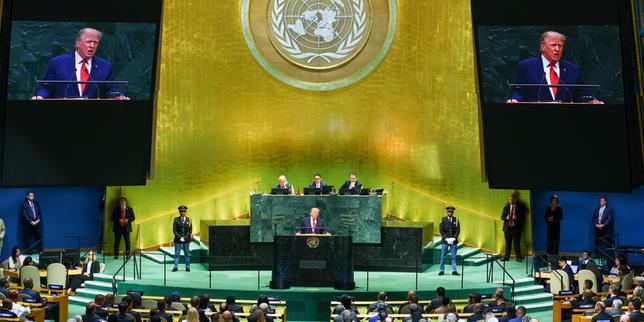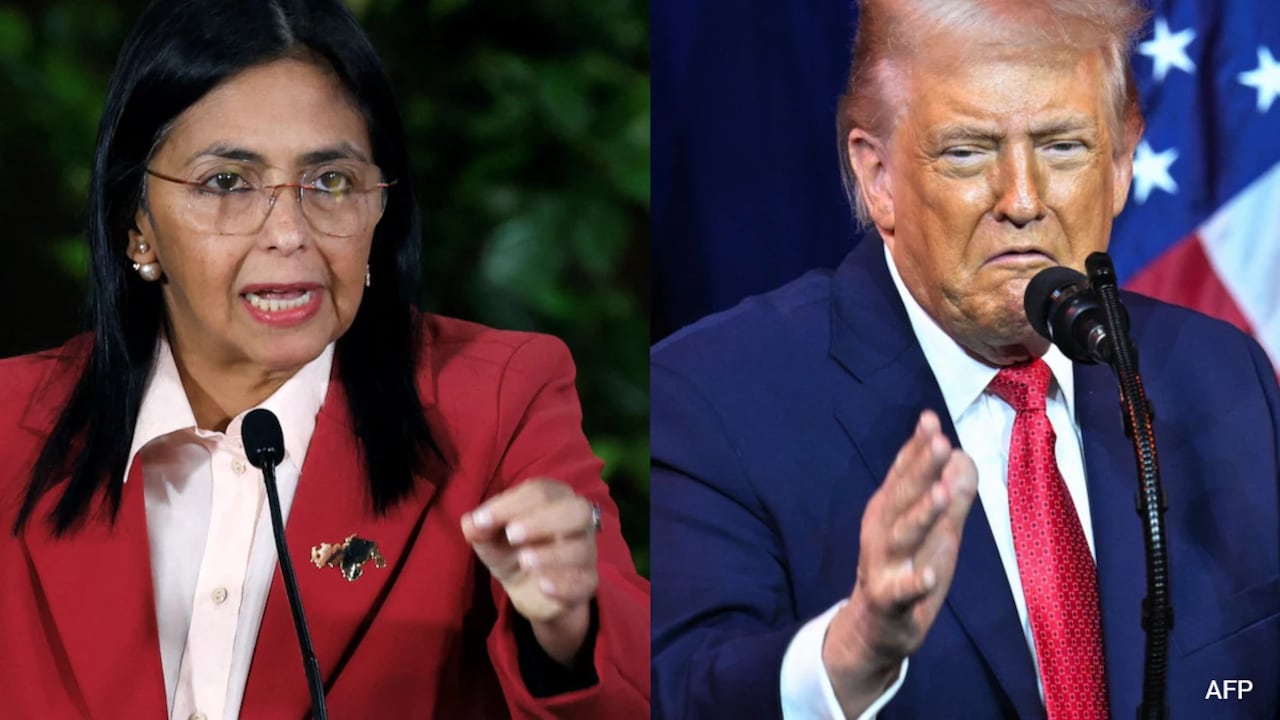
The marble of Turtle Bay does not sweat, but the air above it often feels heavy enough to drown a man.
Inside the United Nations headquarters, quiet is rarely peace. Usually, it is simply the sound of many nations holding their breath at once. On a crisp autumn afternoon, beneath the vast, silent gaze of the General Assembly hall, that collective lungful finally rushed out. It was a sound that didn't rattle windows so much as it realigned the architecture of international power.
Donald Trump sat across a low table from a man whose very presence in that room would have seemed like fiction just a year ago.
This was not a summit of old alliances or carefully choreographed handshakes between leaders whose countries had traded ambassadors for decades. This was something stranger, sharper, and entirely unprecedented. It was the first time an American president sat face-to-face with Venezuela’s interim leader since the dramatic capture of Nicolás Maduro.
To understand the weight of that leather armchair, you have to look past the velvet ropes and the thicket of black boom microphones. You have to look back at the grease-stained asphalt of Caracas streets, at the long lines stretching outside shuttered bakeries, and at the millions of people who had packed suitcases with cardboard and prayer.
Imagine standing on a balcony in Altamira on a Tuesday morning when the electricity dies for the fourth time that week. The hum of the city—that relentless, metallic growl of survival—stops. In that silence, you realize that governments do not fall because of treaties or polite communiqués typed on heavy bond paper. They fall because the invisible threads holding ordinary lives together finally snap.
When Maduro was pulled from his stronghold, the world gasped. Commentators on cable news reached for nautical metaphors about tides and storms, as if history were merely weather. But on the ground, the transition was not a wave; it was a jagged cliff.
The man sitting across from Trump in New York carried the dust of that cliff on his shoulders.
Diplomacy is often described as an art of measured words, but at its core, it is an exercise in desperate geometry. How do you draw a straight line between a fractured nation with empty oil refineries and an American administration eager to prove that old doctrines of hemispheric security still possess teeth?
The photographers lowered their cameras in unison, the rapid-fire clack-clack-clack of shutters pausing for three long seconds. In that quiet, you could hear the faint hum of translation headsets.
"We have a lot to discuss," the American president remarked, his voice flat, devoid of the theatrical bombastic roar that usually filled rally stages. Here, in the belly of the diplomatic beast, the stakes were too raw for performance.
The interim leader nodded. His expression was a study in profound exhaustion. He represented a country that had spent years bleeding its youth into the Caribbean diaspora, a nation sitting atop the largest petroleum reserves on earth while its children drank water from polluted municipal runoffs. He was not just a politician now; he was the curator of a ghost ship trying to steer toward a harbor he had only ever seen in old photographs.
Consider the paradox of modern regime change. For decades, foreign policy experts in Washington and Brussels debated intervention through the sterile lenses of game theory. They drew concentric circles on whiteboards, calculating sanctions like moves on a chessboard. But pawns have pulses.
When sanctions bite, they do not starve dictators in their mahogany-paneled dining rooms; they starve the grandmother trying to buy insulin in Catia. When a regime collapses, the vacuum does not fill itself with liberty; it fills with fear, ambition, and the frantic scramble for control of the valves that pump black gold from the earth.
This meeting at the UN was the moment those abstract whiteboards met the unforgiving geometry of reality.
Behind closed doors, the conversation moved past the public pleasantries. They spoke of barrels per day. They spoke of the rusted tankers anchored off the coast of Maracaibo, rotting like giant iron skeletons in the salt spray. They spoke of the billions of dollars frozen in foreign bank accounts—money that belonged to the Venezuelan people, trapped behind bureaucratic brick walls built by lawyers who had never smelled petrol in their lives.
To the outside observer, it looked like a victory lap for Washington. But if you watched the posture of the men in that room, triumph was entirely absent. There was only the heavy, grinding responsibility of what comes after the fireworks fade.
It is easy to cheer when a strongman falls. It is infinitely harder to sweep up the broken glass of a ruined economy and convince foreign investors that the door is finally unlocked, safe, and stable.
The interim leader laid out his ledger. It was a ledger written in the currency of human survival. Schools needing roofs. Hospitals lacking gauze. Police forces requiring vetting so deep it would take years, not months.
And the American delegation listened. Not with the benevolent charity of an empire dispensing aid, but with the sharp-eyed pragmatism of a nation that realizes a failed state on its southern doorstep is a permanent bleeding wound.
History is rarely made in grand declarations from podiums. It is made in small, air-conditioned rooms where exhausted men try to glue a broken country back together before the sun comes up again.
When the meeting concluded, the heavy oak doors swung open. The press corps surged forward like a breaking wave, shouting questions that overlapped into a chaotic roar of noise. Microphones thrust like lances. Flashes strobed against the dark wood paneling.
Neither man answered. They didn't need to.
The images beamed across satellite feeds to living rooms in Caracas, Miami, Madrid, and Bogotá. In a humble kitchen in Petare, an elderly woman watched the screen while stirring a pot of thin corn soup. She didn't cheer. She didn't weep. She simply stared at the face of the man claiming to lead her home, searching his eyes for the one thing politics rarely delivers.
Truth.
As the sun dipped below the Manhattan skyline, casting long, bruised shadows across the East River, the United Nations returned to its usual hum of polished marble and whispered translations. But the room where history had just pivoted felt different. It felt smaller. Closer.
The strongman was gone. The transition had begun. And out on the dark waters of the harbor, the tankers waited, their engines idling, engines that would soon roar back to life to feed an anxious world, whether it was ready or not.