Listen.
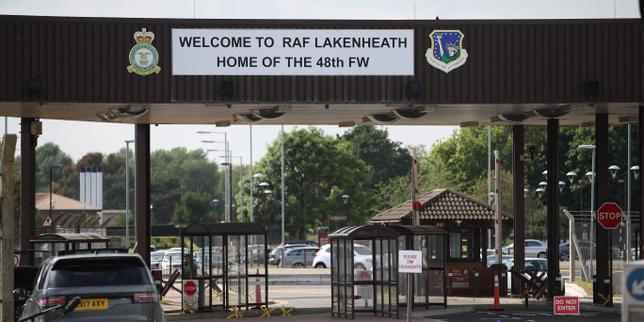
If you stand near the edge of the runway at RAF Lakenheath at two in the morning, the Suffolk air does not smell like war. It smells like wet peat, diesel exhaust, and the faint, metallic tang of cold Norfolk fog rolling in from the North Sea. For decades, that darkness belonged entirely to the men and women who maintained the massive F-15 and F-35 fighter jets parked behind blast walls. You knew what was in the sky because you could feel it in your teeth before you ever saw the navigation lights. The roar of an afterburner rattles the fillings in your jaw; it shakes the tea cups in the nearby village kitchens of Brandon and Mildenhall.
Then came the silence.
Not a peaceful silence. A sharp, electronic hum—barely louder than a swarm of angry wasps—hovering three hundred feet above the perimeter fence where nuclear-capable aircraft sit on alert. When the United States Air Force confirmed that unauthorized small unmanned aerial systems had been spotted over its British bases—Lakenheath, Mildenhall, Feltwell, and Fairford—most headlines treated it like a bureaucratic footnote. A minor airspace violation. A curiosity for aviation buffs.
They missed the point entirely. When a five-hundred-dollar piece of plastic and lithium-ion batteries can drift over one of the most heavily defended airfields in Western Europe without being immediately knocked out of the sky, the rules of gravity have quietly changed.
The Anatomy of an Invisible Intrusion
To understand why a handful of blinking lights over rural England sent specialist U.S. military teams scrambling across the Atlantic, consider a hypothetical night shift on the flight line. Let us call the security forces airman on duty Specialist Vance, though his real counterparts wear the same heavy cold-weather gear and carry the same standard-issue rifles along the frost-bitten asphalt of East Anglia.
Vance is trained to look for threats that make sense. He watches for headlights cutting through the treeline. He listens for the crunch of gravel under boots near the wire. His entire defensive posture—the concrete barriers, the thermal cameras, the multi-million-dollar radar arrays sweeping the horizon for supersonic bombers—is built around mass, speed, and heat.
A small commercial quadcopter has almost none of those things.
To a traditional air defense radar designed to spot a Russian Tu-95 Bear bomber a hundred miles out over the North Sea, a drone the size of a dinner plate looks indistinguishable from a seagull. Or a gust of wind. Or a glitch in the software. By the time Vance hears that faint, high-pitched buzz above the hangar roof, the aircraft is already inside the wire.
What does he do?
This is the question that keeps base commanders awake at night, and the answer is deeply uncomfortable. In peacetime, over sovereign British soil, you cannot simply open fire into the dark with a heavy machine gun. Gravity still works on bullets. Every round fired upward over Suffolk eventually comes down—potentially through the roof of a farmhouse in Hockwold or onto a quiet country road where a nurse is driving home from the night shift. You cannot deploy high-energy lasers or massive electromagnetic pulses without risking the sensitive avionics of the billion-dollar stealth fighters parked fifty yards away, or blinding commercial airliners descending into London Stansted thirty miles south.
So Vance stands there. He watches a red and green strobe light hover motionless against the low clouds. He radios the command post. And somewhere in the dark beyond the perimeter, an operator holding a controller the size of a paperback book watches high-definition video of the base's security response stream directly onto a tablet screen.
Why The Pentagon Sent The Specialists
When the incidents over the U.S. Air Forces in Europe bases persisted across multiple nights in late 2024, the Pentagon did not merely tell the local gate guards to look up more often. They deployed specialized counter-drone teams and electronic warfare assets directly from the United States to the United Kingdom, working alongside British military police and Ministry of Defence personnel.
Why fly specialized troops across an ocean for what looked like a hobbyist prank?
Because the pattern screamed reconnaissance, not recreation. Hobbyists do not coordinate simultaneous, multi-night flights across four separate, geographically dispersed military installations—RAF Lakenheath, RAF Mildenhall, RAF Feltwell, and RAF Fairford—spanning from the flat fens of Suffolk all the way to the rolling hills of Gloucestershire. Fairford, in particular, is no ordinary airfield; it is the forward operating base for America’s heavy strategic bombers, the B-52s and B-2s that form the airborne backbone of nuclear deterrence.
Think of the airspace above a military base like the locks on a bank vault. For seventy years, the West assumed that if you built the vault walls thick enough—if you had the fastest jets, the highest satellites, and the deepest bunkers—nobody could peek inside without triggering every alarm on the continent. Drones are the equivalent of someone sliding a fiber-optic camera under the door while the guards are watching the roof.
I remember the first time I stood near a restricted perimeter during a live security exercise and watched how easily a commercial drone slipped beneath the radar horizon. You feel a sudden, cold drop in your stomach. All that steel, all that concrete, all that sheer industrial might suddenly looks terribly slow. Like a heavyweight boxer trying to swat a mosquito in a dark room.
The Trap of Asymmetric Economics
The true terror of these incursions has nothing to do with explosives. None of the drones spotted over the British bases dropped munitions. They did not need to. Their mere presence was the weapon.
Consider the math of modern airspace defense, a math so lopsided it borders on the absurd. A modified commercial drone—the kind assembled from off-the-shelf components ordered online—costs roughly one to two thousand dollars. To track it, identify it, jam its radio frequencies without disrupting local emergency services, and deploy a specialized reaction force to hunt down the operator in the surrounding woods costs tens of thousands of dollars per hour. If a military ever fires a surface-to-air missile at a target like that, the cost ratio balloons to a thousand to one.
Even worse is the intelligence harvest. You do not need to drop a bomb to map a base. By simply flying near the perimeter and forcing the defenders to react, an adversary watches which lights turn on. They record which radio frequencies suddenly spike with encrypted chatter. They time how many minutes it takes for the quick-reaction force to reach the northern gate, and they map the exact blind spots where the trees block the ground radar.
It is a stress test conducted in live conditions, paid for with pocket change.
And who is holding the controller? That is the part that turns a tactical headache into a geopolitical nightmare. Because small drones leave no exhaust trail, carry no tail numbers, and can be launched from the back of a rented van parked in a lay-by three miles away, attribution becomes a hall of mirrors. Was it a local teenager with too much money and a death wish? An activist group protesting nuclear weapons? Or a state-backed intelligence operative using a cut-out agent to probe NATO’s readiness while Europe sits on a knife-edge?
Until you put handcuffs on the person holding the sticks, every hypothesis looks identical on a radar screen.
The Legal Straitjacket Over Peacetime Skies
If you ask the average citizen why the military doesn't just blast every unauthorized drone out of the sky the second it crosses a fence line, the answer sounds straightforward until you look at the law.
In an active warzone—say, over the trenches of eastern Ukraine or the deserts of Syria—the rules of engagement are brutally simple. If it flies and it isn't yours, you kill it. You flood the electromagnetic spectrum with white noise, you fire kinetic interceptors, and you worry about the debris later.
Peacetime Britain is not a warzone. It is a densely populated, tightly regulated democracy where airspace belongs to civil aviation authorities, radio waves are governed by strict telecommunications laws, and military bases sit right next to civilian towns. At RAF Lakenheath, the runway practically touches the back gardens of local residents. Kids walk to school past the perimeter fence. Farmers drive tractors along the drainage ditches ten feet from the barbed wire.
If U.S. forces unilaterally turn on a high-powered radio-frequency jammer to sever the link between a rogue drone and its pilot, that invisible wave of static does not stop at the base boundary. It washes over the surrounding villages. It can drop mobile phone calls, disrupt ambulance dispatch radios, interfere with cardiac pacemakers, or confuse the GPS navigation of a commercial airliner cruising at thirty thousand feet.
So the defenders are caught in a vise. Act too aggressively, and you endanger the very civilians you are stationed there to protect, while violating the host nation's sovereignty. Act too cautiously, and you allow unknown actors to photograph sensitive flight lines night after night with impunity.
How You Hunt A Shadow
The deployment of specialized U.S. counter-UAS teams to England signals a quiet admission that the old ways of guarding the gate are dead. You cannot solve a twenty-first-century software problem with twentieth-century hardware.
Instead of looking for metal, the new defenders listen for whispers. Modern counter-drone architecture relies on passive radio-frequency sensors that sit silently along the perimeter, sniffing the air for the specific digital handshakes that pass between a controller and an aircraft. Every drone speaks a dialect—a burst of data packets hopping across frequency bands dozens of times a second. By triangulating those invisible signals from three or four points around the base, specialists can sometimes pinpoint not just where the drone is hovering, but where the pilot is standing in the dark.
Think of it less like an anti-aircraft battery and more like a digital bloodhound.
Once the signal is locked, the response shifts from brute force to surgical interference. Rather than blasting the entire sky with noise, newer directional systems fire a narrow beam of tailored code directly at the intruder, tricking its onboard computer into thinking it has lost connection and forcing it to execute an automated landing—or better yet, hijacking the control link entirely and flying the drone gently down into the hands of waiting investigators.
Yet even the best technology runs into human stubbornness. A skilled operator can pre-program a drone to fly completely autonomously using internal inertial navigation, cutting off all radio transmissions so there is no signal left to sniff or jam. It becomes a clockwork toy wound up and released into the dark, flying a pre-drawn path over the hangars before dropping its memory card into a ditch miles away.
The New Front Line Is Three Hundred Feet Up
Walk through the village of Lakenheath today, and life looks remarkably unchanged. The pubs still pour pints at dusk. The massive gray transport planes still lumber down through the clouds into Mildenhall, their landing lights piercing the mist like twin stars. To the untrained eye, the alliance between American air power and British soil looks as solid and permanent as the granite war memorials in the village squares.
Yet something fundamental has shifted in the air above those fields.
For generations, security meant distance. Oceans protected continents; radar networks protected borders; concrete walls protected bases. We built a world where danger was big, loud, and easy to see coming from a long way off. We convinced ourselves that dominance in the high altitude—at fifty thousand feet, where stealth fighters cruise above the weather—meant we owned the sky all the way down to the grass.
We forgot about the space between the treetops and the clouds.
That narrow band of air, once the exclusive domain of starlings and autumn leaves, has become the most contested territory on earth. It requires no runway, no massive industrial base, and no declaration of war to enter. It asks only for a battery charge, a dark night, and the patience to watch how the giants below react when they hear a sound they cannot quite place.
Out on the edge of the Suffolk tarmac, the floodlights still hum against the fog, casting long, sharp shadows across the wet concrete. The jets sit ready beneath their shelters, sleek and lethal, built to cross oceans in hours and strike targets from miles away. And high above them, just beyond the reach of the lights, the dark sky waits—silent, empty, and listening back.


