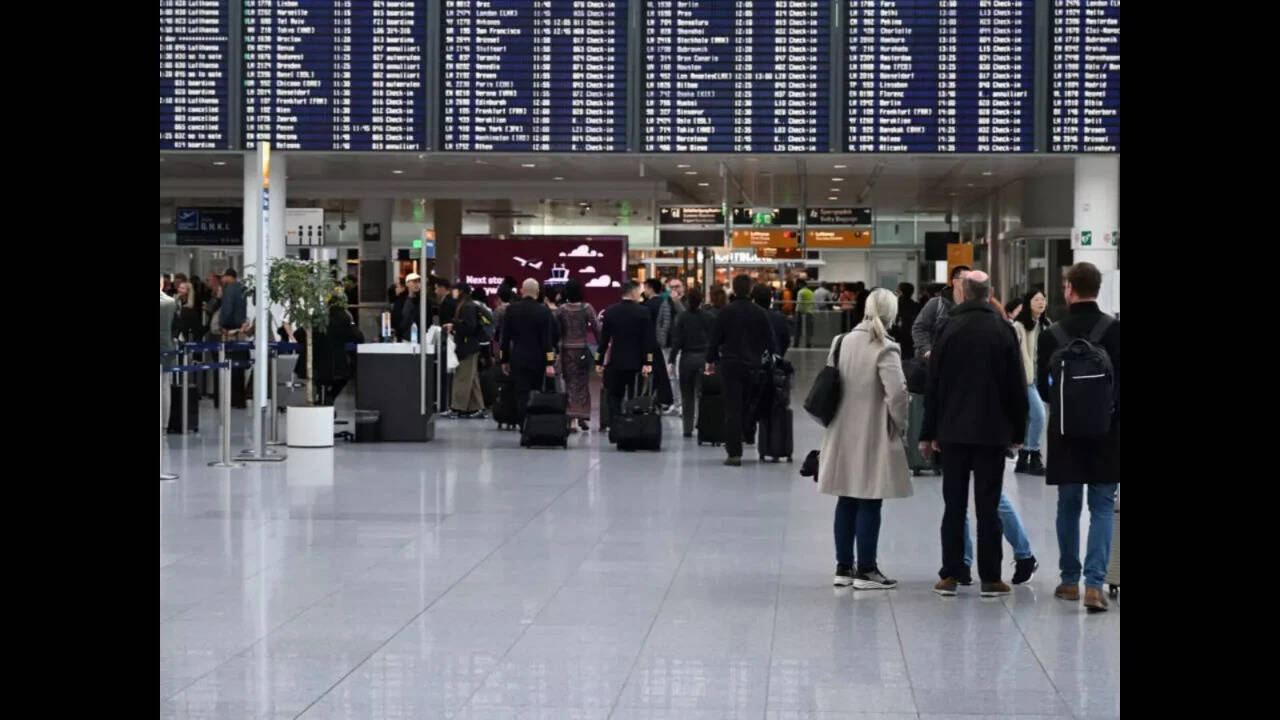
The fluorescent lights of a midnight transit lounge do strange things to the human psyche. They bleach the color from your skin and strip away the normal markers of time. If you have ever sat on a cold metal bench at Frankfurt Airport, clutching a passport like a shield, you know the specific brand of anxiety that builds in the chest.
Your phone battery is hovering at twelve percent. Your neck aches from a six-hour flight from New Delhi. And looming just past the security glass is Germany. Not the Germany of postcards, but the physical country—the soil, the air, the coffee shops just outside the terminal doors. Also making headlines lately: The Anatomy of Maritime Excursion Risk A Brutal Breakdown.
For years, an invisible wall stood between Indian travelers and that outside world. It was a bureaucratic phantom known as the Airport Transit Visa (ATV).
Consider a hypothetical traveler. Let us call her Ananya. She is a twenty-six-year-old software designer flying from Bengaluru to Boston. Her flight has a standard four-hour layover in Munich. She has no intention of leaving the airport. She wants a pretzel, a bottle of water, and a corner where she can stretch her legs before the grueling transatlantic leg. More insights into this topic are detailed by The Points Guy.
Under the old rules, Ananya lived in a state of quiet precarity. If her first flight was delayed by three hours, pushing her boarding window into a razor-thin margin, she could not simply step across the transit line to catch a different connecting flight if it required changing terminals. Doing so would mean technically entering the Schengen territory, even for a fleeting moment. Without that specific piece of paper—the transit visa—she was trapped.
The consequences were rarely measured in grand geopolitical shifts. They were measured in heartbeats. In the panic of an uncle missing a connecting flight to his daughter’s wedding because of a sudden terminal change. In the exhausted tears of a student stuck in a legal no-man's-land because weather diverted their plane to a different German hub.
Then, the rules changed.
The German government quietly clarified a policy that fundamentally alters the geography of international travel for Indian passport holders. The mandate is straightforward: Indian nationals no longer require an airport transit visa for layovers at German airports, provided they remain within the international transit zone and possess valid travel documents for their onward destination.
This is not a minor adjustment in a customs ledger. It is a tectonic shift in how millions of people plan their lives.
To understand why this matters, we have to look at the anatomy of an international airport. Think of a major hub like Frankfurt or Munich as a massive, dual-layered entity. The inner core is the international transit zone. It is a legal archipelago, a series of islands connected to the rest of the world but detached from the country hosting them. The outer ring is the Schengen area, comprising twenty-nine European nations that have abolished internal border controls.
Historically, Germany maintained strict oversight on who could even occupy that inner core. The fear was that travelers would use the transit zone as a stepping stone to slip into the main country illegally. For Indian citizens, this meant that even if you never intended to touch German soil, you had to prove your innocence beforehand. You had to fill out forms, pay fees, visit VFS centers, and wait weeks just for the right to sit in a plastic chair in Frankfurt for three hours.
The burden was psychological as much as financial. It sent a clear message before you even packed a suitcase: You are a risk.
The new reality dismantles that assumption. Now, as long as you hold a valid visa or residence permit for the United States, Canada, the United Kingdom, or a Schengen state, the German transit zone is open territory. The relief is palpable. It changes the entire architecture of a journey.
Imagine the freedom of booking a flight based on price and convenience rather than bureaucratic safety. For decades, Indian travelers scanning flight aggregators would instinctively filter out any itinerary passing through Frankfurt, Munich, or Paris if they lacked the energy to navigate the visa apparatus. They chose longer, more expensive routes through the Middle East or Southeast Asia simply to avoid the stress of European transit laws.
The market has responded instantly. Major airlines are restructuring their ticket pricing, knowing that a massive demographic of global travelers can now flow through European hubs without friction.
But let us look closer at the mechanics of the law, because bureaucracy always hides its traps in the fine print. The removal of the transit visa requirement is a massive victory, but it is not an absolute free pass. It requires a precise understanding of space and time.
The rule applies strictly to the international transit zone.
If you fly from Mumbai to Frankfurt, and your connecting flight is to New York, you stay within the international zone. You do not pass through passport control. Your bags are checked through to the final destination. You are free.
However, consider what happens next if your itinerary changes slightly. If you fly from Delhi to Frankfurt, and your next flight is to Paris, the situation changes entirely. Because Paris is within the Schengen zone, your flight from Frankfurt to Paris is considered a domestic European flight. To board it, you must pass through passport control in Frankfurt. You must legally enter Germany.
For that journey, a regular Schengen tourist visa is still absolutely mandatory. The transit exemption vanishes the moment you try to cross that threshold.
There is also the brutal reality of airport geography. Not all terminals are created equal. In some older airport layouts, moving from Terminal 1 to Terminal 2 requires passing through a non-transit area. If your airline forces a terminal change that breaks the international bubble, you are suddenly in violation of the law without ever meaning to be.
This is where the lived experience of travel becomes essential. Experienced flyers know that checking the terminal layout before clicking "buy" on a discount ticket is no longer a luxury—it is survival.
The shift in German policy reflects a broader, undeniable truth about the modern world: the global Indian traveler is no longer an anomaly to be managed with suspicion. They are the economic engine of international aviation.
In recent years, the explosion of Indian tourism and business travel has forced Western nations to reconsider their twentieth-century border frameworks. When you make it difficult for engineers, doctors, students, and families to pass through your airports, they simply take their capital elsewhere. The easing of German transit restrictions is a pragmatic nod to this shifting balance of power. It is an admission that the old walls are costing more to maintain than they are worth.
For the person on the ground, the macroeconomics fade into the background. What remains is the human scale of the journey.
We return to the transit lounge. The air conditioning hums its low, monotonous song. Somewhere in the distance, a departure announcement echoes in three languages.
A traveler sits with an Indian passport resting on their knee. Five years ago, this moment would have been accompanied by a low-grade, persistent dread. Did the visa officer stamp the right section? Will the border guard at the transfer desk interpret the rules correctly?
Today, that traveler can look out the massive glass windows at the Lufthansa jets lined up on the tarmac, gleaming under the northern European sky. The country outside those windows is still closed without a full visa, but the space inside has grown wider, kinder, and infinitely more respectful.
The clock is still ticking toward boarding time. The coffee is still overpriced. But the invisible weight has lifted, leaving only the clean, uncomplicated anticipation of the open road ahead.


DJI_0636.jpeg?width=1200&auto=webp&trim=83%2C0%2C0%2C0)
