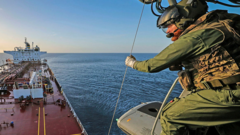
Salt crusts the windshield of the patrol boat, freezing white against the glass as the grey North Sea swells into steep, angry walls. It is four in the morning. Pitch black. The kind of dark where the horizon vanishes entirely, leaving only the rhythmic thrum of the diesel engines and the orange glow of radar screens painting ghost blips across a darkened bridge.
Out here, thousands of miles from the quiet warmth of a kitchen table, international law is not written on parchment. It is enforced in inches.
Imagine standing on that deck, watching a hulking silhouette cut through the freezing murk without lights, without a recorded destination, hauling millions of barrels of sanctioned oil beneath a flag of convenience. This is the shadow fleet. A sprawling, unregulated armada of aging tankers operating in the blind spots of the globe. They slip through the cold corridors of the ocean, dodging sanctions, blinding their transponders, and carrying the financial lifeblood of a war machine across international waters.
When the British government stepped forward to seize one of these drifting giants, it was not merely a routine maritime interception. It was a line drawn in the salt.
The Anatomy of a Phantom
To understand why a seized tanker sparks diplomatic firestorms, you have to look beneath the waterline.
Most people picture international shipping as an orderly dance of containers and transponders, tracked by satellites and guided by rigid port authorities. But the shadow fleet belongs to another era. These are vessels past their prime, often uninsured, carrying names they changed last week and flying flags of tiny nations that barely possess a navy, let alone a regulatory office.
Consider a hypothetical vessel we will call the Petrel. She is a rusted leviathan, built thirty years ago, her steel plates thin with fatigue. A marine biologist watching her pass might worry about the catastrophic spill waiting to happen in fragile coastal ecosystems. An economist watching her route sees billions of dollars bypassing international banking systems, funneled straight into state coffers that fund aggression.
When the UK intercepted a vessel of this exact breed following explicit threats from Moscow, the stakes materialized instantly. It was a high-stakes chess match played with steel hulls and political posturing. The Kremlin warned of consequences. London held its ground.
Why? Because allowing ghost ships to operate with impunity is an invitation to lawlessness on the high seas. If maritime corridors become a free-for-all where sanctions can be outrun simply by turning off a radio, the global economy unravels at the seams.
The Cost of Looking Away
The sea has a long memory, but human beings are remarkably good at ignoring what they cannot see.
For months, these phantom tankers drifted through European waters, hugging maritime boundaries, shifting cargo from ship to ship in the middle of the night like smugglers in an old-school noir film. Ship-to-ship transfers are the oldest trick in the book. Pull two supertankers side by side in international waters, pump the crude across while the sun is down, and suddenly the paper trail evaporates.
The danger is not just financial. It is environmental. An uninsured, poorly maintained tanker colliding with a reef off the coast of Europe would trigger an ecological disaster of historic proportions, and there would be no corporate parent, no legitimate insurance syndicate to foot the cleanup bill. The taxpayers would pay. The wildlife would pay. The coastline would pay.
When authorities finally boarded the vessel, they were stepping into a legal gray zone. The diplomatic threats that followed were predictable. Moscow labeled the move provocative. London countered with the undeniable reality of sanctions enforcement and national security.
The tension crackled through diplomatic channels like static electricity before a summer storm. Threats were issued. Ultimatum lines were drawn. Yet the tanker remained docked, a captive giant surrounded by grey water and armed patrols.
The Ripple Effect
Policy decisions made in parliamentary rooms rarely feel real until you trace them down to the individual.
Think of the coast guard commander staring at the radar screen, knowing that a miscalculation could escalate a regional standoff into an international crisis. Think of the energy traders watching oil prices fluctuate with every intercepted vessel, realizing that the global energy supply chain is far more fragile than anyone cares to admit.
We live in a fragile house built of agreements, treaties, and mutual understandings. When one party decides to turn off their transponder and ignore the rules, the whole structure starts to groan.
The seizure of the shadow fleet tanker was a reminder that borders do not stop at the shoreline. The sea is a highway, but it is also a moat. And defending it requires a quiet, unrelenting kind of courage that rarely makes the history books, yet keeps the lights on thousands of miles away.
The wind howls across the North Sea. The patrol boat cuts another arc through the dark. Somewhere out beyond the spray, another phantom is drifting, waiting to see what happens when the rules finally catch up with the night.