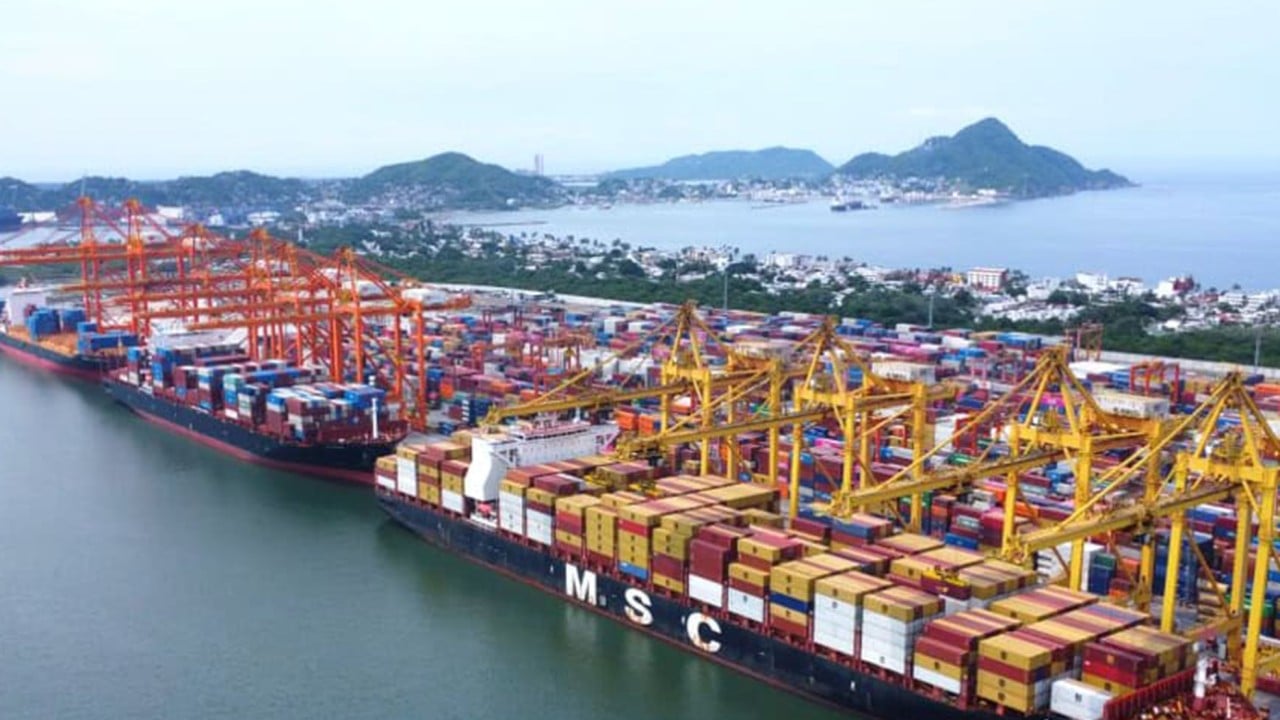
The air at the Port of Manzanillo tastes aggressively of salt and burnt diesel.
Stand on the concrete docks of Mexico’s busiest Pacific port for just an hour, and you will feel the sheer, crushing physical weight of global trade rattling in your teeth. Cranes the size of skyscrapers pivot with terrifying grace. Steel shipping containers, painted in bruised shades of rust and navy, slam onto the beds of waiting trucks.
Boom.
That sound is the heartbeat of a supply chain most of us never think about until a package is late. But lately, that heartbeat has developed an irregular, anxious rhythm. The containers arriving here from across the Pacific are carrying more than just rolled steel, electric vehicle batteries, and cheap electronics. They are carrying a geopolitical crisis.
Washington recently issued a blistering report on international trade, pointing a very sharp, very public finger at Beijing. The accusation? China is aggressively bypassing American tariffs by using Mexico as a convenient, lightly guarded backdoor into the United States market.
Beijing’s response was immediate and predictably icy. They called the American report a "false narrative." A fiction. A protectionist fantasy drummed up by a paranoid superpower.
But the real story isn't found in the sterilized press briefing rooms of Washington or Beijing. It is found right here in the diesel-choked air of Manzanillo, and three hundred miles inland in the sprawling industrial parks of Monterrey. Mexico, suddenly caught in the blinding glare of two colliding empires, is quietly preparing new, severe restrictions on Chinese imports.
The middleman is feeling the squeeze. And the consequences will ripple into the price tag of nearly everything you buy.
The Anatomy of a Backdoor
To understand how a shipping container becomes a weapon, we need a hypothetical scenario to ground the math.
Let us invent a factory manager named Hector. This is a hypothetical scenario, but Hector represents thousands of real operators currently working in the Mexican state of Nuevo León.
Hector runs a mid-sized facility that manufactures specialized aluminum brackets used in commercial refrigeration. Under the United States-Mexico-Canada Agreement (USMCA), Hector can ship his finished brackets across the Texas border with zero tariffs. Free trade. This is the golden promise of North American manufacturing.
But Hector does not mine aluminum. He buys it. Five years ago, he bought it from a domestic supplier. Today, he buys it from a massive conglomerate in Shenzhen, China. Why? Because even with the cost of shipping it across the ocean to Manzanillo, the Chinese aluminum is twenty percent cheaper.
For a long time, this was just smart business. Hector imports cheap raw materials, adds value by turning them into brackets in Monterrey, and exports them tariff-free to Dallas.
Washington no longer sees this as smart business. Washington sees this as a fatal loophole.
From the American perspective, the heavy tariffs slapped on Chinese goods—intended to protect domestic industries and punish unfair trade practices—are being rendered entirely useless. To use an architectural metaphor, the United States built a towering, expensive fortress wall on its western coast to keep Chinese goods out, only to realize the side door bordering Mexico was propped open with a brick.
This practice is known as "transshipment." Sometimes, it involves actual manufacturing and value addition, like our hypothetical Hector. Other times, it is far more brazen. A container of finished Chinese electronics arrives in Mexico, gets stripped of its "Made in China" labels, slapped with "Made in Mexico" stickers in a dark warehouse, and rolled across the border in a truck.
Washington’s recent report meticulously cataloged this surge. Billions of dollars in discrepancies. A sudden, mathematically impossible spike in Mexican industrial output that perfectly mirrors the volume of components leaving Chinese ports.
The numbers do not lie. But the interpretation of those numbers is where the war begins.
The Battle of the Narrative
When a spokesperson in Beijing steps up to a podium and dismisses the United States tariff report as a "false narrative," they are not necessarily denying that Chinese goods are moving through Mexico. They are contesting the moral framework of the accusation.
Consider the Chinese perspective for a moment. For three decades, Western economists preached the gospel of globalization. The rules were simple: find the most efficient, cost-effective way to manufacture and distribute goods. China mastered this game. They built the infrastructure, trained the workforce, and became the undisputed factory of the world.
Then, the political winds in Washington shifted. Tariffs were erected. Sanctions were applied. The rules of the game were violently rewritten.
To Beijing, routing goods through Mexico or Vietnam or Malaysia is not a sinister plot to undermine American sovereignty. It is simply the market finding a way around an artificial barrier. Water flowing around a rock. They view the American outrage as hypocritical—a declining superpower attempting to punish a competitor for winning a game the United States originally invented.
"False narrative" is a calculated phrase. It implies that the United States is intentionally drumming up a boogeyman to justify protectionist policies that violate the spirit of free trade. It is a refusal to accept the label of the villain.
But rhetoric does not clear customs. While the superpowers trade barbs across the Pacific, the actual burden of proof falls onto the shoulders of the country stuck geographically and economically in the middle.
The Golden Goose and the Guillotine
Mexico is currently experiencing a historic economic boom known as "nearshoring."
American corporations, terrified by the supply chain fractures of the pandemic and the escalating tensions with China, are moving their manufacturing closer to home. Monterrey is exploding with new money, new factories, and new jobs. Mexico recently surpassed China to become the number one exporter of goods to the United States.
It is a moment of profound national triumph. But it is incredibly fragile.
Mexico’s entire economic miracle hinges on one single document: the USMCA. The free trade agreement is the golden goose. If Washington decides that Mexico is no longer a trusted partner, but rather a Trojan Horse for Chinese industry, they could slam the border shut. They could impose punishing tariffs on Mexican exports. They could kill the goose.
This is the invisible terror gripping the halls of government in Mexico City.
The United States has made its ultimatum clear, though perhaps not in such crude terms. The message is simple: Clean up your ports, stop the transshipments, and prove you are a North American partner, or lose your privileged access to our markets.
Faced with this existential threat, Mexico is blinking.
Draft proposals and hushed conversations in Mexican trade ministries point to a sweeping new set of curbs targeting Chinese imports. We are talking about severe tariffs on incoming steel, aluminum, and plastics from non-free-trade partners. We are talking about aggressive, forensic customs inspections at ports like Manzanillo and Veracruz.
Mexico is preparing to heavily police its own borders not for drugs or weapons, but for unauthorized zinc and microchips.
Think about our hypothetical factory manager, Hector. If Mexico implements these new curbs, his cheap Chinese aluminum suddenly becomes prohibitively expensive. He will have to find a new supplier. His costs will skyrocket. He will pass those costs on to the American buyer in Dallas. The American buyer will raise the price of the commercial refrigerators they sell to the local grocery store. The grocery store will raise the price of milk to cover the cost of the new refrigeration units.
Everything is connected by invisible, trembling wires. When you pluck the wire in Monterrey, it rings in the dairy aisle in Ohio.
The Illusion of Separation
What we are witnessing is the messy, painful, and ultimately impossible attempt to untangle two economies that spent half a century fusing together.
The United States wants to sever its reliance on China. But modern supply chains are not a neat stack of building blocks that can be easily separated. They are a root system. They have grown deep, twisting into the soil of a dozen different nations. You cannot simply pull up the Chinese roots without ripping apart the Mexican stems and the American leaves.
The new curbs Mexico is planning will undoubtedly appease Washington in the short term. They will generate headlines about "securing the supply chain" and "protecting domestic interests." The tariff reports will look slightly better next quarter.
But it will not stop the water from flowing.
If Mexico becomes too expensive, the transshipment hubs will simply move further south. To Colombia. To Brazil. The routes will become longer, the logistics more complex, the fuel burned across the oceans more vast. The goods will still arrive, but they will arrive carrying the heavy, invisible tax of geopolitical friction.
We are not ending globalization. We are merely forcing it to wear disguises and take the back roads.
Walk away from the ports and drive out to the industrial fringes of Monterrey as the sun dips below the Sierra Madre Oriental mountains. The factories here run through the night. The floodlights bleach the concrete. Inside those corrugated steel walls, workers are boxing up components, printing out shipping manifests, and pressing labels onto cardboard.
Labels.
A piece of paper with sticky backing. That is what the global trade war has been reduced to. A desperate, frantic battle over what is written on a sticker, who gets to print it, and who is willing to believe it.
Somewhere in the Pacific, another ship is burning heavy fuel oil, pushing through the dark water toward the Mexican coast. The hull is filled with steel and plastic and conflict. It will dock. The cranes will scream. The cargo will find its way in.
Always.