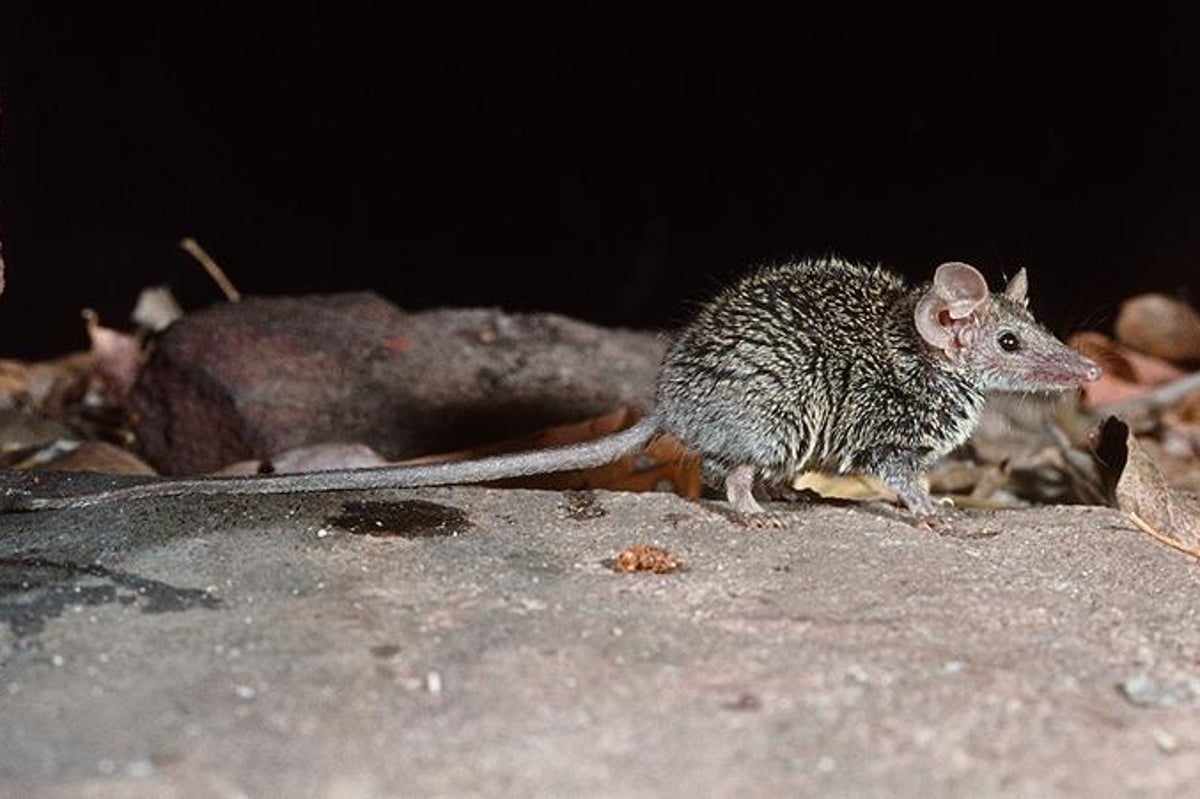
Imagine holding a creature that weighs less than two paper clips, yet possesses the raw, unadulterated ferocity of a lion.
For decades, scientists exploring the sheer sandstone cliffs of Arnhem Land in Australia's Northern Territory suspected something was hiding in the shadows. The local ecosystem was shifting, mammal populations were nose-diving across the continent, and researchers were racing against an invisible clock to catalog what remained.
They were looking for a shadow. What they found instead, locked away inside century-old museum drawers and confirmed by modern genetics, was Planigale petrophila—a creature biologists are calling the world's cutest and fiercest mini-predator.
But the real revelation isn't just that this tiny marsupial exists. It is that we almost lost it before we even knew its name.
The Monster in the Matchbox
To understand the planigale, you have to throw out everything you know about scale. It looks like a mouse designed by an animator aiming for maximum cuteness—vast, ink-black eyes, delicate paws, and a face that could fit comfortably on a thumbnail.
Yet, beneath that soft brown fur beats the heart of an unyielding apex predator.
When darkness falls over the jagged rocks of Kakadu National Park, these tiny titans emerge to hunt. They do not nibble on seeds. They stalk. They ambush. They will confidently tackle centipedes, massive crickets, and predatory spiders twice their size, using a jaw structure engineered to crush chitin and bone. Because their skulls are extraordinarily flat, they can squeeze into microscopic rock crevices, pursuing prey into subterranean labyrinths where larger predators cannot follow.
For a long time, science lumped them together under a single, generic label. It was an easy mistake to make. When two animals look identical under a standard field microscope and share the same coat of dusty brown fur, you assume they are the same.
The breakthrough required stepping away from the field and stepping into the quiet, sterile vaults of museums.
Secrets in the Vaults
Dr. Linette Umbrello and her research team at the Queensland University of Technology didn't discover Planigale petrophila by trekking into a remote cave with flashlights. They discovered it by examining more than 2,000 museum specimens, some of which had been preserved in jars of alcohol for over a century, including samples sitting quietly in a Swedish museum.
By utilizing advanced genetic sequencing, the team began comparing the DNA of these long-dead specimens with modern tissue samples. The results shattered the existing taxonomy. What scientists thought was a single widespread species, Planigale ingrami, was actually a complex web of distinct evolutionary lines.
They resurrected an old name, Planigale subtilissima, for the ultra-thin variants dwelling in the Kimberley. But the true shock came when looking at the samples from the rugged, rocky slopes of western Arnhem Land. The genetics screamed that this was something entirely new.
It was larger than its cousins, boasting a significantly longer tail and distinct skull proportions optimized for a life spent clinging to vertical sandstone faces. They named it P. petrophila—the rock-loving planigale.
The Ghostly Reality
But celebration in the scientific community has quickly turned to anxiety.
Consider a chilling statistic: Planigale petrophila is currently known from exactly three specimens. All three were found within a tiny, twelve-kilometer radius on the sandstone plateau of Kakadu.
Worse still, not a single living individual has been seen or caught since 2004.
This isn't just a quirk of biology; it is a crisis of tracking. Conventional metal box traps used by wildlife surveyors are virtually useless for an animal this light. A planigale can walk right over the trip mechanism of a standard trap without triggering it. To catch one, scientists have to dig deep "pitfall" traps—buried plastic buckets—and pray the tiny creatures tumble in during their nightly hunts.
Associate Professor Andrew Baker has raised the alarm, noting that northern Australia is currently experiencing a catastrophic, silent decline in native mammal populations. When a species is restricted to a tiny geographic pocket and hasn't been verified in over two decades, the line between "newly discovered" and "already extinct" becomes terrifyingly thin.
Taxonomy—the boring science of naming and sorting things—suddenly becomes the thin line defending a species from oblivion. Without an official name and a documented genetic profile, an endangered animal cannot receive government funding, habitat protection, or a dedicated conservation assessment. You cannot save a ghost if you refuse to admit it haunts the room.
The discovery of Planigale petrophila is a stark reminder of the mysteries still breathing in the remote corners of our world. It challenges the assumption that everything of consequence has already been mapped, tagged, and understood. As teams prepare to return to the sun-baked sandstone of Kakadu to find a living survivor, the tiny predator remains out there, a fierce and fragile remnant of a wild world running out of time.