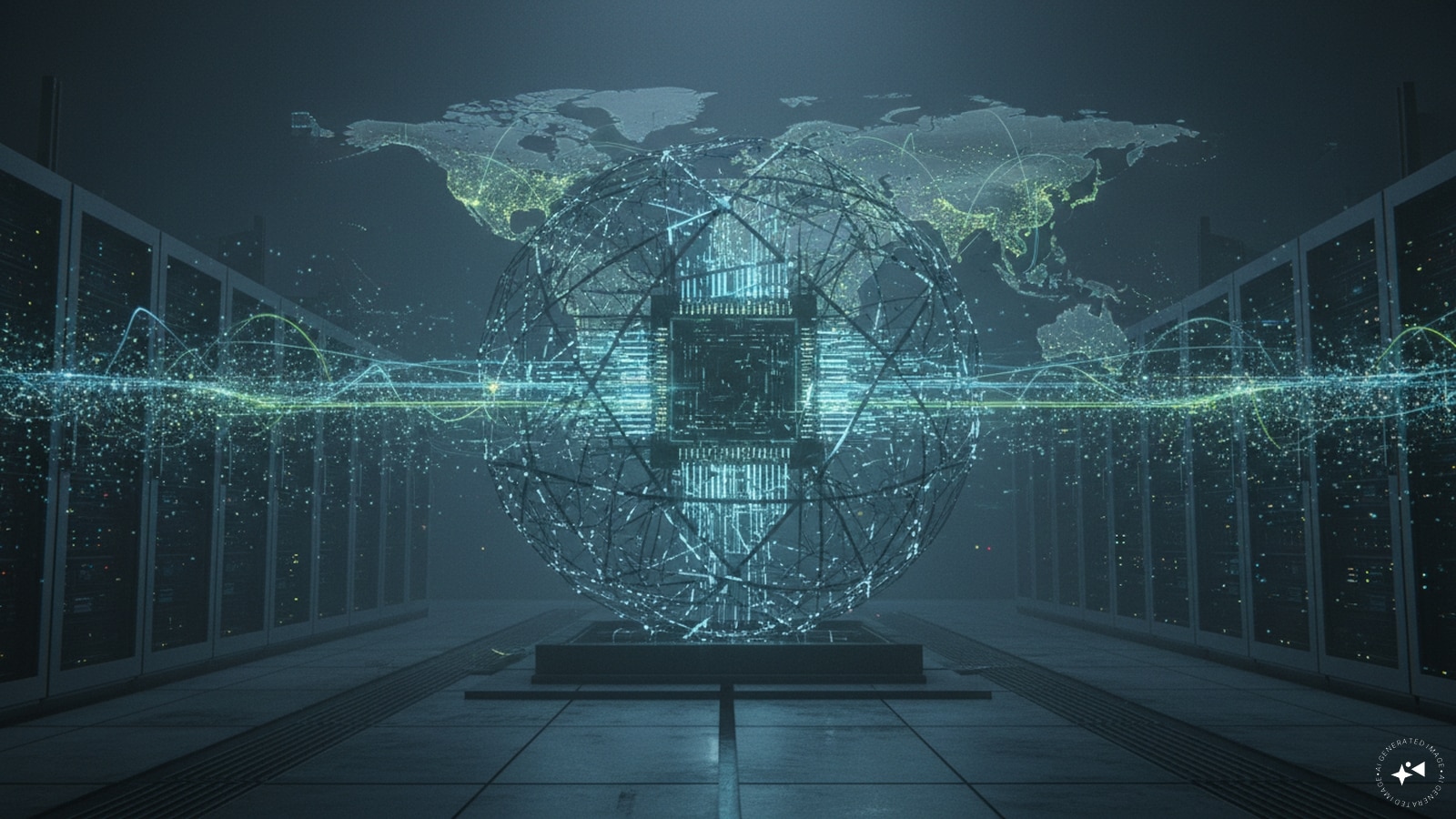
The desk lamp in a basement three time zones away flickered, casting long, fractured shadows across a keyboard worn smooth by years of midnight typing. Outside, the night was quiet. Inside, a dissident was drafting an essay that would take thirty minutes to write, ten minutes to edit, and perhaps a lifetime to explain to a security tribunal.
She did not know that the pen she was using had begun to watch her. Don't forget to check out our earlier coverage on this related article.
We tend to think of artificial intelligence as a mirror of human aspiration—a clever engine designed to summarize emails, write mediocre poetry, or generate sleek marketing copy. We treat it like an assistant sitting quietly in the corner of a virtual office, waiting for our commands. But every tool is a weapon waiting for an angle. When advanced language models transition from the laboratory bench to the arsenals of statecraft, the boundary between productivity and surveillance blurs until it vanishes entirely.
Recent revelations involving state-linked actors utilizing high-performance platforms like Anthropic’s Claude offer a chilling window into this transformation. These were not hackers breaking down digital steel doors with brute-force scripts. They were operatives sitting at standard terminals, using conversational prompts to organize surveillance, translate intercepted documents, map dissident networks, and draft psychological influence campaigns. If you want more about the background of this, CNET provides an in-depth breakdown.
The machine did not know it was hunting. It only knew how to follow instructions. And therein lies the quiet terror of our current technological epoch.
To understand how a tool built to foster human creativity became a ledger for state control, we have to look past the flashing lights of cybersecurity dashboards and into the daily reality of intelligence work. Intelligence gathering has never been a shortage of data; it has always been an excess of noise.
Imagine a room filled with millions of intercepted text messages, rough transcripts of phone calls, smuggled manifestos, and grainy photographs of street corners. For decades, making sense of that morass required an army of analysts—human beings who grew tired, made mistakes, missed subtle linguistic cues, and occasionally leaked secrets because they possessed a conscience.
Now, imagine replacing that fragile human army with an intelligence that never sleeps, never blinks, and feels no moral vertigo when asked to categorize the family ties of a religious minority.
When state-linked actors from regions like China turn their attention toward domestic critics, overseas exiles, or persecuted groups, their primary obstacle is scale. How do you monitor millions of people without drowning in the sheer volume of information? You don't. You outsource the cognitive load to an artificial mind.
According to investigative findings and industry disclosures, threat actors have leveraged frontier AI models to streamline target identification, translate minority-language documents into actionable intelligence reports, and structure massive databases of opposition movements. They ask the model to find inconsistencies in a target's public statements. They ask it to synthesize disparate threads of digital chatter into a coherent profile of an activist's daily habits.
The prompts are mundane. The output is devastating.
Consider the human cost of this efficiency. For a dissident living in exile, safety used to be a function of obscurity. If you lived quietly enough, spoke softly enough, and changed your phone numbers often enough, the vast bureaucratic machinery of a superpower might lose your trail in the static.
Obscurity is dead.
When an algorithm can cross-reference social media handles with travel manifests, financial records, and stylistic writing markers—a technique known as stylometry—the concept of anonymity becomes an illusion. The AI does not need to hack a secure server. It simply reads the breadcrumbs that dissidents, journalists, and religious practitioners leave behind in their daily digital lives, knitting them together into a shroud.
This brings us to a deeply uncomfortable truth about the tools we build. Innovation is morally neutral, but deployment is not. Every breakthrough in natural language processing, every leap in contextual understanding, every reduction in latency lowers the cost of repression.
When AI companies build models with robust safety guardrails, they are usually thinking about malicious actors writing phishing emails, generating malware, or producing dangerous chemical instructions. They build walls to keep out the script kiddies and the cybercriminals. But state-backed intelligence agencies do not use tools like clumsy vandals. They use them like master locksmiths. They find the tolerances in the system, craft prompts that bypass restricted keywords through indirection, and treat the AI not as an oracle of truth, but as a tireless, compliant clerk.
How do you stop a clerk that works for a government?
The tech companies themselves find trapped in a tightening vise. Anthropic, OpenAI, Microsoft, and Google build systems that are inherently dual-use. A prompt that helps a researcher translate a historical text can also help an operative translate a confiscated diary. A capability that allows an engineer to debug code can also allow a cyber warfare unit to optimize an intrusion script.
When these companies discovered that their models were being probed and prodded by state-linked entities—specifically groups tracked under names like Cotton Sandstorm or various APT designations—the response was swift. Accounts were terminated. Access was revoked. Digital gates were slammed shut.
Yet anyone who believes a ban solves the problem misunderstands the nature of modern power.
State actors do not rely solely on commercial APIs accessed via web browsers. They download open-source models, fine-tune them on private servers, and run them away from the prying eyes of Silicon Valley compliance teams. As open-weights models become more powerful, the ability of any single corporation to police how its technology is used evaporates. The genie is not just out of the bottle; it has been copied a million times and distributed to every basement laboratory on earth.
We are standing at a strange crossroads where the democratization of intelligence tools means the democratization of surveillance. The same capability that allows a small startup to compete with a Fortune 500 company also allows an authoritarian bureaucracy to track a religious minority with unprecedented precision.
We must confront the reality of what we have created. We did not build a digital utopian assistant. We built a mirror that reflects both our highest ambitions and our darkest impulses.
When the dissident in our story finishes her essay and hits send, she is throwing a pebble into an ocean of algorithms. She does not know if the ripple will reach a terminal in Beijing, where a language model is quietly parsing her syntax, weighing her risks, and assigning her a priority score. She only knows she has something worth saying.
The lights in the basement do not flicker again. The screen stays bright. And somewhere in the dark corridors of the digital world, the code keeps running, processing the input, waiting for the next prompt.