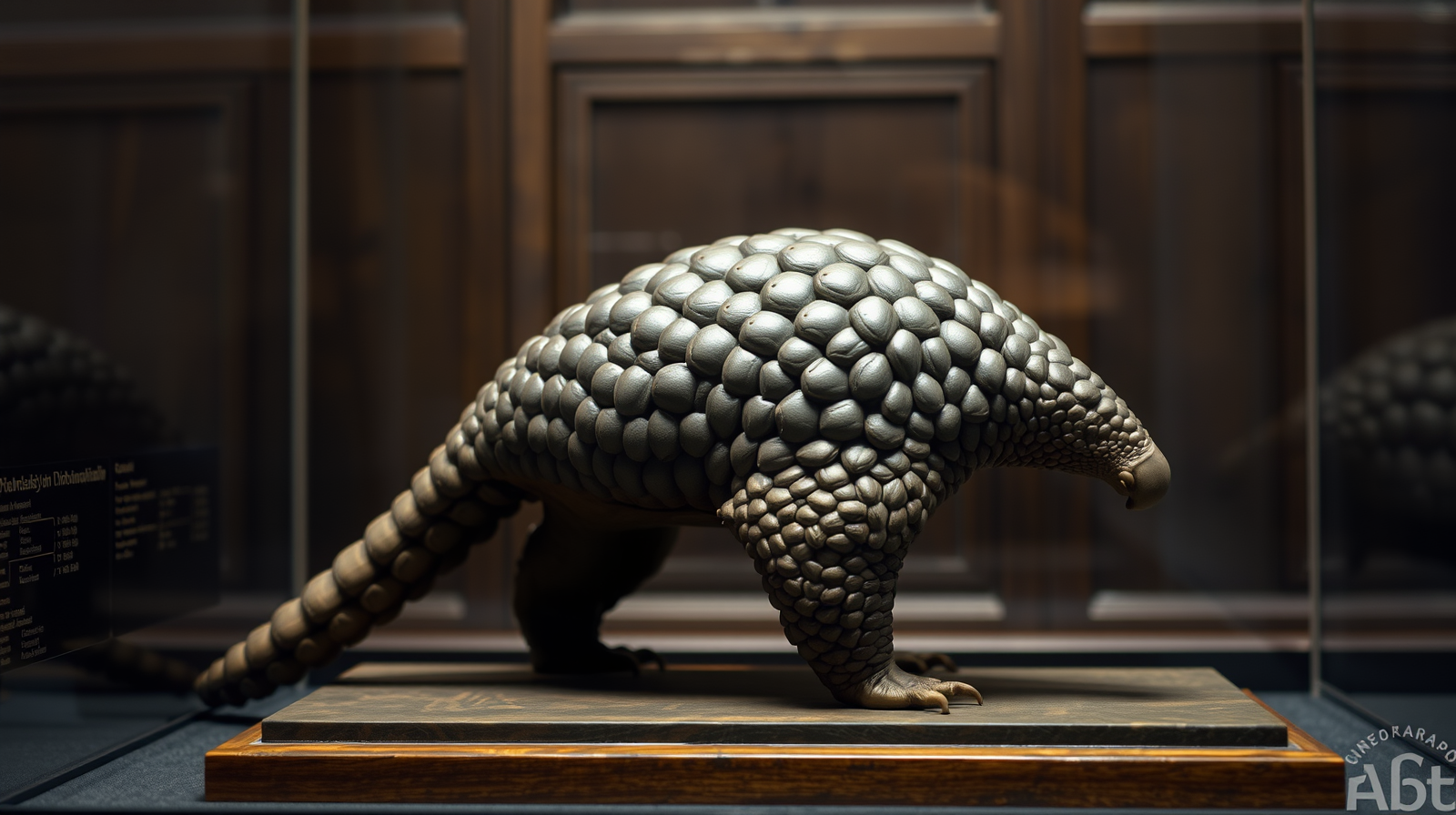
Dust does not merely settle; it waits. In the quiet, climate-controlled belly of a nineteenth-century museum, drawers slide open with a heavy, oiled sigh. Inside one such drawer, resting on yellowed cotton wool that had turned brittle with age, lay a creature collected in 1836. For nearly two centuries, it was a ghost. A specimen pinned by history, cataloged with a neat, fading ink label, and quietly forgotten.
It looked like any other scaly anteater. Its keratin scales overlapped like roof shingles, its snout was long and tapered, and its posture was frozen in an eternal, stiff curl. Generations of curators walked past the cabinet. Scholars peered through glass cases at grander exhibits—towering dinosaurs, brilliant tropical birds—while this quiet anomaly rested in the dark.
Nobody knew it was holding a secret. Nobody knew it was an entirely different kind of life.
Consider what happens when time freezes. To the naked eye, a specimen in a museum is a dead end. The animal lived, it died, it was stuffed, it was boxed. Case closed. Science had mapped the world, or so nineteenth-century naturalists believed. They gave things names, drew sketches by candlelight, and filed them away in heavy wooden furniture. They thought they had captured the inventory of the planet.
They were wrong.
Decades bled into centuries. Wars tore across continents. Governments rose and fell. Dust accumulated on the upper ledges of the archive room, and still, the creature waited. It waited through the birth of aviation, the atomic age, and the digital revolution. It sat in silence while entire ecosystems outside the museum walls were quietly dismantled by human hands.
Then came the enzymes.
Science changed its lens. We stopped looking only at the shape of a jawbone or the count of a scale. We learned to listen to the whispers locked inside dead cells.
When researchers finally extracted DNA from the 1836 specimen, they weren't expecting a revelation. They were routine-checking genetic markers, cross-referencing museum archives with modern wildlife data to map the known diversity of pangolins. Scales can look identical. Bones can play tricks on the human eye. Evolution often carves two entirely different animals from the exact same functional blueprint, a phenomenon known as convergent evolution.
The computer screen flickered. The data loaded.
The base pairs did not match the species living in the forests today. They did not match any known record. The creature resting in the drawer—collected during an era when Queen Victoria had just ascended the throne—belonged to a completely undocumented lineage.
Silence. Then, the realization.
This animal was not just an old artifact. It was a witness from a ghost population. Somewhere in the world, deep within dense canopies or hidden by the cloak of nocturnal habits, a lineage had existed—or perhaps still exists—completely unknown to modern conservationists.
We tend to think of discovery as an act of forward motion. We imagine explorers hacking through vines with machetes, shouting eureka as they stumble upon a hidden waterfall or a strange new monkey. We picture rocket ships piercing the upper atmosphere, or deep-sea submersibles sweeping their searchlights across abyssal plains.
We forget that discovery can happen backward.
Sometimes, the frontier isn't a thousand miles away. Sometimes, it is sitting in a cardboard box under a shelf, waiting for someone clever enough to ask a better question.
The implications hit with a quiet, devastating weight. Pangolins are currently the most trafficked mammals on Earth. They are hunted relentlessly for their scales, which are used in traditional medicines, and for their meat. Conservationists are locked in a desperate, frantic race against time to protect them. We are trying to save species we barely understand, mapping populations that are blinking out of existence before we can even write their names down.
And here, tucked away in nineteenth-century storage, was proof that our ignorance is even vaster than we feared. If a distinct species of pangolin could sit unnoticed in a European museum for nearly two hundred years, what else are we missing? What other ghosts are hiding in plain sight, waiting for a genetic sequence to bring them back into the light?
The drawer closes. The heavy wood slides back into its groove, cushioned by rubber stops. The room is dark again.
Outside, the modern world roars past with its traffic, its glowing screens, and its relentless expansion. Ecosystems fragment. Rivers run warm. Somewhere out there, in the damp twilight of a shrinking forest, a creature walks on heavy claws, its scales catching the moonlight. It is trying to survive in a world that is running out of room.
It does not know it has a twin in a museum drawer across the ocean. It does not know that science has finally learned how to read its language.
The past is never finished. It is only waiting to be translated.