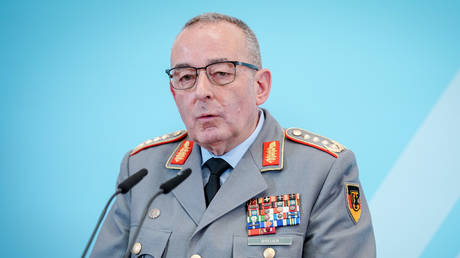
The internal balance of power within Western defense is shifting. General Carsten Breuer, Germany’s highest-ranking soldier and current Inspector General of the Bundeswehr, has been elected to chair the NATO Military Committee.
He will step into the alliance's top military advisory role in summer 2027, succeeding Italian Admiral Giuseppe Cavo Dragone. For Berlin, this appointment marks a profound psychological and strategic milestone. A country that spent decades cautious about projecting military leadership on the international stage is now taking the operational steering wheel of the world's most powerful alliance.
If you look past the formal diplomatic statements coming out of Copenhagen, this transition signals a fundamental restructuring of European security priorities.
The Man Behind the Uniform
Who is Carsten Breuer, and why did NATO choose him over other prominent candidates, including Canada's Chief of the General Staff, Jennie Carignan?
Breuer isn't a conventional desk general. He earned a reputation inside Germany for crisis management long before he took over the Bundeswehr. Back during the height of the COVID-19 pandemic, former Chancellor Olaf Scholz tapped Breuer to lead the national coronavirus crisis team. He handled logistics, inter-agency friction, and public communication with clinical precision.
More importantly, Breuer has been brutally honest about contemporary threats. He has publicly warned that Russia could rebuild its forces enough to launch an attack against a NATO nation within a five-to-eight-year window. While other military officials wrap their warnings in diplomatic cushioning, Breuer talks about readiness timelines in stark, immediate terms. That blunt operational realism won over allied chiefs of staff who are anxious to move past bureaucratic delays.
What the Chair of the NATO Military Committee Actually Does
The title sounds administrative, but the position carries massive weight. The Military Committee is NATO's highest military authority. The officer holding this post acts as the primary bridge between the alliance's political leadership—headed by Secretary General Mark Rutte—and the operational commanders.
When NATO needs to deploy troops, adjust deterrence postures along the eastern flank, or coordinate complex multinational equipment standards, this is the general who shapes the consensus.
With the United States increasingly shifting its strategic focus and military resources toward the Indo-Pacific to deter China, European members must shoulder a much heavier burden of their own collective defense. Having a German general at the helm of military planning means Berlin will have a direct hand in orchestrating how European armies organize, supply, and deploy their forces in an era of diminished American bandwidth.
The Domestic Ripple Effect in Berlin
You can't talk about Breuer's promotion without looking at who replaces him at home. Defense Minister Boris Pistorius named Lieutenant General Christian Freuding—the current army chief and former coordinator of military aid to Ukraine—to step in as the next Inspector General.
This swap tells you everything you need to know about Germany's trajectory. Freuding is a modernizer who understands modern drone warfare, procurement bottlenecks, and the gritty realities of supporting an active frontline defense.
Germany is frantically trying to transform the Bundeswehr from a chronically underfunded peacekeeping force into a war-fighting deterrent. Putting leaders like Breuer and Freuding at the center of both NATO and German military command ensures that the "Zeitenwende"—Berlin's historic defense policy pivot—isn't just political rhetoric. It's an operational reality.
The Road Ahead for Western Security
The alliance is entering its most volatile era since the Cold War. Supply chains are strained, defense manufacturing is struggling to keep pace with ammunition consumption rates, and political cohesion is constantly tested.
Breuer takes over a military apparatus that must modernize faster than ever before. His background in logistics and crisis response will be tested on a global scale. If Europe wants to secure its borders independently while maintaining transatlantic unity, the execution of military strategy over the next few years will dictate the outcome.
Germany's highest-ranking general elected as Chair of NATO's Military Committee | DW News
This video provides an in-depth look at General Carsten Breuer's background, his election in Copenhagen, and what his upcoming leadership means for NATO's evolving defense strategy.