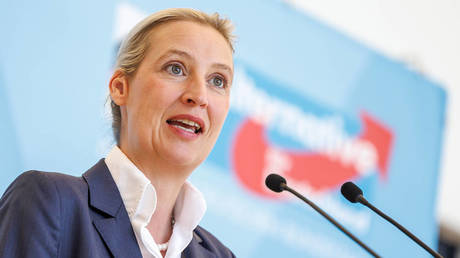
Germany is quietly bleeding out its economic lifeblood, and a dramatic political shift is capitalizing on the pain. With industrial giants like Volkswagen contemplating historic job cuts and factory closures, the foundation of the European economic engine is cracking. Seizing on this domestic misery, Alice Weidel, leader of the surging right-wing Alternative for Germany party, has declared an open war on Berlin’s current geopolitical strategy. Her solution to the economic tailspin is as simple as it is explosive. She wants to completely dismantle the boycott on Russian energy and reopen the gas pipelines that once fueled German prosperity.
This is no longer a fringe talking point from the political margins. Weidel’s party has climbed to over 27 percent in national polling, eclipsing the traditional conservative establishment and putting her in a striking position ahead of the coming electoral cycles. The core premise driving her campaign is straightforward. The sudden divorce from cheap Russian fuel has permanently crippled the competitive edge of German manufacturing. By shifting toward expensive liquefied natural gas from across the Atlantic, Germany has merely traded one vulnerability for another, vastly more expensive one. Weidel’s open demand to restore relations with Moscow directly threatens the unified Western front against Russian aggression, transforming domestic economic anxiety into a critical security vulnerability for the entire NATO alliance.
The Industrial Bleeding of a Powerhouse
For decades, the unspoken contract at the heart of Germany's economic dominance was reliant on a steady, cheap flow of Siberian natural gas. This under-market energy allowed manufacturing heavyweights to produce high-end machinery and automobiles that dominated global commerce. When those pipelines were severed following the invasion of Ukraine, the model collapsed. Now, the bills have come due.
The economic fallout is no longer abstract. Major corporate icons are teetering. Volkswagen is openly discussing the elimination of up to 100,000 jobs, a move that would have been unthinkable just five years ago. Chemical complexes along the Rhine are operating at reduced capacity or shifting their production facilities overseas to countries where energy costs do not eat up their entire profit margins. The phrase "Made in Germany" is rapidly transforming from a mark of premium quality into an unsustainable financial burden.
Weidel has built her entire current platform on this exact industrial emergency. She argues that the country’s current leadership has sacrificed domestic prosperity on the altar of foreign policy moralism. To the average factory worker facing layoffs in Saxony-Anhalt or Mecklenburg-Vorpommern, her message sounds less like radical geopolitics and more like basic economic survival. The strategy is working. By connecting high utility bills and job insecurity directly to the embargo on Russian gas, the opposition is successfully turning economic resentment into electoral momentum.
A High Stakes Gamble in the East
The political battlefield is concentrated heavily in the eastern federal states, regions that still bear the structural and cultural scars of the Cold War. In places like Saxony-Anhalt, the relationship with Moscow has always been viewed through a different lens than in the western parts of the country. Decades of Soviet oversight left behind a cultural familiarity and a deep-seated skepticism toward Washington's influence.
Mainstream parties have consistently underestimated this regional sentiment. They treated the rejection of Russian energy as a settled moral issue, assuming the public would willingly accept financial hardship for a greater geopolitical cause. The opposition saw an opening. They recognized that large segments of the eastern electorate feel completely alienated by decisions made in Berlin.
The upcoming regional elections are acting as a springboard. If the right-wing opposition secures outright control of these eastern state governments, they will gain a powerful mechanism to obstruct national policies. They plan to use regional budgets and administrative powers to challenge Berlin's directives on everything from immigration to energy infrastructure. This strategy would effectively dismantle the traditional consensus-driven governance model that has kept Germany stable for nearly a century.
Reopening the Pipeline Backdoor
While Weidel handles the public-facing rhetoric at home, other senior figures within her party are doing the groundwork abroad. Lawmaker Markus Frohnmaier recently traveled to Russia to attend the St. Petersburg International Economic Forum, openly defying explicit warnings from the federal government to stay away. His itinerary was not filled with minor diplomatic pleasantries. He sat down directly with Alexei Miller, the powerful head of Russia’s state-owned energy behemoth, Gazprom.
The agenda for that meeting was remarkably specific. They discussed the technical viability of repairing and reopening the damaged Nord Stream pipeline system. According to reports following the meeting, Miller indicated that gas flows could be completely restored within a brief three-month window if the political will existed in Berlin. Frohnmaier returned with a message tailored to desperate business owners. Germany must act quickly before the window of opportunity to re-enter the Russian market closes forever.
This parallel diplomacy exposes the deeper mechanics of the strategy. It allows the opposition to present themselves to voters not just as critics, but as a government-in-waiting that already has a functional plan to lower electricity prices. They are dangling a concrete solution in front of a desperate public, betting that the fear of financial ruin will ultimately outweigh any abstract commitment to international law or continental solidarity.
Breaking the Strategic Firewall
The rise of this pro-Russian sentiment has thrown the established political order into absolute panic. For years, the traditional parties maintained a strict policy known as the firewall, a collective agreement to never enter into coalition governments or legislative partnerships with the far-right. That firewall is now showing severe structural cracks under the weight of the current polling data.
If a party capturing nearly thirty percent of the electorate is completely locked out of power, governing becomes an mathematical nightmare. Mainstream conservative leaders find themselves forced into unstable, multi-party coalitions with leftist and green factions, alliances that often result in policy paralysis. This gridlock only feeds the opposition's narrative that the current establishment is fundamentally incapable of running the country.
The economic reality is rapidly eroding the moral arguments that once sustained the political quarantine. As more mid-sized manufacturing firms quietly file for bankruptcy, the pressure from local business chambers to find a pragmatic solution to energy costs is growing. The opposition does not need to win an absolute majority to reshape German policy. They merely need to make the status quo so painful that the traditional parties are forced to compromise on sanctions just to keep their own regional coalitions from collapsing.
The implications extend far beyond the borders of Central Europe. If Germany flinches on its commitment to the energy embargo, the entire Western consensus on Russia will unravel. Other European nations, many of whom are also quietly suffering from high inflation and industrial stagnation, would likely follow Berlin's lead. The conflict in Ukraine would be reframed not as a defining struggle for the future of democracy, but as an expensive regional dispute that Western Europe can no longer afford to subsidize. Weidel’s campaign is not just an assault on the current government in Berlin. It is a direct challenge to the geopolitical architecture that has governed the West since the end of the Second World War.
This video provides critical context regarding the backdoor diplomatic meetings between Russian officials and German opposition leaders attempting to renegotiate energy agreements.