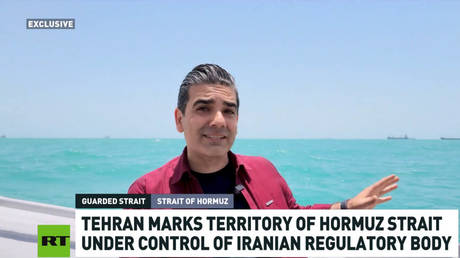
The Strait of Hormuz represents the most significant single point of failure in the global energy supply chain. While media narratives often focus on the visual "gridlock" of tankers or the presence of naval patrols, these are symptoms of a deeper structural vulnerability. The strait is not merely a shipping lane; it is a high-pressure hydraulic valve for the global economy. Approximately 21 million barrels of oil pass through this 21-mile-wide passage daily, representing roughly 20% of global petroleum liquid consumption. If this valve is constricted, the resulting price shock is not linear—it is exponential.
The Strategic Geometry of the Strait
To understand the volatility of Hormuz, one must first look at its physical and legal constraints. The shipping channel consists of two 2-mile-wide lanes—one inbound and one outbound—separated by a 2-mile wide buffer zone. This narrowness dictates the entire operational reality of the region.
The Transit Passage Doctrine
Under the United Nations Convention on the Law of the Sea (UNCLOS), the strait is governed by the "transit passage" regime. This allows vessels the right of unimpeded navigation for the purpose of continuous and expeditious transit. However, Iran, which controls the northern territorial waters of the strait, is not a party to UNCLOS. This creates a permanent legal friction point. Iran asserts that "innocent passage" applies instead, which gives coastal states more power to regulate or suspend transit if they deem it prejudicial to their security.
Navigational Constraints and Bottlenecks
The density of traffic creates a phenomenon known as "maritime congestion risk." Unlike open-ocean navigation, tankers in the strait have limited room for evasive maneuvers. The presence of the IRGC (Islamic Revolutionary Guard Corps) fast-attack craft introduces a variable of "asymmetric interference." These small, highly maneuverable vessels can disrupt the steady flow of VLCCs (Very Large Crude Carriers) without firing a shot, simply by forcing changes in course that lead to navigational hazards or delays.
The Cost Function of Maritime Insecurity
Risk in the Strait of Hormuz is immediately priced into the market through three specific mechanisms. These are not speculative theories; they are the hard mathematical realities that determine the cost of energy at the pump.
1. The War Risk Insurance Premium
When a "rare look" at the strait reveals increased military activity or seizures, Lloyd’s of London Joint War Committee often updates its "Listed Areas." Once a vessel enters a listed area, it must pay an additional war risk premium. During periods of heightened tension, these premiums can spike from 0.02% of the hull value to 0.5% or higher within 48 hours. For a $100 million VLCC, this adds $500,000 to the cost of a single voyage.
2. The Freight Rate Contango
Uncertainty regarding transit times creates a "risk premium" in freight rates. If a shipowner fears their vessel might be detained or caught in a kinetic exchange, they demand higher spot rates. This increases the "landed cost" of crude oil, which is passed directly to refiners and then to consumers.
3. The Inventory Carrying Cost
Refiners in East Asia (specifically Japan, South Korea, and China) rely on the Strait of Hormuz for the majority of their crude imports. When the reliability of the strait is questioned, these nations must increase their Strategic Petroleum Reserves (SPR). The capital tied up in sitting inventory represents a massive opportunity cost for these economies.
The Architecture of Asymmetric Denial
A total closure of the strait is unlikely because it would be an act of economic suicide for the perpetrator. Instead, the real threat is "incremental attrition." This strategy uses a mix of kinetic and non-kinetic tools to drive up the cost of business for the West and its allies.
Naval Mines and Sub-Surface Threats
The most effective tool for closing the strait is the bottom-moored sea mine. These are inexpensive, difficult to detect, and create a psychological barrier that halts all commercial traffic. Modern variants include "smart mines" that can be programmed to target specific acoustic signatures, such as those of a US Navy destroyer or a specific class of oil tanker.
Cyber-Electronic Warfare (EW)
The "gridlock" observed in the strait is increasingly exacerbated by GPS spoofing. Vessels have reported their AIS (Automatic Identification System) positions appearing miles away from their actual location, sometimes even showing them inside Iranian territorial waters when they are in international lanes. This creates a "gray zone" conflict where a vessel can be "legally" seized for a technical border violation that was induced by electronic interference.
Shore-to-Ship Missile Envelopes
The topography of the Iranian coastline—high cliffs and rugged terrain—provides natural camouflage for mobile anti-ship cruise missile (ASCM) batteries. These systems, such as the Noor or Gader series, provide a "persistent threat envelope" over the entire width of the strait. Even without being fired, their presence forces naval escorts to operate in a high-alert state, which accelerates crew fatigue and equipment wear.
The Failure of Alternative Routing
Many analysts point to pipelines as a solution to the Hormuz bottleneck, but the math does not support this as a total mitigation strategy.
- The East-West Pipeline (Saudi Arabia): This pipe can move roughly 5 million barrels per day (mb/d) to the Red Sea. While significant, it covers less than 25% of the total volume typically moving through the strait.
- The Abu Dhabi Crude Oil Pipeline (ADCOP): This bypasses the strait to the port of Fujairah, but its capacity is limited to roughly 1.5 mb/d.
- The Goureh-Jask Pipeline (Iran): Iran’s own bypass allows them to export oil from outside the strait, ironically giving them more freedom to close the strait to others without halting their own revenue.
The total spare pipeline capacity in the region is roughly 6.5 to 7 mb/d. In the event of a total blockage of the strait, over 14 mb/d would still be trapped. No amount of global SPR release can compensate for a sustained 14 mb/d deficit.
The Geopolitical Feedback Loop
The Strait of Hormuz operates within a feedback loop involving three primary actors: the "Status Quo Powers" (US and allies), the "Regional Challenger" (Iran), and the "Commodity Consumers" (China and India).
The Security Dilemma
When the US increases its naval presence to "ensure freedom of navigation," Iran views this as an escalatory threat to its sovereignty. This leads to further Iranian naval exercises, which in turn leads to higher insurance premiums and more calls for US intervention. This cycle ensures that the strait remains in a state of "permanent crisis."
The China Variable
China is the largest importer of oil passing through the strait. This creates a unique diplomatic constraint. If Iran were to actually close the strait, it would inflict more damage on the Chinese economy than the American one (as the US is now a net exporter of petroleum). This makes China the "silent guarantor" of the strait's relative stability, despite the aggressive posturing of other players.
Tactical Realities of Tanker Defense
Defending a tanker in the Strait of Hormuz is not a simple matter of providing a "convoy." The physical scale of the vessels makes them "fat targets."
$$V_{KE} = \frac{1}{2}mv^2$$
Even a small explosive charge delivered by a drone or a limpet mine can cause significant structural damage to a double-hulled tanker. While it is difficult to "sink" a vessel of that size, it is very easy to "disable" it. A disabled tanker in a 2-mile-wide channel is a navigational catastrophe. It effectively blocks the lane, creating a physical "plug" that stops all following traffic.
The Role of UAVs and USVs
The introduction of Unmanned Aerial Vehicles (UAVs) and Unmanned Surface Vessels (USVs) has changed the cost-exchange ratio of strait security. A $20,000 loitering munition can theoretically disable a $100 million ship. For the defending forces, using a $2 million SM-2 interceptor to down a $20,000 drone is an unsustainable economic model. The "gridlock" in the strait is therefore increasingly a battle of "economic attrition" rather than "kinetic destruction."
Strategic Mitigation Framework
The only way to de-risk the Strait of Hormuz is to move from a "reactive escort" model to a "structural diversification" model. This requires three distinct shifts in global energy policy.
- Distributed Liquefaction: Increasing the capacity to export LNG (Liquefied Natural Gas) from terminals outside the Persian Gulf.
- Hardened Maritime Domain Awareness: Implementing decentralized, blockchain-verified AIS systems that are resistant to GPS spoofing, allowing ships to maintain "synthetic vision" even when electronic signals are compromised.
- The "Middle Corridor" Infrastructure: Investing in trans-Caspian pipelines that move Central Asian energy directly to Europe, bypassing both the Russian and the Iranian spheres of influence.
The Strait of Hormuz will remain the world's most dangerous chokepoint as long as the global economy remains tethered to the "Just-in-Time" delivery of Gulf crude. The gridlock isn't a traffic problem; it is a fundamental design flaw in the 20th-century energy architecture. The next decade will be defined by whether the world builds a "bypass" or continues to pay the "Hormuz Tax" in the form of perpetual volatility.