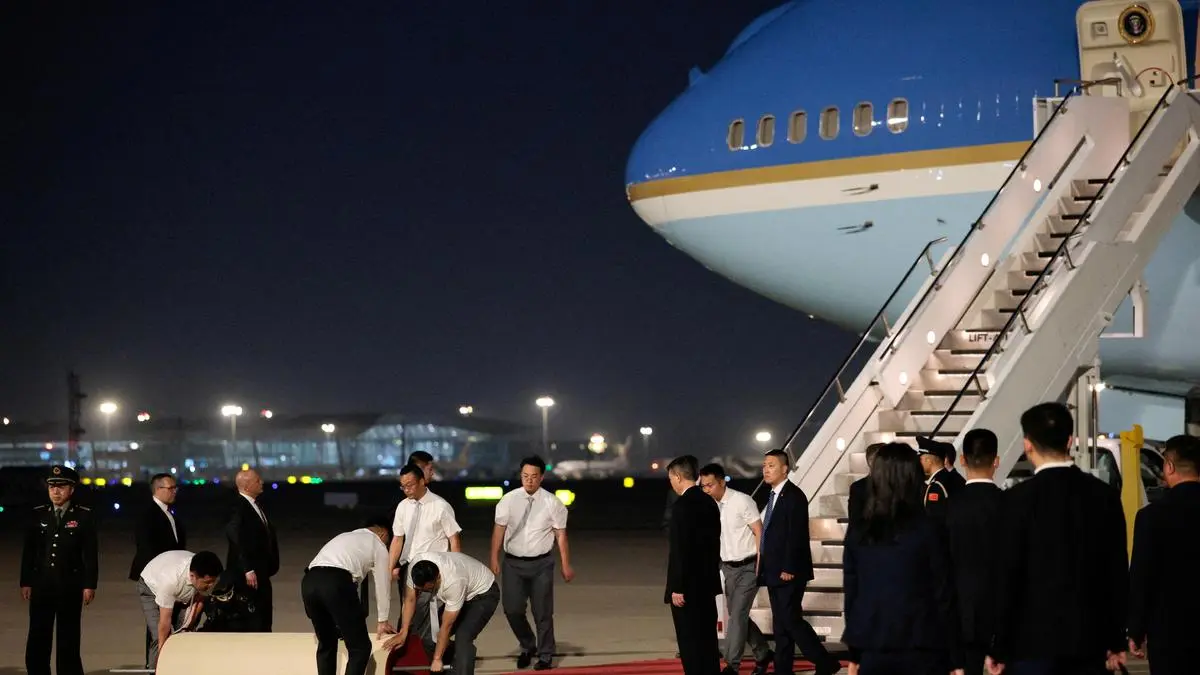
The convergence of a potential regional conflict in the Middle East, a structural trade deficit, and a shifting security architecture in the Pacific defines the current diplomatic mission to Beijing. This visit serves as a stress test for the "Strategic Competition" model that has governed US-China relations for the last decade. Success depends on the ability to decouple immediate tactical flashpoints—specifically the risk of a full-scale Iran-Israel war—from the long-term industrial friction of trade and the ideological impasse of Taiwan.
The Tri-Polar Crisis Architecture
The diplomatic agenda is built upon three distinct but interconnected pillars. Each pillar operates on a different temporal scale: the Iran conflict is an immediate kinetic threat; trade is a persistent macroeconomic drag; and Taiwan is a generational security dilemma.
1. The Kinetic Buffer: Managing the Iran War Risk
The primary objective in Beijing is to secure a Chinese commitment to restrain Iranian escalation. This relies on the Dependency Asymmetry between Beijing and Tehran. China is the primary buyer of Iranian crude, often utilizing non-USD denominated transactions to bypass sanctions.
The US logic suggests that a total regional war in the Middle East would disrupt the Strait of Hormuz, causing a price shock that China’s energy-heavy industrial base cannot absorb. China imports roughly 70% of its oil; a sustained price spike above $120 per barrel acts as an unhedged tax on the Chinese manufacturing sector. The strategic goal is to move China from "passive beneficiary" of regional instability to "active stabilizer" by leveraging their buyer-power over the Iranian regime.
2. The Industrial Balancing Act: Trade and Overcapacity
The trade discussions focus on "New Three" industries: electric vehicles (EVs), lithium-ion batteries, and solar products. The friction here is not merely about tariffs but about a fundamental divergence in economic models.
China utilizes a Supply-Side Subsidy Model, where state-owned banks provide low-interest loans to manufacturing entities regardless of immediate profitability. This creates a global glut, driving prices down and threatening the viability of the US domestic manufacturing "onshoring" initiatives. The US strategy involves presenting evidence of market-distorting behavior to justify Section 301 tariffs while seeking a mechanism for "managed trade" that prevents a total decoupling of supply chains.
3. The Security Redline: US Arms Sales and Taiwan
Arms sales to Taiwan represent the most volatile variable. The US operates under the Taiwan Relations Act, which mandates the provision of defensive articles. China views these sales as a violation of the Three Communiqués and a direct challenge to its sovereignty.
The current tension is exacerbated by the Pacific Missile Gap. As China increases its anti-access/area-denial (A2/AD) capabilities, the US has accelerated the delivery of asymmetric defense systems to Taiwan, including Harpoon missiles and HIMARS. Beijing’s response is a calibrated mix of military posturing and economic coercion directed at US defense contractors.
The Cost Function of Non-Cooperation
Analytical failure often occurs by viewing these issues in isolation. In reality, they form a zero-sum cost function. If China refuses to pressure Iran, the US may retaliate by tightening tech-export controls on Chinese semiconductor firms. If the US proceeds with a massive new arms package for Taipei, China may retaliate by restricting the export of critical minerals like gallium and germanium, which are essential for US defense manufacturing.
The "Tit-for-Tat" escalation cycle can be mapped as follows:
- Action: US increases high-end chip export bans.
- Reaction: China restricts graphite exports (critical for EV batteries).
- Action: US increases military presence in the South China Sea.
- Reaction: China increases support for "gray zone" activities around Taiwanese offshore islands.
This cycle creates a Volatility Premium in global markets. Investors are no longer pricing assets based on earnings alone but on the probability of a sudden regulatory or military shock.
Strategic Frameworks for De-escalation
To move beyond the current deadlock, the talks must establish "Guardrail Protocols." These are not grand treaties but functional communication channels designed to prevent accidental escalation.
Establishing the "Hotline" for Economic Shocks
The first protocol involves a pre-notification system for major trade actions. By reducing the "surprise factor" of new tariffs or export bans, both nations can manage domestic political fallout without resorting to immediate, reflexive retaliation.
The Energy Security Compact
The second framework is a shared commitment to Middle Eastern maritime security. Both nations have a vested interest in the free flow of energy through the Persian Gulf. By framing the Iran conflict as a shared economic threat rather than a purely political one, the US can offer China a "Stakeholder Role" in regional stability. This requires the US to acknowledge China's legitimate energy needs in exchange for Beijing's use of its diplomatic leverage in Tehran.
The Structural Bottleneck of Technology Transfers
The most significant hurdle is the "Small Yard, High Fence" policy regarding advanced technology. The US defines national security through the lens of computational power. By restricting China’s access to H100-class GPUs and lithography equipment, the US seeks to freeze China’s AI and military development at current levels.
China views this not as a security measure but as a containment strategy designed to prevent its transition to a high-value-added economy. This creates a structural bottleneck:
- China cannot reach its growth targets without technological parity.
- The US cannot maintain its military edge if that parity is reached.
This fundamental contradiction ensures that even if short-term deals are reached on Iran or trade, the underlying technological cold war will persist.
Calibrating the Outcome: Strategic Benchmarks
To judge the success of this visit, one must look past the joint statements and focus on three specific indicators:
- The Frequency of Military-to-Military (Mil-Mil) Communications: If high-level military channels are fully restored and utilized during the visit, the risk of an accidental kinetic event in the Taiwan Strait drops significantly.
- The Price Action of Critical Minerals: A stabilization or easing of Chinese export restrictions on rare earth elements signals a "Trade Ceasefire."
- The Rhetoric of Iranian State Media: If Tehran begins to soften its stance on regional escalation immediately following the Beijing summit, it indicates that Chinese pressure was applied and accepted.
The current global environment does not allow for a "Grand Bargain." Instead, the goal is Crisis Management in a Bipolar World. The US is attempting to manage a transition from unipolar dominance to a competitive equilibrium. China is attempting to secure its periphery while maintaining the export markets it needs to avoid a middle-income trap.
The most effective strategic play for the US is to decouple the "Survival" issues from the "Competitive" issues. Survival issues—like preventing a nuclear Iran or a global depression—require deep cooperation. Competitive issues—like 2nm chip manufacturing or influence in Southeast Asia—will remain contested. The failure to distinguish between these two categories is what leads to catastrophic miscalculation. The Beijing talks are an attempt to draw that line.
Washington must accept that it cannot stop China’s rise through trade policy alone, just as Beijing must accept that it cannot displace the US security umbrella in the Pacific without a conflict it is not yet prepared to win. The strategic recommendation is the institutionalization of the "Managed Competition" model, where both sides agree on the rules of the contest to avoid a war that would leave neither side with a prize worth claiming.