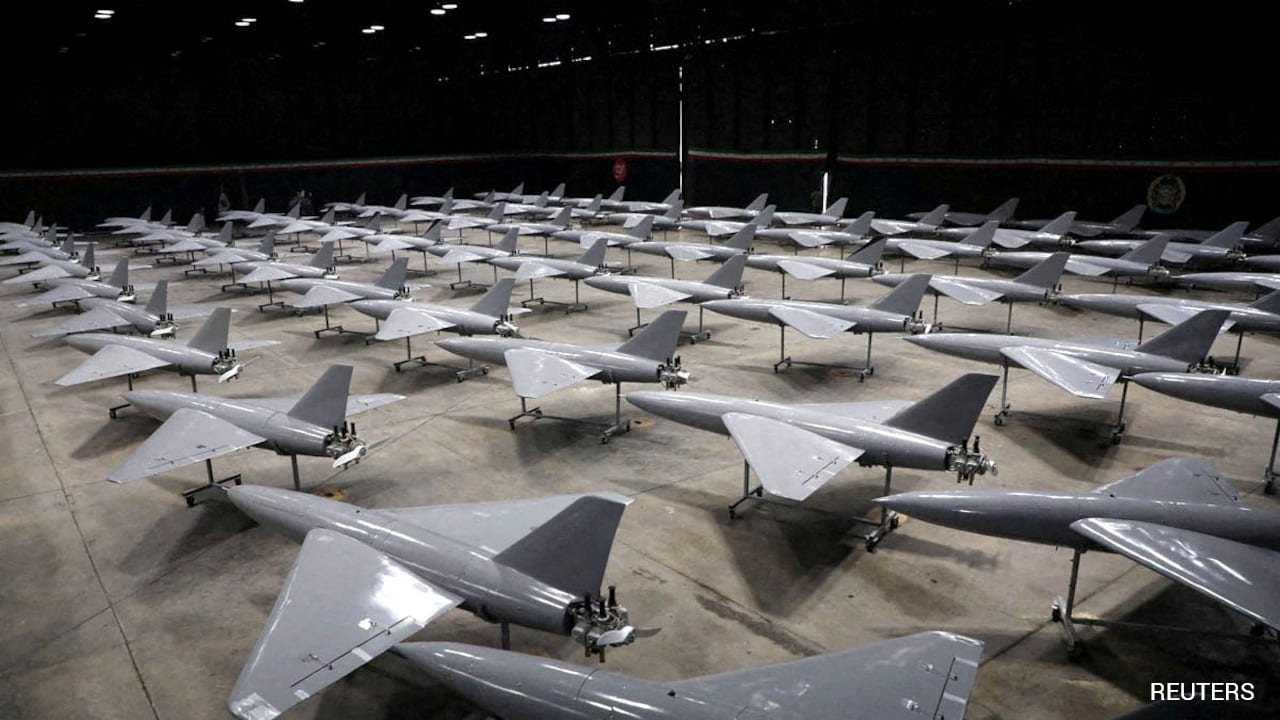
The precise strike capability exhibited by Iranian uncrewed aerial vehicles (UAVs) against clandestine U.S. Central Intelligence Agency (CIA) facilities across the Gulf region represents an operational inflection point in modern proxy warfare. Iran's kinetic targeting of highly guarded intelligence infrastructure—including the CIA station within the U.S. Embassy in Riyadh and operational sites in eastern Iraq—exhibits a level of navigational accuracy and target acquisition that significantly exceeds domestic Iranian baseline capabilities. This escalation stems from an asymmetric force-multiplication architecture enabled by Russian technology transfers and real-time intelligence integration.
Analyzing this operational shift requires evaluating three distinct vectors: electronic navigation upgrades, satellite-based targeting data, and the strategic calculus of Russian transactional friction against Western power projection.
The Technical Vector: Hardware Upgrades and Electronic Warfare Resilience
Standard Iranian Shahed-series one-way attack drones traditionally rely on commercial-grade, multi-constellation Global Navigation Satellite System (GNSS) receivers paired with basic Inertial Navigation Systems (INS). In high-threat environments saturated with Western radio frequency (RF) jamming, these platforms suffer significant terminal guidance degradation.
The accuracy observed in recent strikes relies on a structural hardware enhancement: the integration of Russian Kometa-M series controlled reception pattern antennas (CRPA).
- Anti-Jamming Dynamics: The Kometa-M system utilizes multi-element spatial filtering arrays to isolate and nullify jamming signals coming from the horizon while retaining lock on high-angle GNSS satellite signals. This reduces the effective radius of Western ground-based electronic countermeasure (ECM) shields.
- Terminal Precision: By stabilizing satellite lock through intense electronic warfare environments, flight path errors decrease from a marginal circular error probable (CEP) of 15–30 meters down to less than 3 meters.
- Tandem Strike Tactics: Enhanced navigational accuracy enables synchronized multi-drone strike tactics. In the Riyadh embassy station attack, a leading UAV breached structural barriers, creating a vector for a follow-on unit to penetrate and detonate within the interior structure—a tactic requiring sub-meter flight path consistency.
This hardware transfer transitions Iranian loitering munitions from indiscriminate, high-area deterrence tools into surgical assets capable of targeting specific office annexes and hardened command nodes.
The Intelligence Vector: Targeting Data vs. Coincidental Acquisition
Distinguishing between organic Iranian intelligence collection and foreign strategic targeting assistance requires evaluating the sensor-to-shooter loop. The CIA’s overseas stations and operational safe houses are designed around strict emissions security (EMSEC) and physical obfuscation.
+-----------------------------------+       +------------------------------------+
|  Russian Space-Based Recon        |       |  Electronic Intelligence (ELINT)   |
|  (Kanopus-V / Persona Optics)     |       |  Sigint / Spectrum Mapping         |
+-----------------------------------+       +------------------------------------+
                 |                                             |
                 +----------------------+----------------------+
                                        |
                                        v
                    +---------------------------------------+
                    |  Data Fusion & Coordinates Mapping    |
                    +---------------------------------------+
                                        |
                                        v
                    +---------------------------------------+
                    |  Shahed-136 Target Programming        |
                    |  (Kometa-M CRPA Guidance)             |
                    +---------------------------------------+
                                        |
                                        v
                    +---------------------------------------+
                    |  Kinetic Strike on CIA Facility       |
                    +---------------------------------------+
To execute precise kinetic strikes against these facilities, an attacking force requires actionable intelligence across three primary dimensions:
- Space-Based Optical and SAR Reconnaissance: High-resolution Synthetic Aperture Radar (SAR) satellites can penetrate cloud cover and camouflage to identify physical structural modifications, vehicle patterns, and security perimeter alterations consistent with intelligence hub operations.
- Signal/Emissions Intelligence (SIGINT/ELINT): Intercepting and triangulating high-frequency encrypted communication bursts provides precise geolocational coordinates of command nodes within broader diplomatic complexes.
- Operational Pattern Analysis: Fusing physical surveillance with satellite imagery reveals shift patterns, supply logistics, and high-value personnel movements.
While Iran maintains independent regional intelligence networks, its domestic satellite constellation lacks the persistent revisit rates and high-resolution imaging needed for real-time target development against low-visibility sites. Russia’s intelligence assets—including military optical and SAR platforms—provide the exact data matrix required to generate zero-point coordinates for strike planning.
The Strategic Balance: The Cost-Benefit Architecture of Russian Involvement
Russian strategic support for Iranian strikes operates on a calibrated asymmetric exchange rate. Russia avoids direct military engagement with U.S. forces, choosing instead to proxy-target U.S. intelligence capabilities to alter the cost structure of American deployments.
Strategic Gains for Moscow
- Resource Diversion: Forcing the U.S. to reallocate advanced air defense batteries, counter-UAS networks, and intelligence surveillance platforms to the Middle East reduces assets available for European theaters.
- Asymmetric Cost Imbalance: Supplying navigation components like the Kometa-M costs tens of thousands of dollars per unit, while forcing the U.S. and regional partners to expend multi-million-dollar interceptor missiles (e.g., PAC-3, SM-2) to counter high-volume strikes.
- Reciprocal Intelligence Value: Field data on U.S. counter-drone tactics, radar frequencies, and interceptor performance gathered during these strikes feeds directly back into Russian defense development pipelines.
Operational Vulnerabilities and Friction Points
This intelligence-sharing model creates structural risks for both state actors:
- Attribution Risk: Advanced hardware recovery from unexploded ordnance gives Western intelligence physical evidence of Russian component origins, eliminating plausible deniability and triggering targeted retaliatory sanctions or cyber operations.
- Escalation Management Control: Indirectly facilitating kinetic attacks on U.S. intelligence personnel risks crossing unspoken deterrence thresholds, potentially prompting direct U.S. counter-measures against Russian logistics hubs in regional theaters like Syria.
Western defense planners must respond not by treating these events as isolated regional drone strikes, but by recognizing them as integrated multi-domain operations. Countering this threat requires expanding dynamic electronic countermeasure bands to disrupt multi-constellation satellite links, deploying hardened physical intercept infrastructure around forward stations, and increasing the strategic friction on Russian technical transfer nodes.