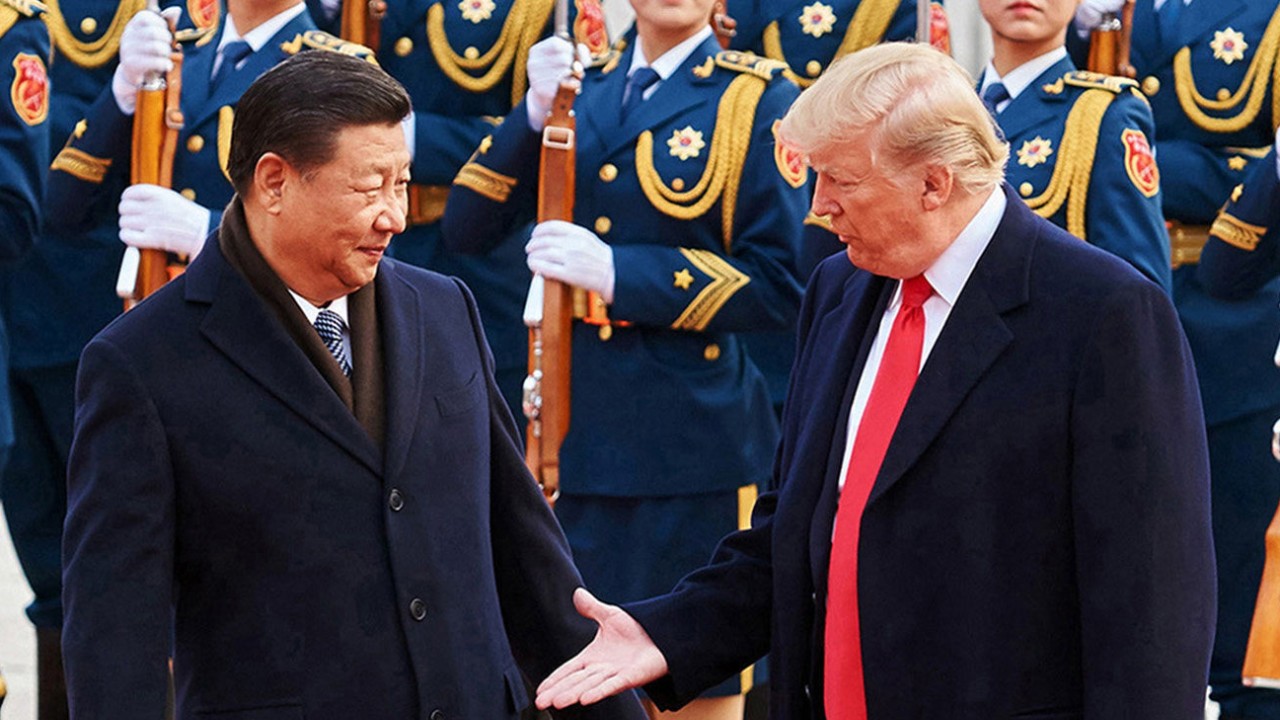
The media is obsessed with the "rebalancing" of U.S.-China ties. They treat the relationship between Donald Trump and Xi Jinping like a volatile marriage that just needs the right therapist and a better prenuptial agreement. They talk about "love and hate," "nationalism," and "trade wars" as if these are temporary hurdles on a track leading back to 1990s-style globalization.
They are wrong. Meanwhile, you can find related developments here: The Caracas Divergence: Deconstructing the Micro-Equilibrium of Venezuelan Re-Dollarization.
The premise that these two superpowers can—or even want to—find a stable equilibrium is a fantasy sold by consultants who need to justify their retainers and diplomats who are paid to hope. We aren't looking at a rebalancing. We are witnessing the systematic dismantling of a fifty-year economic experiment.
The Myth of the Great Rebalance
Current analysis suggests that if Trump and Xi can just sit in a room and hammer out a "Grand Bargain" on soy beans and semiconductors, the world economy will stop shaking. This assumes the friction is about specific line items. It isn't. To explore the bigger picture, check out the detailed report by CNBC.
The friction is structural. It is baked into the very math of how both nations function. China’s entire economic model is predicated on overcapacity—producing more than its internal market can ever consume and dumping the surplus onto the global stage. The U.S. model, conversely, has shifted toward protecting its remaining industrial base at all costs to prevent internal social collapse.
When two entities have fundamentally incompatible survival strategies, "balance" is a euphemism for "stalling." You cannot rebalance a scale when one side is playing by the laws of physics and the other is trying to rewrite them.
Trump Isn't the Problem—He’s the Symptom
Pundits love to frame Trump as a chaotic outlier. They argue his "America First" rhetoric is the primary wedge driving the two nations apart. This ignores the fact that the Biden administration kept—and in many cases, sharpened—the very tariffs and tech restrictions Trump initiated.
The consensus has shifted. The American security establishment has reached a point of no return. I’ve sat in rooms with policy planners who used to be "panda huggers" in the early 2000s; today, they talk about "de-risking" with the cold clinical tone of a surgeon discussing an amputation.
Trump’s return doesn't change the trajectory; it just accelerates the velocity. His approach isn't about finding a middle ground. It’s about leverage. But leverage only works if the other party is willing to move. Xi Jinping’s "Global Civilization Initiative" and his push for "Total National Security" prove that Beijing has already decided that the West is a declining power. Xi isn't looking for a seat at the table; he’s building a different house.
Why "Nationalism" is a Lazy Explanation
The competitor piece leans heavily on "nationalism" as the driver of friction. That’s a surface-level take. Nationalism is the tool used to sell the policy to the public, but the real driver is The Thucydides Trap wrapped in a digital chip.
We are no longer fighting over steel or textiles. We are fighting over the foundational layers of the 21st century:
- Compute Power: The ability to process data at scale.
- Energy Dominance: Who controls the transition from hydrocarbons to lithium and rare earths.
- Information Integrity: Who controls the algorithms that dictate what billions of people believe to be true.
When the stakes are existential, "nationalism" is just the branding. The reality is a zero-sum competition for the commanding heights of technology. If China wins the race to AGI (Artificial General Intelligence) or masters high-end lithography, the U.S. dollar’s status as the global reserve currency becomes a historical footnote.
The Fallacy of "Win-Win" Cooperation
Every time a diplomat says "win-win," a realist loses their wings. The idea that we can cooperate on climate change while competing on everything else is a delusion.
Imagine a scenario where the U.S. depends entirely on Chinese green tech—EV batteries and solar panels—to meet its climate goals. In that scenario, China holds the kill switch for the American energy grid. No sovereign power accepts that level of vulnerability. Therefore, the "cooperation" is inherently limited by the "competition."
We saw this during the pandemic. The moment the global supply chain blinked, the "just-in-time" efficiency we all worshipped turned into a "just-in-case" nightmare. Companies didn't learn to cooperate better; they learned to hoard and repatriate.
The Brutal Reality of Decoupling
People ask: "Can we really afford to decouple?"
The honest, brutal answer is: It doesn't matter if we can afford it. Decoupling—or "friend-shoring," "de-risking," whatever the sanitized term of the week is—is happening because the alternative is perceived as national suicide. I have watched Tier 1 manufacturers move operations from Shenzhen to Vietnam, Mexico, and Ohio. They aren't doing it because it’s cheaper. It’s actually significantly more expensive and less efficient. They are doing it because the political risk of staying in China has exceeded the profit margin.
When the risk-adjusted return on investment (ROI) in China turns negative, the capital flees. This isn't a policy choice by Trump or Xi; it’s a market reaction to the end of the post-Cold War peace.
The Xi-Trump "Chemistry" is Irrelevant
The media loves the "strongman" narrative—the idea that two powerful egos can cut a deal because they "understand" each other. This is the ultimate distraction.
Xi Jinping is constrained by the CCP’s need for internal stability and its fear of a "color revolution." Trump is constrained by a Congress that is more hawkish on China than he is and a public that blames globalization for the hollowed-out middle class.
Even if Trump and Xi shared a bucket of KFC and signed a "Peace for our Time" document, the underlying machinery of their respective states would continue to grind against each other. The FBI would still be hunting for industrial spies. The PLA would still be rehearsing for a Taiwan Strait blockade. The Department of Commerce would still be blacklisting Chinese tech firms.
Stop Asking if Ties Can be "Rebalanced"
You are asking the wrong question.
The question isn't "how do we fix the relationship?"
The question is "how do we manage the collapse?"
Businesses that are waiting for things to "go back to normal" are going to go bankrupt. Investors who think the 2010s era of easy Chinese growth and American consumption is coming back are holding onto a ghost.
We are moving toward a bipolar world. Two different tech stacks. Two different financial systems. Two different sets of values.
The "rebalance" isn't a return to a steady state. It is a violent recalibration where both sides are trying to grab as much of the lifeboat as possible before the ship goes down.
The Contradiction of the "Trade War"
The biggest misunderstanding is that trade wars are about trade. They aren't. They are about leverage.
When Trump threatens a 60% tariff on Chinese goods, he isn't trying to bring back t-shirt manufacturing to South Carolina. He is trying to force China to stop subsidizing its high-tech industries. Beijing knows this. They also know that if they stop those subsidies, their economy collapses because they have no other engine for growth.
It is an impasse.
China cannot stop being what it is: a state-led industrial powerhouse.
The U.S. cannot stop being what it has become: a protective, security-obsessed hegemon.
Your Strategic Pivot
If you are a CEO or an investor, ignore the headlines about "thawing relations" or "productive summits." Those are for the Sunday shows. Look at the capital flows. Look at the export controls. Look at the defense budgets.
- Abandon the "China + 1" strategy. It's too late for that. You need a "China OR Everything Else" strategy.
- Price in the Tariffs. Stop treating them as a temporary tax. Treat them as a permanent cost of doing business in a fractured world.
- Own the IP. If your intellectual property is sitting on a server in a jurisdiction that doesn't respect your laws, you don't own it. You’re just renting it until they decide to take it.
The "Love and Hate" era is over. This is a cold, calculated divorce.
The paperwork is already filed. The lawyers are already fighting over the house. Anyone telling you they can "save the marriage" is either lying to you or lying to themselves.
Stop looking for a rebalance. Start looking for the exit.