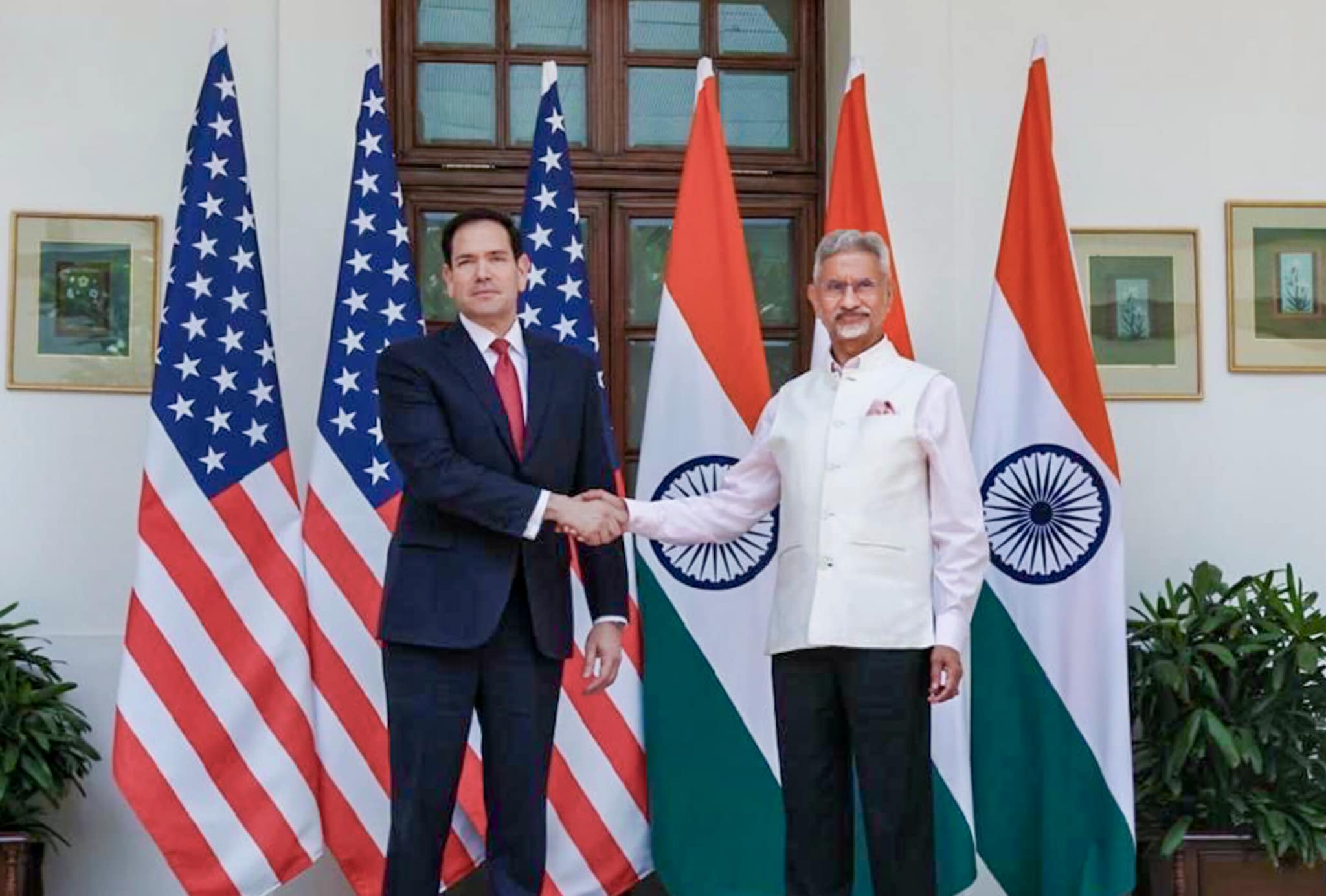
The global energy market is bound by physical bottlenecks, the most critical of which is the Strait of Hormuz. When conflict or state-sponsored disruption closes or restricts this maritime artery, the economic fallout is felt not merely in fluctuating spot prices but in the structural rewiring of sovereign trade architectures. The diplomatic engagement in New Delhi between U.S. Secretary of State Marco Rubio and Indian External Affairs Minister S. Jaishankar highlights this reality. While political commentary frames the bilateral talks around expressions of goodwill and impending trade agreements, a rigorous economic and strategic analysis reveals a complex calculus. This calculus is defined by India's acute supply vulnerabilities, the limitations of U.S. export capacity, and the shifting dynamics of the Indo-Pacific maritime security architecture.
The Cost Function of Chokepoint Disruption
To quantify the impact of the ongoing conflict involving Iran and the subsequent closure or severe restriction of the Strait of Hormuz, one must evaluate the macro-economic friction imposed on major net energy importers. India imports more than 80% of its crude oil requirements. A significant portion of these imports historically traversed the Persian Gulf. The disruption of this route introduces three distinct variables into India’s national energy cost function:
- The Maritime Risk Premium: Freight insurance rates do not scale linearly; they spike exponentially when an international waterway is declared a war zone. Underwriters price in hull risk, war risk, and cargo liability, forcing shipping lines to either pay exorbitant premiums or reroute vessels around the Cape of Good Hope. This detour adds approximately 10 to 14 days to transit times, inflating bunker fuel consumption and operational costs.
- The Domestic Subsidy Burden: India’s fiscal deficit is tightly coupled with global crude pricing. When international benchmarks rise due to supply-side shocks, the state-owned oil marketing companies face a margin squeeze. If the government caps retail fuel prices to mitigate inflation, the fiscal burden shifts to the state treasury, crowding out public capital expenditure.
- The Refining Disutility: Indian refineries are highly sophisticated, optimized for specific slates of sour and heavy crudes predominantly sourced from the Middle East. Substituting these inputs with alternative grades requires technical recalibration, altering the yield mix of high-value distillates like diesel and aviation turbine fuel.
[Geopolitical Shock: Hormuz Restriction]
               │
               ▼
┌──────────────────────────────────────────────┐
│       Exponential Insurance Spikes           │
│     & Cape of Good Hope Rerouting            │
└──────────────┬───────────────────────────────┘
               │
               ▼
┌──────────────────────────────────────────────┐
│     Incurred Friction in Supply Chain       │
│  (Increased Transit Days + Freight Charges)  │
└──────────────┬───────────────────────────────┘
               │
               ▼
┌──────────────────────────────────────────────┐
│      Refinery Input Recalibration            │
│  (Yield Mismatches & Margin Degradation)     │
└──────────────────────────────────────────────┘
The U.S. diplomatic posture—articulated by Secretary Rubio’s statement that Washington will not allow Iran to hold the global market hostage—seeks to address these vulnerabilities by offering American energy exports as a stabilizing mechanism. However, the structural limits of this substitution must be evaluated against physical production and logistics constraints.
The Substitution Mechanics of U.S. Energy Diplomacy
The assertion that U.S. energy products can completely diversify India away from high-risk Middle Eastern or sanctioned Russian crude requires an examination of capacity constraints. While U.S. crude production has reached historic highs, the physical properties of light, sweet West Texas Intermediate (WTI) differ significantly from the heavy, sour grades around which India's refining infrastructure was built.
To overcome this structural mismatch, the U.S. strategy introduces a secondary mechanism: leveraging Venezuelan crude oil. Under an evolving framework, U.S. domestic refineries absorb Venezuelan heavy crude—which matches their complex coking and hydroprocessing capabilities—while coordinating the diversion of alternative heavy volumes or participating in complex swap arrangements with New Delhi. The upcoming visit of Venezuela’s leadership to New Delhi underscores this coordinated market realignment.
However, substituting Persian Gulf supply with transatlantic or South American supply introduces a geographic penalty. The transit distance from the U.S. Gulf Coast to India’s western ports (such as Jamnagar or Mundra) via the Cape of Good Hope is significantly longer than the short voyage from the Persian Gulf. This permanent geographic penalty manifests as higher baseline shipping costs, establishing a floor under the price of diversified crude.
Furthermore, this pivot occurs against a background of bilateral economic friction. The "interim trade agreement" framework negotiated earlier aimed to lower punitive U.S. tariffs on Indian goods to 18% from 50%, contingent on India reducing its purchases of Russian oil and lowering its own domestic trade barriers. The fact that a final, comprehensive trade agreement remains unexecuted months after the interim framework demonstrates that market access and tariff adjustments remain highly transactional.
The Institutional Architecture of Indo-Pacific Alignment
Beyond energy arbitrage, the U.S.-India relationship is bound by the security dynamics of the Indo-Pacific, operationalized through the Quadrilateral Security Dialogue (Quad). The strategic convergence between Washington and New Delhi is driven by shared systemic challenges, yet it operates under distinct institutional limitations.
| Strategic Domain | United States Objectives | India Objectives | Structural Friction Points |
|---|---|---|---|
| Maritime Security | Preserve open access; counter Chinese naval expansion across the first and second island chains. | Maintain dominance in the Indian Ocean Region (IOR); secure sea lines of communication (SLOCs). | India prioritizes the Western Indian Ocean; the U.S. focuses on the South and East China Seas. |
| Supply Chain Security | Reshore or "friend-shore" manufacturing of critical minerals and semiconductors away from China. | Establish domestic manufacturing hubs via Production Linked Incentive (PLI) schemes. | U.S. intellectual property demands conflict with India's technology transfer requirements. |
| Technology Integration | Restrict the proliferation of dual-use technologies to adversarial states. | Acquire dual-use technologies to modernize domestic defense manufacturing. | Legacy Indian defense dependence on Russian platforms impedes full systems integration. |
Secretary Rubio’s assertion that progress has been made toward achieving a "completely open strait without tolls" reflects a tactical optimization of diplomatic pressure and maritime escort operations. However, long-term stability in the Indo-Pacific cannot rely on temporary tactical diplomatic breakthroughs. It requires structural alignment on the freedom of navigation.
For India, the strategic calculation is defensive. It seeks to protect its economic periphery from external shocks without becoming entangled in formal military alliances that compromise its historic strategic autonomy. For the United States, the relationship is foundational to balancing power in Asia. The tension between America's desire for a committed security partner and India's insistence on strategic independence remains the defining feature of the bilateral architecture.
The Tactical Blueprint for Sovereign Risk Mitigation
To convert diplomatic convergence into measurable economic and security resilience, New Delhi and Washington must move past rhetorical alignment and execute a concrete, multi-layered strategy.
Phase 1: Strategic Crude Slates and Infrastructure Upgrades
India must accelerate the technical modernization of its public-sector refineries to maximize feedstock flexibility. This requires investing in deep-conversion coking units and advanced hydrotreaters capable of processing highly variable API gravity and sulfur-content crudes without degrading refining margins. Simultaneously, the U.S. must provide long-term, fixed-price export allocations of liquefied natural gas (LNG) and crude options to insulate Indian state-owned enterprises from spot-market volatility.
Phase 2: Joint Maritime Escort Architecture
The Quad framework must evolve from a consultative forum into an operational coordination mechanism for securing sea lines of communication. This does not require a formal mutual defense pact. Instead, it demands interoperable maritime domain awareness (MDA) data feeds, pre-positioned logistics nodes, and synchronized escort protocols in the Western Indian Ocean. This infrastructure will actively depress the maritime risk premiums levied by commercial insurers during regional crises.
Phase 3: Finalizing the Transnational Commercial Compact
The pending bilateral trade agreement must be concluded by decoupling systemic geopolitical goals from transactional tariff disputes. Washington must formalize predictable pathways for skilled labor visas, clarifying that recent modernization drives are not targeted exclusions. In return, New Delhi must formalize its structural pivot away from sanctioned energy regimes by locking in long-term supply agreements with reliable Western Hemisphere producers. This will solidify the trade architecture required to meet the "Mission 500" target of $500 billion in bilateral trade by 2030.