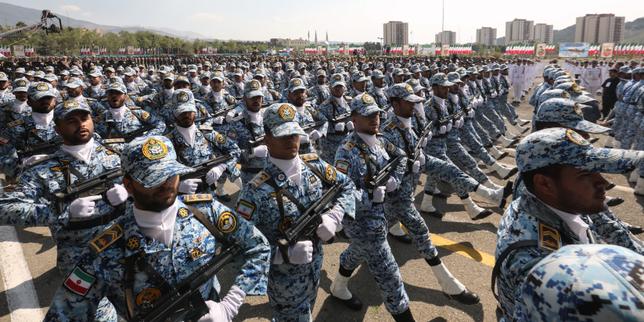
The declaration by Iranian military leadership regarding reconstituted armed forces and the threat of an crushing defeat if the United States restarts direct confrontation is a calculated exercise in asymmetric deterrence. Strip away the rhetorical posturing, and the statement reveals a highly structured military-economic strategy designed to alter the risk-reward calculus of Western decision-makers. Western strategic planning frequently miscalculates Iranian capability by focusing on conventional parity—a metric that is fundamentally irrelevant to Tehran's operational model. To accurately assess the escalation risks in the Middle East, analysts must evaluate Iran's security apparatus not through the lens of static military inventory, but through a dynamic cost function based on layered attrition, regional proxy integration, and geographic bottlenecks.
The true architecture of Iran’s defense strategy relies on a triad of interdependent components: active denial capabilities, gray-zone offensive networks, and strategic depth via localized supply chains. This framework dictates that any kinetic intervention by external powers triggers an automatic escalation ladder. This structure aims to impose costs that quickly exceed the political and economic tolerance thresholds of a democratic adversary. Meanwhile, you can read similar developments here: The Reality of Gaza Police Casualties Under Israeli Airstrikes.
The Triad of Iranian Strategic Deterrence
Evaluating Iran's reconstituted military power requires breaking down its operational capacity into three distinct vectors. Each vector operates on a different temporal and geographic scale, creating a comprehensive matrix of deterrence.
1. Anti-Access/Area-Denial (A2/AD) Bottlenecking
Iran’s primary defensive layer is designed to deny adversaries freedom of maneuver within the Persian Gulf and the Strait of Hormuz. This is not achieved through capital warships, but through mass-produced, low-cost precision systems. To explore the bigger picture, check out the detailed analysis by The Washington Post.
- Loitering Munitions and Unmanned Aerial Vehicles (UAVs): The integration of delta-wing attack drones provides a highly distributed, low-radar-cross-section strike capability. These systems overwhelm complex air defense networks like the Aegis Combat System or Patriot batteries through sheer volume. This forces an unfavorable economic exchange ratio where a $20,000 drone consumes a $2 million interceptor missile.
- Anti-Ship Cruise Missiles (ASCMs) and Fast Attack Craft (FAC): Operating from subterranean bases along the rugged coastline of the Zagros Mountains, mobile ASCM launchers can execute coordinated swarming attacks. The geography of the Strait of Hormuz restricts deep-draft naval vessels to narrow shipping lanes, eliminating their ability to maneuver and maximizing the effectiveness of saturated missile salvos.
- Smart Sea Mining: The deployment of unmoored and bottom-influence mines creates a persistent, high-risk environment for both military vessels and commercial energy transport, disrupting maritime logistics without requiring active engagements.
2. Forward-Deployed Proxy Networks (The Axis of Resistance)
The second layer shifts the conflict from a localized theater to a regional, multi-front war. Iran’s external state-sponsored and non-state partners act as force multipliers that decouple Tehran from direct attribution while maintaining strategic leverage.
                  [Tehran Strategic Command]
                             |
       +---------------------+---------------------+
       |                     |                     |
[Levant Theater]      [Yemeni Chokepoint]   [Mesopotamian Front]
 - Hezbollah           - Ansar Allah         - Islamic Resistance
 - Rocket/Missile      - Red Sea Anti-Ship    - Asymmetric Rocket/
   Saturation            Interdiction          UAV Staging Ground
This decentralized structure means that a strike on sovereign Iranian territory does not isolate the conflict. Instead, it activates pre-coordinated offensive vectors across the Levant, the Iraqi theater, and the Bab al-Mandab strait. This forces an adversary to distribute its defensive assets across thousands of miles, thinning out theater air defenses and logistics chains.
3. Autarkic Industrial Adaptation
The assertion of a "reconstituted" military force underscores Iran's transition to a self-sustaining defense industrial base. Decades of strict international sanctions have prevented Tehran from acquiring Western or advanced Russian/Chinese fifth-generation platforms. Consequently, Iran optimized its domestic manufacturing toward a low-cost, high-yield paradigm.
By focusing on reverse-engineered solid-propellant ballistic missiles, GPS-independent inertial guidance packages, and commercial off-the-shelf electronics for drone guidance, the domestic supply chain remains immune to external trade embargoes. The underground factory networks, deep within mountainous terrain, ensure that industrial capacity cannot be permanently neutralized by standalone air campaigns.
The Calculus of Asymmetric Escalation
A critical flaw in standard Western escalation models is the assumption that conventional superiority guarantees deterrence. In a conflict scenario involving Iran, the escalation ladder is nonlinear. The relationship between military input and economic outcome can be expressed through a conceptual cost function where the primary variable is the disruption of international trade flows.
The Strait of Hormuz handles roughly 20% of the world's liquefied natural gas (LNG) and petroleum consumption. A kinetic conflict that forces even a temporary closure of this maritime chokepoint shifts the global energy supply curve violently to the left. The economic damage is not measured in hulls sunk, but in insurance premiums spiked, supply chains broken, and localized inflationary shocks triggered across G7 economies.
The strategic objective of Iranian military posturing is to ensure that any threat of a military strike by a U.S. administration triggers immediate resistance from global financial markets and international allies. The "overwhelming defeat" promised to a renewed push by Washington is not a claim of conventional victory over American forces; it is a declaration that Iran can make the systemic cost of a Western victory ruinous to global economic stability.
Structural Bottlenecks in the Western Interdiction Strategy
Defeating or neutralizing this specific deterrence architecture requires more than just launching precision-guided munitions. It demands solving deep structural constraints inherent in modern Western military doctrine.
The Munitions Deep-Stovepipe Crisis
Modern Western militaries optimize for short-duration, high-intensity conflicts utilizing hyper-advanced, expensive precision weapons. A prolonged campaign against a deeply entrenched adversary with deep stockpiles of low-cost munitions exposes severe industrial bottlenecks. The consumption rate of air defense interceptors (such as SM-2, SM-6, and PAC-3) against waves of low-cost drones quickly outpaces production capacity. Western industrial bases lack the manufacturing elasticity to rapidly scale up missile production, creating a hard physical limit on prolonged theater defense.
The Tyranny of Distance and Basing Vulnerability
U.S. forces in the region rely heavily on fixed installations throughout the Gulf Cooperation Council (GCC) states. These bases sit well within the tactical range of Iran’s short- and medium-range ballistic missile inventory (such as the Fateh and Qiam families). This geographic reality turns forward staging grounds into high-value targets.
Host nations face intense internal and external geopolitical pressure, which frequently results in them restricting the use of their territory for offensive operations against Iran. This limits Western strike options to carrier strike groups, which must operate at extended distances outside the A2/AD envelope, reducing sorting rates and increasing operational friction.
The Attribution Dilemma
Because Iran utilizes a decentralized command architecture for its regional network, establishing clear attribution for specific kinetic actions remains difficult. When a commercial vessel is struck in the Red Sea or an installation is targeted in Iraq, the action is carried out by localized actors using Iranian blueprints and components, rather than Iranian personnel. This provides Tehran with plausible deniability, blurring the lines of engagement and complicating the legal and political justification required for a sovereign state to launch a direct counter-offensive.
Operational Reality: Systemic Limits of the Deterrence Model
While Iran’s strategic architecture is formidable, it contains critical structural vulnerabilities that limit its long-term viability under prolonged pressure.
- Severe Conventional Deficiencies: Iran's conventional air defense network is built on a fragmented mix of aging domestic systems and imported platforms. It cannot maintain air superiority over its own airspace against low-observable, fifth-generation aircraft. Its conventional navy cannot project sustained power outside its immediate coastal waters.
- Economic Fragility and Internal Strain: The autarkic defense sector operates in isolation from a brittle domestic economy marked by high inflation and currency depreciation. Diverting capital to sustain regional proxy groups creates internal social friction, meaning the state's security apparatus must always reserve a significant portion of its organizational capacity for internal stability and regime preservation.
- Single-Point Failure Risks in Command Structures: The highly centralized nature of the upper echelons of the Islamic Revolutionary Guard Corps (IRGC) creates a vulnerable point of failure. Targeted elimination of key operational coordinators can degrade proxy synchronization for extended periods, as localized commanders often lack the strategic authority to adjust large-scale campaigns independently.
Strategic Playbook for Navigating the Escalation Matrix
De-escalating or neutralizing this security dynamic requires a shift away from high-profile threats of conventional regime change, focusing instead on targeted economic and technical containment.
The most effective counter-strategy avoids large-scale kinetic engagements that activate Iran’s A2/AD cost function. Instead, it prioritizes degrading Iran's domestic manufacturing supply chain through enhanced counter-proliferation networks and targeted cyber interdiction of dual-use electronic imports. Simultaneously, Western powers must expand regional integration of automated, lower-cost directed-energy defense systems to change the unfavorable economic calculus of drone interception.
By systematically lowering the cost of defense while tightening the supply constraints on Iran’s domestic missile and drone manufacturing, the West can neutralize the leverage of Tehran’s regional triad. This reduces Iran's capability from a systemic global threat down to a localized containment challenge.