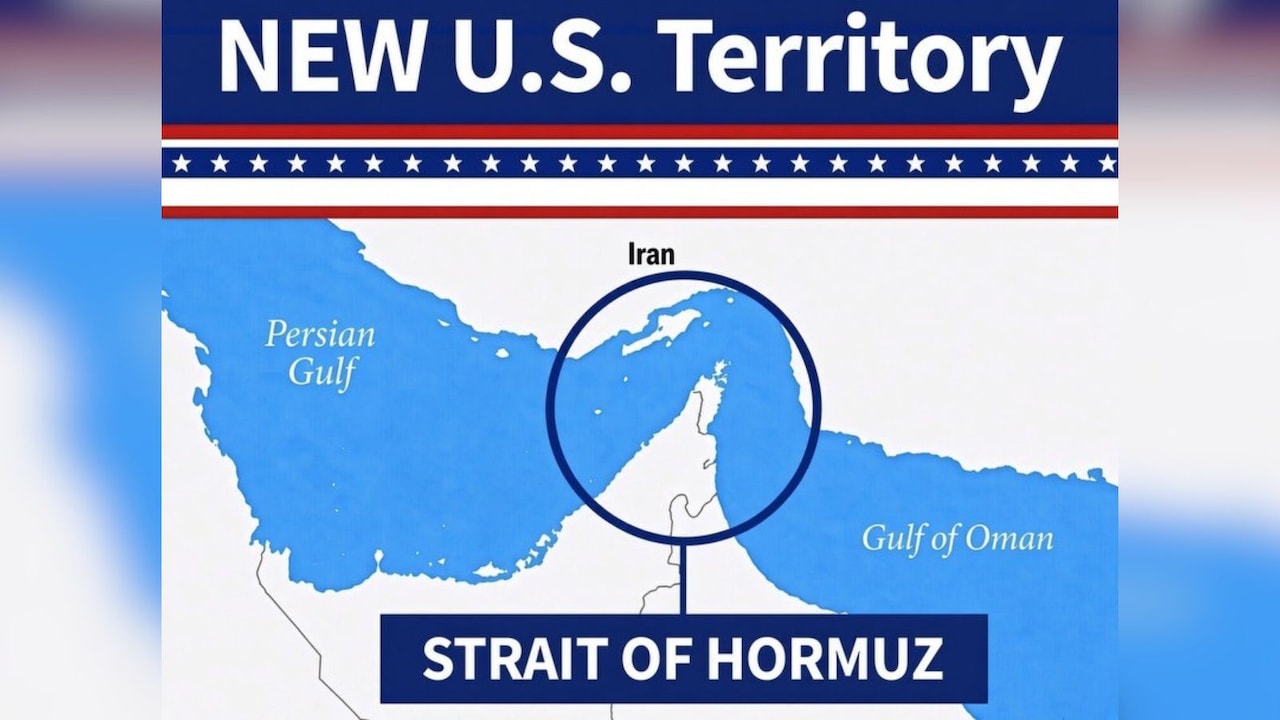
Geopolitical posturing in critical energy chokepoints rarely adheres to traditional legal frameworks, instead operating on a spectrum of strategic signalling and economic coercion. The recent distribution of an artificial intelligence-generated image depicting the Strait of Hormuz labeled as United States territory, paired with declarations that all naval mines have been cleared, highlights a fundamental friction between digital sovereignty assertions and physical maritime realities. Analyzing this dynamic requires stripping away the rhetorical veneer to examine the underlying mechanics of naval blockades, mine warfare mitigation costs, and the structural limits of unilateral jurisdictional claims over international waters.
The Structural Mechanics of Maritime Blockades
A naval blockade functions as an economic choke point designed to alter the cost-benefit calculus of a target nation by restricting trade flow. In the context of the Persian Gulf, the enforcement mechanism relies on a combination of surface combatants, aerial surveillance, and interception protocols designed to halt petroleum exports. Discover more on a connected issue: this related article.
The stated objective of keeping the waterway open to international commercial shipping while simultaneously maintaining an active blockade against specific state actors creates an operational paradox. Commercial shipping insurance rates, crew safety protocols, and corporate liability thresholds do not respond to political declarations alone. They respond to risk mitigation metrics. When a state actor declares a maritime corridor open while enforcing restrictions on adjacent sovereign ports, the operational friction shifts from physical transit blockages to marine insurance underwriting.
The economic transmission mechanism operates through three distinct variables: Further journalism by BBC News delves into similar perspectives on this issue.
- Insurance Premium Elasticity: Marine underwriters assess risk based on active kinetic threats rather than political announcements, meaning residual conflict zones maintain elevated hull and machinery rates regardless of who claims administrative control.
- Throughput Volume Constraints: Unrestricted commercial navigation requires predictable traffic separation schemes and navigational aids that are frequently disrupted during periods of bilateral hostility.
- Port Access Symmetry: A blockade targeting national exports inherently depresses regional trade throughput, creating supply chain adjustments that affect global commodity pricing independently of transit lane declarations.
The Economics of Mine Remediation and Verification
The assertion that all underwater mines have been removed or detonated introduces a complex engineering challenge. Naval mine warfare is structurally asymmetrical; laying ordnance requires minimal capital and infrastructure, whereas clearing and verifying a maritime corridor demand extensive time, specialized equipment, and high-risk operations.
Historical mine countermeasures rely on a combination of airborne laser mine detection systems, uncrewed underwater vehicles equipped with side-scan sonar, and explosive ordnance disposal divers. Achieving a zero-threat verification state in a high-traffic geographic bottleneck requires exhaustive sweep cycles.
[Mine Deposition] ---> Low Cost / High Asymmetry
       |
       v
[Threat Perception] ---> Insurance Risk Spikes / Traffic Stalls
       |
       v
[Remediation Cycle] ---> High Cost / Extended Time / Complex Verification
The friction point in post-conflict maritime safety is not merely the physical removal of known ordnance, but the elimination of the psychological threat factor. Commercial carriers operate on zero-tolerance safety margins. Even a low statistical probability of unlocated bottom-influence mines prevents fleet operators from committing multi-billion-dollar asset classes to a contested corridor without formal international clearance certifications.
Sovereignty Claims Versus International Maritime Law
Declaring a vital international transit lane as a domestic territory violates foundational tenets of the United Nations Convention on the Law of the Sea, specifically regarding the right of transit passage through straits used for international navigation. Sovereignty assertions made via digital media platforms serve an internal signaling function rather than establishing legal jurisdiction under international admiralty law.
The operational reality is that control over a chokepoint like the Strait of Hormuz is functionally transient. It depends on continuous power projection rather than administrative annexation. Bilateral agreements, such as expired memorandums of understanding involving regional intermediaries, often attempt to establish temporary navigational corridors separating traffic inbound toward specific national coasts from outbound commercial tonnage. When these diplomatic frameworks collapse, the default state returns to a contest of military deterrence and economic attrition.
Strategic Outlook
The standoff over the Persian Gulf transit corridor will continue to pivot on three measurable indicators rather than rhetorical escalations.
First, monitor maritime insurance underwriters for adjustments to war-risk premium surcharges on vessels transiting the Gulf. Until underwriters normalize rates, the waterway remains economically constrained.
Second, track the operational tempo of regional mine countermeasures vessels and allied naval assets; sustained physical presence is the only metric that reduces structural uncertainty for commercial fleets.
Third, evaluate official shipping registry data to determine whether tonnage transit metrics approach pre-disruption baselines, separating baseline oil flow from the rhetorical output of participating state actors.