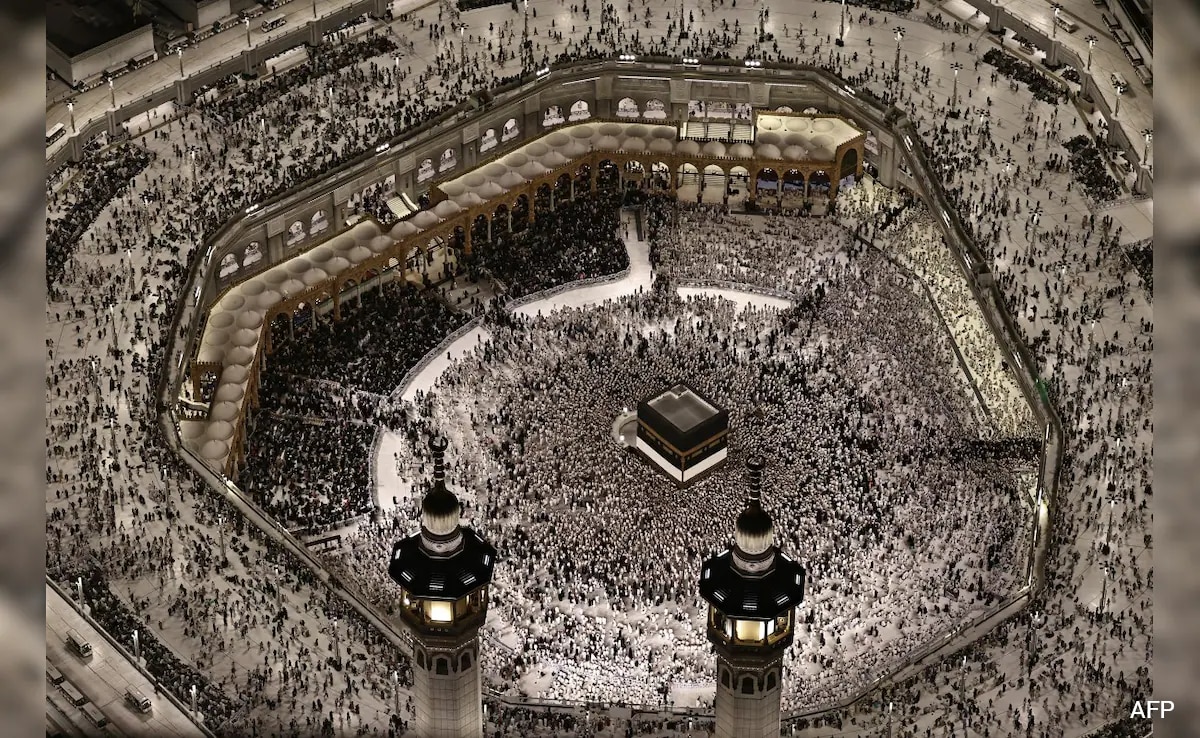
The Hajj is no longer merely a religious obligation or a logistical feat; it functions as a high-stakes stress test for Saudi Arabia’s Vision 2030 and a barometer for Middle Eastern stability. While the pilgrimage involves the movement of approximately two million people into a concentrated geographic area, the 2024–2026 cycle is defined by the tension between religious soft power and the hard realities of the Gaza-Israel conflict. The convergence of these two forces creates a volatile environment where logistical precision must insulate the Kingdom from regional contagion.
The Mechanics of Sovereign Legitimacy
The Saudi monarchy derives its primary international and domestic legitimacy from its role as the Custodian of the Two Holy Mosques. This creates a non-negotiable performance requirement. Any failure in safety, public health, or crowd control directly degrades the Kingdom’s authority. During periods of war, this risk profile shifts from operational to existential.
The current conflict in Gaza introduces three specific vectors of instability that the Saudi state must neutralize through administrative control:
- Ideological Contamination: The Hajj serves as the world’s largest gathering of the Ummah. Under standard conditions, Saudi authorities strictly prohibit political demonstrations to maintain the sanctity of the ritual. During active warfare involving regional powers, the risk of spontaneous protests or the importation of external political grievances increases.
- Transnational Security Gaps: The mobilization of millions requires the suspension of typical border friction. Hostile actors or non-state groups can theoretically exploit these flows, necessitating a high-friction surveillance state beneath a low-friction pilgrim experience.
- Reputational Arbitrage: Adversaries of the Saudi state, particularly those within the "Axis of Resistance," use the Hajj as a platform to critique Saudi alignment with Western interests. Success is measured by the absence of headlines.
The Logistical Infrastructure of Mass Ritual
The 1.8 to 2.5 million pilgrims attending the Hajj represent a population density that exceeds almost any other human event. Managing this requires a rigid framework of spatial and temporal slotting.
The Spatial Bottleneck Theory
The Hajj occurs within a fixed geography—Mina, Arafat, and Muzdalifah. These sites cannot be expanded. Therefore, the only way to increase capacity is through vertical integration (infrastructure) and temporal precision (scheduling).
- Flow Optimization: Authorities utilize AI-driven heat mapping to prevent "crush points." These systems calculate the fluid dynamics of human movement, treating the crowd as a non-Newtonian fluid that must remain in constant motion to avoid a catastrophic density event ($ \rho > 4 $ persons per square meter).
- The Health Subsidy: The Kingdom essentially subsidizes a global public health initiative. By requiring specific vaccinations and maintaining a network of mobile hospitals, they mitigate the risk of a "super-spreader" event that could trigger a global pandemic, a concern that remains heightened in a post-COVID-19 regulatory environment.
The Economic Distortion of Religious Tourism
The Hajj and Umrah are the pillars of the Saudi "non-oil" GDP targets. Vision 2030 aims to host 30 million pilgrims annually by the end of the decade. However, the current regional war creates a significant economic divergence.
While the "religious captive market" remains stable—devout Muslims will often spend their life savings to attend regardless of the geopolitical climate—the "luxury and auxiliary" segments are sensitive to regional instability. High-net-worth pilgrims from the West and the Gulf may shorten their stays or reduce discretionary spending if the perception of regional insecurity persists.
The cost structure of the Hajj is rising due to three primary factors:
- Insurance Premiums: Increased regional kinetic activity (such as Red Sea maritime disruptions) raises the cost of logistics and transit, which is passed down to the pilgrim.
- Security Overhead: The deployment of tens of thousands of security personnel, drones, and biometric monitoring systems is an unrecouped operational expense.
- Infrastructure Debt: The massive capital expenditure on the Makkah Royal Clock Tower, the Haramain High-Speed Railway, and the expansion of the Grand Mosque requires high occupancy rates to service the underlying investment.
The Gaza Conflict as a Strategic Constraint
The war in Gaza forces Saudi Arabia into a defensive diplomatic posture. They must balance three conflicting objectives:
- Solidarity with the Palestinian Cause: Essential for maintaining domestic stability and leadership in the Islamic world.
- Maintenance of the Security Architecture: Preserving the tacit and explicit defense cooperation with Western allies that ensures the Kingdom’s safety.
- The Neutrality of the Hajj: Ensuring that the pilgrimage does not become a theater for the conflict.
The "trajectory of the war" mentioned in contemporary reporting is actually a question of escalation control. If the conflict expands to include direct state-on-state friction between major regional players, the Hajj becomes a liability. The closure of airspace or the disruption of desalination plants—which provide the water for the millions of pilgrims—would transform a religious event into a humanitarian disaster.
The Quantifiable Risks of Climate and Conflict
We must account for the "Wet Bulb Temperature" risk. As the Hajj shifts deeper into the summer months over the lunar cycle, the physical toll on pilgrims increases. When combined with the stress of regional war, the margin for error disappears.
- Resource Competition: During a conflict, state resources (transport, medical, fuel) may be diverted to military readiness.
- Cyber-Kinetic Threats: In modern warfare, the Hajj infrastructure—specifically the digital identity and visa systems—is a high-value target for state-sponsored cyberattacks intended to cause chaos and delegitimize the host.
Strategic Directive for Regional Stability
The Hajj should be viewed as a stabilizing mechanism rather than a point of vulnerability. For the Saudi state, the priority is the Sanitization of the Sacred Space. This involves:
- Information Dominance: Controlling the narrative within the holy sites to ensure the focus remains on the ritual, not the geopolitical reality outside the gates.
- De-escalation via Bureaucracy: Using the visa system as a filter to prevent the entry of known political agitators.
- Operational Decoupling: Ensuring that the Hajj’s supply chain (food, water, electricity) is entirely independent of regional trade routes that might be affected by the war.
The success of the Hajj in 2026 will not be measured by the number of attendees, but by the invisibility of the security apparatus and the containment of regional political fervor. The Kingdom must demonstrate that it can host the world while the periphery burns. Any deviation from this clinical execution provides an opening for rivals to challenge the current regional order. The ultimate strategic play is the maintenance of "Normalcy at Scale"—proving that the Saudi state is the only entity capable of managing the volatile intersection of mass religious fervor and modern geopolitical friction.