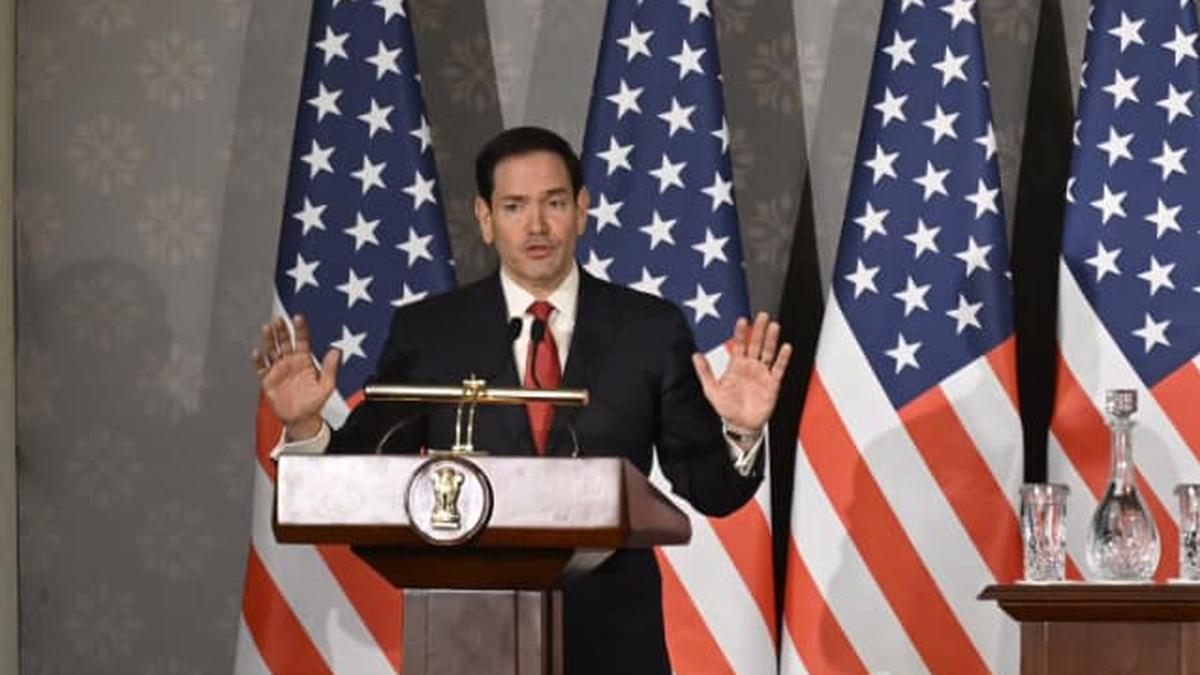
Washington cannot brush off targeted online bigotry as the mere ramblings of uneducated citizens if it expects New Delhi to remain its anchor in Asia. When U.S. Secretary of State Marco Rubio stood next to Indian External Affairs Minister S. Jaishankar in New Delhi on Sunday, he attempted a classic political pivot to defuse rising anger over anti-immigrant vitriol emanating from the highest levels of American political discourse. By dismissing targeted racist remarks against Indian Americans as the isolated actions of "stupid people" who exist in every nation, Rubio chose a rhetorical escape hatch that ignores a much deeper systemic crisis threatening the economic and strategic bonds between the two global powers.
The diplomatic dance at Hyderabad House comes at a precarious moment. Just weeks prior to Rubio's arrival, New Delhi uncharacteristically lambasted an offensive social media post from President Donald Trump that labelled India a "hellhole" and falsely attacked the literacy and hiring practices of Indian tech professionals. For decades, the Indian diaspora has served as the human bridge cementing Washington-Delhi ties. Trashing that community to score domestic points while simultaneously demanding billions in tech investments is an unsustainable foreign policy. Rubio’s defense—invoking his own family’s journey from Cuba and highlighting the twenty billion dollars Indian firms have plowed into the American economy—reveals a superpower trying to have its cake and eat it too.
The Friction in the Machinery
The United States is currently overhauling its legal immigration framework, creating massive anxiety across the tech corridors of Bengaluru and Silicon Valley. Rubio insisted that tightening restrictions on J1, F1, and H1B visas is part of a global modernization effort to address a massive border crisis rather than a policy aimed at punishing India.
The data tells a more complicated story. Indian nationals routinely secure more than seventy percent of the highly coveted H1B specialty occupation visas issued annually. Any systemic shift to this pipeline directly hits Indian tech conglomerates and American tech giants alike. The administration's attempt to bundle the highly vetted, economically vital high-skilled immigration apparatus with broader panic over millions of unauthorized border crossings is causing severe economic whiplash.
Consider a hypothetical Silicon Valley enterprise relying on advanced systems architects from IIT Mumbai. Under the guise of global modernization, these engineers face unpredictable delays and hostile rhetoric, forcing multinational firms to reconsider whether to expand operations in Texas or simply relocate entire divisions to Toronto or Hyderabad. This isn't just friction; it's a structural realignment of global tech talent.
The Strategy vs the Screed
The paradox of the current U.S. posture is glaring. While the political rhetoric leans into isolationist protectionism, the military and intelligence apparatus is demanding unprecedented integration with India. Jaishankar noted that the two countries just renewed their ten-year major defense partnership and signed a comprehensive roadmap for underwater domain awareness.
| Dimension | Strategic Objective | Rhetorical Reality |
|---|---|---|
| Defense | Joint manufacturing and naval integration | Xenophobic political narratives targeting allies |
| Technology | Securing supply chains against adversaries | Threats to dismantle high-skilled H1B pathways |
| Capital | Attracting deeper Indian corporate investments | Dismissing targeted diaspora harassment as internet noise |
This split-brain foreign policy cannot survive a protracted cold war in the Indo-Pacific. India is one of the few nations maintaining robust ties with Washington, Israel, Iran, and the Gulf states simultaneously. New Delhi knows its value and is increasingly unwilling to overlook public insults for the privilege of buying American hardware.
Dismissing anti-Indian vitriol as online white noise ignores how that noise influences actual policy decisions. When the leadership of an allied nation routinely utilizes weaponized xenophobia to mobilize its base, it creates an environment where immigration policy becomes punitive rather than strategic. The modernization Rubio speaks of looks less like an optimized, merit-based update and more like an ideological retrenchment that treats vital allies as economic competitors.
The Limits of Immigrant Exceptionalism
Rubio’s reliance on his personal narrative as the son of a Cuban bartender and a maid to prove America's welcoming nature is a powerful piece of political theater, but it misses the contemporary reality. The post-1965 Indian migration wave to the United States represents one of the most highly educated, high-earning immigrant cohorts in human history. They did not just assimilate; they built the infrastructure of the modern digital economy.
Treating this group as a convenient political punching bag while expecting them to continue fueling twenty-billion-dollar investment cycles is a dangerous miscalculation. The modern Indian state, buoyed by its own economic rise and aggressive diplomatic posture under Jaishankar, is no longer content to play the quiet partner. If Washington continues to tolerate or excuse racist rhetoric under the banner of domestic political freedom, it will find that strategic trust is a non-renewable resource.
The United States cannot successfully execute a high-tech manufacturing pivot or secure the Indian Ocean if its political class continues to alienate the very population required to build those bridges. True strategic partnership requires alignment not just in closed-door defense briefings, but in the public language used to describe the people who make those partnerships possible. A superpower that tolerates the casual denigration of its most vital economic partners cannot expect to hold their loyalty when geopolitical pressures mount.


