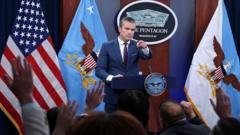
The red "On Air" light has a way of sanitizing combat. Under the soft glow of studio LEDs, war becomes a series of maps, digital overlays, and confident assertions delivered in a baritone that never wavers. For years, Pete Hegseth occupied that space. He was the bridge between the visceral reality of the infantryman and the polished outrage of the evening news. But the transition from describing a war to directing one is not a change of scenery. It is a fundamental shift in the nature of power.
When Donald Trump tapped Hegseth to lead the Department of Defense, the shockwaves through the Pentagon weren't about policy. They were about culture. This was the elevation of a specific kind of American archetype: the insurgent veteran who believes the greatest threat to the military isn't found in a bunker in Tehran, but in a boardroom in Arlington.
The Weight of the Rucksack
Imagine a young lieutenant in the 101st Airborne. The air in Samarra is thick with the smell of burning trash and diesel. His pulse is a rhythmic hammer against his ribs. Every alleyway is a question mark; every pile of rubble is a potential death sentence. That version of Hegseth, the one who earned Bronze Stars in the dust of Iraq and Afghanistan, learned a singular, brutal lesson. He learned that bureaucracy is often a luxury the front line cannot afford.
In the decades that followed, that lieutenant traded his rifle for a microphone. He didn't just report the news; he curated a worldview where the "warrior class" was being betrayed by a "managerial class."
To understand the current tension in Washington, you have to understand that resentment. It is the feeling of a man who believes the people giving the orders have forgotten what it’s like to carry the weight. Hegseth didn't arrive at the Pentagon to refine the budget. He arrived to break the mold. He represents a segment of the country that views the military as a weapon that has been dulled by social engineering and administrative bloat.
The Iranian Chessboard
Tehran is not a static target. It is a living, breathing entity with a memory that stretches back millennia. For the Iranian leadership, the appointment of a man like Hegseth is a signal. It tells them that the era of "strategic patience" and calibrated diplomacy has been replaced by something far more volatile.
Consider the mechanics of a standoff in the Strait of Hormuz. A small Iranian fast boat buzzes a U.S. destroyer. In the old world, the response is a series of pre-approved escalations, a dance choreographed by decades of precedent. But Hegseth has spent years arguing that this dance is a sign of weakness. He views the "rules-based international order" as a set of handcuffs.
When he speaks of Iran, he doesn't use the cautious language of a career diplomat. He uses the language of a man who wants to win. This is where the human element becomes dangerous. In the high-stakes game of nuclear brinkmanship, perception is reality. If the adversary believes you are looking for a fight, they may decide to start it on their own terms.
The War Within the Walls
Walking through the rings of the Pentagon is like moving through a cathedral of stability. The floors are polished to a high shine. The portraits of past Secretaries look down with somber, measured expressions. It is a place built on the idea that the institution is greater than the individual.
Hegseth’s presence there is an organ transplant that the body is trying to reject.
He has openly called for the firing of top-tier generals, specifically those he deems "woke" or more concerned with diversity than lethality. To the career officer who has spent thirty years climbing that ladder, this is heresy. To the soldier in a foxhole who feels the military has lost its way, it is a long-overdue reckoning.
The conflict isn't just about Iran or China. It’s about the soul of the American fighting force. Hegseth is the avatar for a movement that wants to strip away everything they see as extraneous. They want a military that does one thing: kill people and break things.
But war is rarely that simple.
Modern conflict is a messy blend of cyber-attacks, economic sanctions, and psychological operations. It requires the very nuance that Hegseth’s "combative style" seeks to eliminate. The fear among the "gray beards" in the basement of the Pentagon is that in the rush to restore a perceived sense of toughness, the United States will lose the sophistication required to prevent a global catastrophe.
The Mirror of the Media
There is a peculiar irony in a man who built his career on television now being the one to manage the most sensitive secrets in the world. Television requires a villain and a hero. It requires a clear narrative arc with a satisfying conclusion before the next commercial break.
Geopolitics offers no such closure.
The standoff with Iran is a marathon, not a sprint. It is a series of quiet compromises and invisible concessions. For someone used to the instant feedback of ratings and social media engagement, the slow, grinding pace of international relations can be infuriating.
The danger lies in the temptation to perform. When the cameras are on, the pressure to maintain the "combative" persona can lead to decisions that are irreversible. A stray comment, a provocative tweet, or a sudden shift in posture can be interpreted by a nervous commander in the Islamic Revolutionary Guard Corps as the beginning of an invasion.
The Invisible Stakes
Strip away the politics, the tattoos, and the talking points. What remains is the human cost of a miscalculation.
Behind every headline about "Hegseth’s War" are families in places like Des Moines and Shiraz who have no interest in the ideological battles of their leaders. They are the ones who will pay the price if the rhetoric turns into reality.
Hegseth’s rise is a symptom of a deeper fracture in the American psyche. We are a nation that has grown tired of "forever wars" but is simultaneously obsessed with the idea of a decisive, cinematic victory. We want the strength without the sacrifice. We want the hero without the complexity.
The man now standing at the helm of the world’s most powerful military is a reflection of that desire. He is the personification of a country that is finished with talking and is looking for a fight. Whether that fight leads to a renewed sense of American power or a devastating global conflict depends entirely on whether the man can transcend the persona.
The "On Air" light is off. The studio is empty. The maps are now real, and the stakes are measured in lives, not viewers.
The lieutenant is no longer in Samarra, but the dust has never really settled. It follows him into the halls of power, a reminder that in the world of shadows and steel, there are no scripted endings. Only the cold, hard silence that follows the flash.
The world is watching, not to see if he can speak the truth, but to see if he can survive it.
Would you like me to analyze the historical parallels between Pete Hegseth's appointment and other unconventional choices for Secretary of Defense?