Fourteen thousand dollars buys you a decent used sedan, a modest kitchen remodel, or a shelf full of secondhand curiosities at a flea market if you know how to haggle without blinking.
It does not buy an imperial secret. In related news, read about: What Autumn Light Tells Us About Staying Awake.
Yet somewhere in a room crowded with tarnished silver, mismatched cufflinks, and brass candlesticks that have forgotten which parlor they once warmed, a piece of gold with a clock hidden inside sat waiting to be recognized. No brass band played. No velvet rope dropped. Just cold metal, a quiet tick or a silent spring, and a human eye trained to notice what everyone else walks past.
I have spent years in rooms that smell like old wool, floor wax, and pennies. You learn quickly in those rooms that the most dangerous phrase in the trade is probably nothing. Every antique shop, estate sale, and salvage table is a graveyard of probably nothings—objects stripped of their names, their dates, their owners, and the revolutions that knocked them off their pedestals. Sometimes a tray of scrap holds only scrap. Sometimes, once in a lifetime, a fourteen-thousand-dollar gamble turns out to be a thirty-three-million-dollar resurrection. Cosmopolitan has provided coverage on this critical subject in extensive detail.
To understand how a small fortune hides in plain sight, you have to follow the invisible thread between the person who bought it and the court that once owned it.
The Weight of a Quiet Purchase
Money changes shape when you spend it on something nobody else wants.
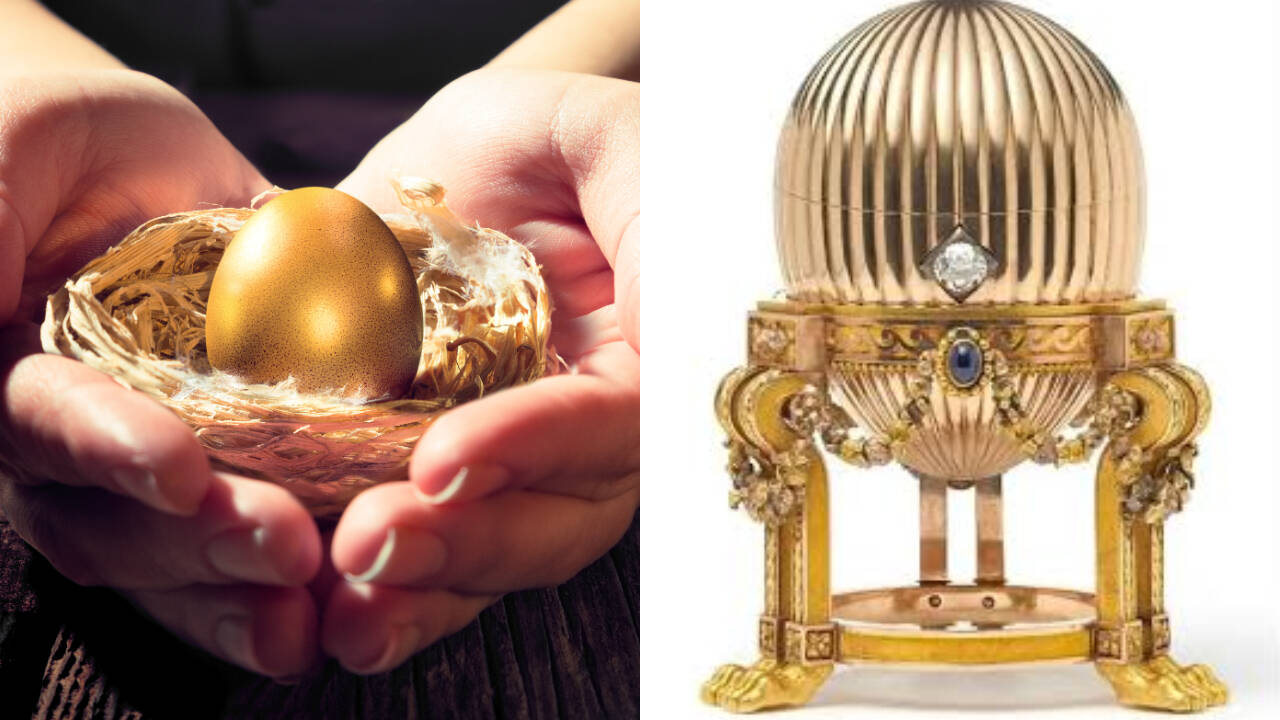
When a dealer lays down fourteen thousand dollars for a gold egg, that money is not sitting comfortably in a savings account earning interest. It is tied up in metal, risk, and time. If the piece turns out to be a clever twentieth-century imitation, fourteen thousand dollars becomes an expensive lesson in humility. If it is real—truly real, bearing the quiet mark of a master workshop from imperial Russia—that same fourteen thousand dollars becomes the opening bid on a story worth tens of millions.
Let me offer a hypothetical scenario to make the tension tangible. Picture a buyer named Arthur—not a real person in this specific transaction, just a composite of every careful picker I have ever watched work a table—standing under a humming fluorescent tube on a Tuesday morning. Arthur has grease on his thumb from checking a pocket watch hinge. His loupe hangs from a lanyard around his neck like a small black telescope. In front of him sits a gold egg, heavy enough to anchor a paper stack, ornate enough to look like a novelty from a distance, yet understated in a way cheap reproductions rarely manage. Cheap reproductions shout. Real imperial craftsmanship whispers until you lean in close.
Arthur does not see thirty-three million dollars at first. Nobody sees a number that large on a scuffed table without first seeing doubt. He sees weight. He sees enamel or engraving or mechanical mystery. He sees the possibility that history stepped sideways, slipped out of a velvet case in St. Petersburg over a century ago, crossed oceans and borders without a passport, and landed on a counter where nobody knew its real name.
That is the real stake of a discovery like this. Not merely the jump from fourteen thousand dollars to thirty-three million, though that gap is wide enough to take your breath away. The deeper stake is memory. Objects survive empires that do not. Palaces burn, crowns melt down, aristocracies scatter into exile, and archives get lost in cellars, yet a tiny gold object can outlive them all—quietly holding the fingerprints of its maker while waiting for someone to ask the right question.
When Imperial Craftsmanship Meets Ordinary Luck
History rarely announces itself with a trumpet. Usually it arrives in a cardboard box.
To grasp why a Fabergé egg commands thirty-three million dollars, you have to step back from the price tag and look at the world that produced it. In late imperial Russia, the House of Fabergé operated at a level of technical obsession that feels almost unreal in an era of mass production. Goldsmiths, lapidaries, enamelists, and watchmakers worked together under Peter Carl Fabergé to create objects of astonishing delicacy. For the Romanov court, Easter eggs were not mere trinkets. They were intricate works of art, often concealing a surprise inside—a miniature, a mechanism, a tiny triumph of engineering tucked into precious metal and stone.
Then came 1917.
Revolutions are notoriously careless with beauty. When the Bolsheviks seized power and the imperial family fell, the glittering ecosystem of St. Petersburg shattered overnight. Treasures were confiscated, hidden beneath floorboards, sold abroad for hard currency to feed a starving state, or carried out in coat linings by fleeing nobles. Many of the famous imperial Easter eggs were accounted for over the decades, cataloged by scholars and museums. Others vanished into the fog of war, exile, and private collections—the so-called "lost" eggs whose whereabouts became a mix of historical detective work and rumor.
Think of the odds for a moment.
A lost Fabergé treasure is not like finding an old baseball card in an attic, exciting as that can be. It is like finding a missing page from a book everyone thought had been burned. Every scratch, hallmark, design detail, and historical trace matters. Scholars and specialists do not simply gawk at shiny gold; they cross-reference provenance, inspect workmanship, verify marks, and weigh the evidence with fierce skepticism because the art market is full of wishful thinking and clever forgeries.
If you have ever held a genuine antique that turned out to be authentic after years of uncertainty, you know the strange quiet that follows the moment of certainty. The room does not change. The light outside the window stays the same. Yet the object in your hand suddenly carries a different gravity, as if time has compressed inside it.
Let me use a metaphor here—a deliberate one, so we do not confuse poetry with proof. Finding a lost masterpiece in an ordinary place is like hearing a faint, familiar melody through a closed door in a noisy train station. Most people keep walking toward their platform. One person stops, presses an ear to the wood, and realizes the song belongs to a symphony that was supposed to be lost forever.
Why People Miss Fortunes Sitting on the Counter
It is tempting to assume that anyone with fourteen thousand dollars to spend on an antique must be a walking encyclopedia.
In reality, expertise is lumpy. A dealer might know American silver inside and out while knowing very little about Russian court workshops. Another might spot a fake Rolex from across a crowded room yet miss a subtle stylistic clue on a continental piece of goldsmith work. Markets are fragmented. Information travels unevenly. An object can pass through dozens of hands over eighty years, each owner treating it as a curiosity, a souvenir, a scrap investment, or a decorative oddity.
Consider what happens next when a piece sits without documentation:
A grandson inherits a box from an uncle who rarely spoke about his youth. Nobody remembers where the box came from. Maybe there is a story about a relative who worked in Europe after the war, or maybe there is no story at all—just an object that looked "fancy" enough to keep on a dresser. Eventually, bills come due, or a house gets cleared out, or a dealer buys a lot on instinct.
That instinct is the part outsiders often misunderstand.
Outsiders look at a headline about a fourteen-thousand-dollar gold egg turning into a thirty-three-million-dollar Fabergé treasure and think of it as pure lottery luck. Luck certainly plays a role; you cannot find what never crosses your path. Still, luck in the antique world rarely visits people who never look closely. It rewards habit. It rewards picking the heavy thing up instead of glancing at it. It rewards noticing a tiny detail that feels slightly too refined for the price tag.
I have been wrong plenty of times myself. I have passed on things that later sold for more than I expected, and I have bought things with great confidence that turned out to be clever reproductions or modest pieces with big imaginations attached to them. There is a vulnerability in admitting that. Anyone who claims they never miss a trick or never misread a piece is either lying or hasn't handled enough objects yet. The market humbles everyone eventually.
That humility is actually what makes a real discovery so electric. Because you know how often the answer is no, the rare moment when the evidence lines up feels less like a win and more like a door swinging open in a wall you thought was solid.
The Gap Between Curiosity and Certainty
There is a wide canyon between I think this could be something extraordinary and thirty-three million dollars.
Most people never cross that canyon because crossing it takes patience, money, and nerve. Authentication and sale at the top tier of the art and collectibles world are slow, demanding processes. A piece has to be examined carefully. Its history has to be traced as far back as records and clues allow. Buyers at the thirty-three-million-dollar level are not guessing; they are committing generational wealth, so they want certainty—or as close to certainty as human scholarship and physical inspection can achieve.
Along the way, doubt creeps in from every angle.
What if the provenance has a gap? What if the craftsmanship is superb, yet a detail raises a question? What if the excitement of a potential windfall clouds judgment? Anyone who has ever waited on news that could change their financial life knows that waiting has its own physical weight. Sleep gets thinner. Every detail looks sharper. You start replaying conversations and examining photographs as if staring hard enough at the pixels could make the truth speak louder.
And when the answer finally comes back—when a modest fourteen-thousand-dollar purchase is revealed to be a lost Fabergé treasure worth thirty-three million dollars—the numbers themselves do something strange to the imagination. Thirty-three million is more than a big number. It is a threshold. It moves an object out of the world of nice find and into the world of museums, auction houses, sovereign-level collectors, and historical permanence.
Yet even at thirty-three million dollars, the egg is still just matter shaped by human hands. Gold. Craft. Time. A surviving fragment of a vanished world that refused to stay buried.
What This Story Really Asks of Us
Stories like this hook us because they combine two things humans crave: sudden reversal and hidden meaning.
We love the idea that the ordinary world is thicker with history than it looks. We like believing that a quiet Tuesday, an unassuming object, or a modest stake can suddenly open onto something vast. At the same time, there is a sharper edge to the story if we let ourselves feel it. How many stories, heirlooms, and pieces of history slip past us every day simply because we are moving too fast to look closely?
You do not need thirty-three million dollars—or fourteen thousand—to care about what survives. You only need attention. You need the willingness to pause over an object without a label, to ask where it came from before assuming what it is worth, and to respect the quiet labor of the people who made it long before you arrived.
A gold egg sits on a table. Nobody claps. Nobody knows yet how far it has traveled or what it will fetch when the world catches up.
Then someone picks it up, feels the weight in their palm, and listens.