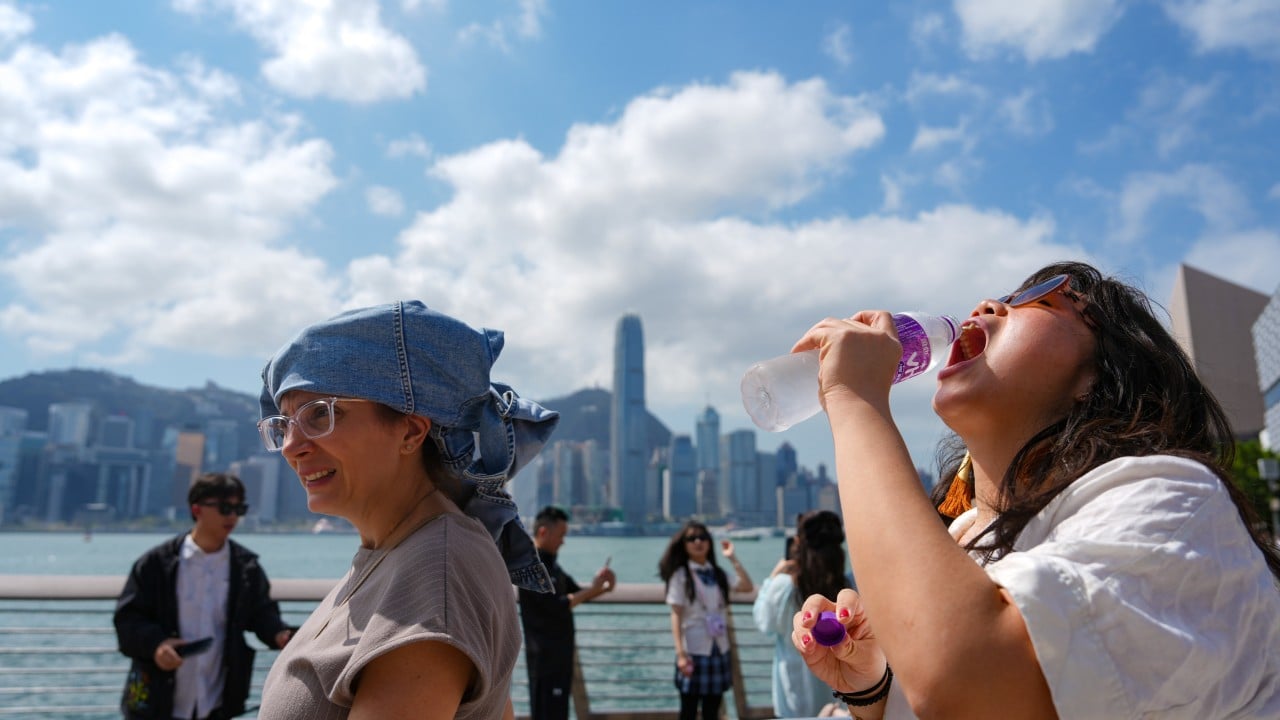
The thermometer on the brick wall of the bakery doesn’t lie, but it doesn't tell the whole truth either. It reads 33 degrees. To a casual observer, that number looks like a standard summer peak. It sounds like a beach day. It sounds like ice cream melting down a child's wrist.
But it is the duration that transforms a number into a weight.
Four straight days. Ninety-six hours where the walls of our homes never quite cool down, where the pavement acts like a storage battery for discomfort, and where the human body is forced into a relentless, low-grade battle against its own environment. When temperatures hit this threshold and refuse to budge for a ninety-six-hour stretch, something shifts in the rhythm of a city. The air grows heavy. The temper of the streets shortens. We enter a period of collective endurance that testing data can predict, but only human skin can truly understand.
Consider a hypothetical citizen named Marcus. He works in a logistics warehouse, a vast metal structure that behaves less like a workplace and more like a convection oven during a prolonged heatwave. On Tuesday, the first day of the 33-degree streak, Marcus feels fine. He sweats, he drinks water, he jokes with his coworkers about the sun. The body is an incredible machine; its built-in cooling mechanisms are efficient and prompt.
By Wednesday, the equation changes.
The heat has soaked into the concrete floor. The night didn't offer relief because the ambient temperature stayed trapped in the high twenties. Marcus didn't sleep well. His heart worked a little harder all night just to keep his core temperature stable. When he returns to work on Thursday, the third consecutive day, he isn't just dealing with the weather outside. He is dealing with the cumulative deficit of his own exhaustion.
This is the hidden mechanics of a four-day heat event. The danger isn't just the peak temperature reached at 3:00 PM. The danger is the absence of a valley.
The Physiology of the Unbroken Stretch
To understand why a prolonged stretch of 33-degree weather catches us off guard, we have to look at how our internal thermostat operates. We are, essentially, water-based engines that need to maintain a steady internal environment. When the air around us approaches our core body temperature, the standard method of shedding heat—radiating it out into the room—stops working.
The body resorts to its secondary defense: evaporation.
Every bead of sweat that forms on your skin is a tiny rescue mission. As the liquid turns to vapor, it pulls a fraction of a calorie of heat away from your flesh. It is a beautiful, elegant system. But it requires an enormous amount of energy. Your heart pumps faster, diverting blood away from your internal organs and toward your skin to help cool it down.
When this happens for a few hours, it is a minor workout. When it happens for four days without a break, it becomes a marathon.
Medical professionals refer to this cumulative strain as heat burden. On day one, your kidneys and cardiovascular system handle the stress. On day two, the lack of deep, restorative sleep begins to fray your cognitive sharpness. By day three and four, the risk of heat exhaustion spikes exponentially, not because the weather got hotter, but because the human reservoir of resilience has run dry. The elderly, the very young, and those without access to reliable climate control bear the brunt of this invisible tax.
The Quiet Transformation of Common Spaces
Walk down any main street during a standard summer afternoon and you will hear a symphony of activity. Children playing, outdoor cafes filled with chatter, the general hum of a community in motion.
Watch what happens by day three of a 33-degree blockade.
The streets empty by noon. The social fabric retreats indoors, seeking the hum of fans and the artificial chill of air conditioning. This retreat creates a strange, ghostly quiet in our neighborhoods. The economic impact is real, though rarely tallied in the immediate aftermath. Foot traffic drops. Productivity slows down because human brains simply do not process complex tasks as quickly when the body is redirected toward survival.
We often view weather as an external event, something happening out there while we go about our lives in here. A sustained heatwave shatters that illusion. It penetrates the brick, leaks through the insulation, and alters how we interact with one another. Irritability increases. Road rage incidents tick upward. The emergency room see a steady rise not just in heat stroke cases, but in accidents born from fatigue and distraction.
Surviving the Third and Fourth Waves
We cannot stop the high-pressure system from sitting over our heads, but we can change how we respond to the timeline. The mistake most of us make is treating day four the same way we treated day one.
We try to power through.
True adaptation during a four-day stretch requires a shift from active resistance to strategic pacing. It means acknowledging that by Thursday, your body is operating on a deficit. Hydration isn't something you start when you feel thirsty; it is a preventative measure you maintain hours before the sun hits its peak. It means checking on the neighbor who lives alone on the top floor, where the rising heat of the entire building collects like a stagnant pool.
The forecast tells us the numbers, but we have to write the narrative of how we handle them. We have to look past the superficial appeal of a sunny sky and recognize the quiet strain happening beneath the surface of our towns and cities.
The sun will eventually dip. A cool front will arrive, breaking the pressure cook and allowing the concrete to breathe again. Until that moment arrives, the task is simple, unglamorous, and vital. We watch the clock, we share the shade, and we remember that the heat is a test of endurance, passed one cool glass of water at a time.


