Two thousand bottles sit on a white tablecloth in Wan Chai, sweating slightly against the air conditioning, while a man from Bordeaux tries to explain clay soil to a sommelier from Seoul using nothing but his hands and a cracked smartphone screen.
Noise. That is the first thing you notice when you step off the escalator into the Hong Kong Convention and Exhibition Centre during a major trade pour. It is not the polite, library-quiet clink of crystal you might expect from an industry built on velvet ropes and tasting notes about wet slate. It is a roar. It is three hundred dialects colliding over the smell of crushed blackcurrant, damp cardboard, and ambition.
For the past few years, that roar had grown fractured. If you worked in the global drinks trade, you felt the vertigo of a map constantly redrawing itself. One spring you were packing your spit bucket for Singapore; the next, you were trying to calculate shipping tariffs for a boutique harvest that might get stuck in customs before the first badge was even printed. Buyers were exhausted. Producers were bleeding cash on flights that led to half-empty aisles. The industry needed a heartbeat again, steady and predictable, in one place.
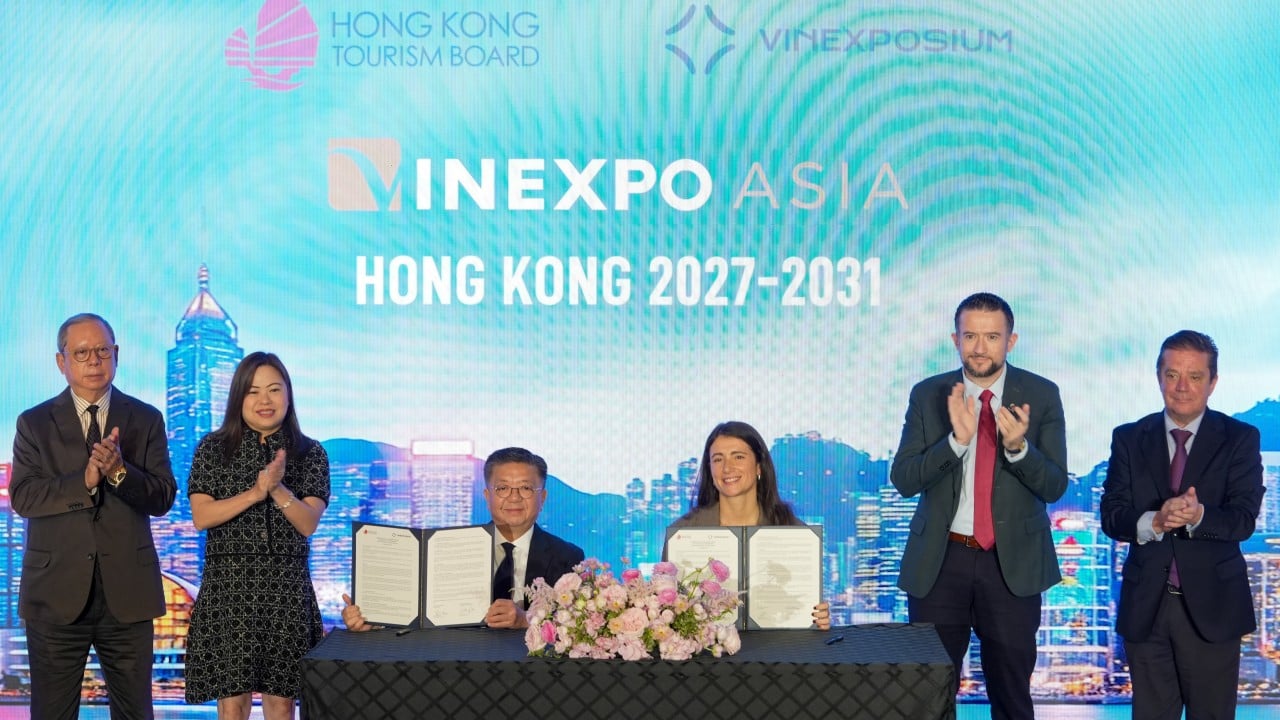
Then came the announcement that quieted the room. Vinexpo Asia—the gravitational center of the wine and spirits trade across the Pacific—locked in Hong Kong as its exclusive home for the next five years.
On paper, that reads like a dry municipal press release. A venue contract. Five calendar dates inked in advance.
In reality, it is a lifeline thrown to an entire ecosystem of farmers, importers, and late-night bartenders who were starting to wonder if Asia’s golden era of wine had quietly slipped through their fingers.
The Cost of a Wandering Market
To understand why a five-year residency matters, you have to understand what happens to a winemaker when a trade show becomes a nomad.
Consider a hypothetical producer—let’s call her Elena—who farms twelve hectares of old-vine Grenache on a sun-baked hillside outside Zaragoza, Spain. Elena does not have a marketing department. She has a tractor, a cellar hand named Mateo, and an export budget that barely covers two international trips a year. When Vinexpo Asia alternated between cities, splitting its energy between Singapore’s gleaming Marina Bay and Hong Kong’s harborfront, Elena faced a brutal math problem every twelve months.
Do you bet your harvest on Southeast Asia, where tropical humidity makes cold-chain logistics a nightmare and import duties can triple the price of a ten-euro bottle before it ever touches a restaurant menu? Or do you wait for the Hong Kong rotation, risking an entire year of silence while your competitors steal your shelf space in Shanghai, Taipei, and Tokyo?
I have watched dozens of real producers make that exact calculation in cramped airport lounges from Frankfurt to Doha. You see it in the dark circles under their eyes as they nurse lukewarm espressos, trying to figure out whether three days behind a booth will pay for next autumn’s oak barrels. Uncertainty is the quietest killer in agriculture. You can survive a hailstorm in May; you cannot survive spending forty thousand dollars to pour wine for buyers who stayed home because they were confused about where the party moved this year.
When Vinexposium, the organizers behind the fair, decided to anchor Vinexpo Asia exclusively in Hong Kong through the end of the decade, they stopped asking producers to gamble. They turned a wandering circus into an institution.
Why Hong Kong Still Holds the Keys
Skeptics will raise an eyebrow here. They always do. Over the last half-decade, plenty of armchair analysts wrote premature obituaries for Hong Kong’s status as Asia’s premier trading hub. They pointed to shifting corporate headquarters, changing travel habits, and the rise of regional rivals eager to snatch the crown.
Those analysts missed something fundamental about how wine actually moves across borders. Wine is not software. You cannot email a pallet of Burgundy. It is heavy, fragile, temperature-sensitive, and deeply bound to trust.
Hong Kong possesses a structural advantage that no rival city in the region has managed to replicate, and it comes down to a single, miraculous decision made back in 2008: zero wine duty.
Before 2008, importing fine wine into Hong Kong carried an eighty percent tax. Overnight, that wall vanished. Within three years, the city surpassed London and New York to become the largest wine auction hub on earth. Warehouses carved into the humid hillsides of the New Territories transformed into climate-controlled vaults holding billions of dollars in liquid history.
Think of Hong Kong not as a single market of seven and a half million people, but as a high-pressure valve sitting directly at the mouth of the Pearl River Delta. From a booth overlooking Victoria Harbour, a winemaker isn't just talking to a local hotelier in Central. Within a ninety-minute high-speed train ride or a three-hour flight, that same winemaker is sitting across from buyers representing the booming middle-class dining scenes of Shenzhen, Guangzhou, Bangkok, Ho Chi Minh City, and Manila.
Singapore is immaculate, efficient, and wealthy—a remarkable gateway for Southeast Asia. Yet when you factor in alcohol excise taxes calculated by the liter and alcohol percentage, opening a bottle in Singapore carries an immediate financial friction that every importer feels in their margins. In Hong Kong, the friction disappears. Samples flow freely. Deals get struck over dim sum at noon, verified in bonded warehouses by three, and loaded onto container ships bound for half a dozen Asian ports before dinner.
By committing exclusively to Hong Kong for five years, Vinexpo Asia isn't ignoring the rest of the continent. It is planting its flag on the one patch of ground where the entire continent can afford to meet without a tax collector standing between every handshake.
What Actually Happens Behind the Booths
If you have never worked a three-day trade fair, it is easy to romanticize it. You picture swirling glasses, poetic descriptions of blackberry compote, and effortless glamour.
The truth is blisters.
By day two of Vinexpo Asia, the carpet in Hall 3 feels like concrete. Your teeth are stained purple from tannin, your palate is stripped raw by high-acid Rieslings, and your voice is a raspy whisper from shouting over the din of ten thousand conversations. Around two in the afternoon, a quiet desperation sets in among the exhibitors. You watch a family-owned spirits distiller from Tasmania stare at the aisle, willing a buyer from a major Japanese hotel group to slow down for thirty seconds.
That thirty-second window is why continuity changes everything.
In Asian business culture—and particularly in the relationship-driven world of wine distribution—nobody buys a container on the first hello. Trust is built through repetition. When a buyer from Kuala Lumpur walks past your booth in year one, they take your card and taste one wine. In year two, if you are standing in the exact same corridor, they remember your face and bring their head sommelier. By year three, they sign the distribution contract.
When a trade show jumps cities every other year, that rhythm breaks. Faces vanish. Rhythms reset. By guaranteeing five consecutive years in Hong Kong, the organizers have effectively handed every small and mid-sized producer a five-year runway to build real, durable human relationships.
Consider what happens next: a boutique biodynamic producer from Mendoza no longer has to treat Asia like a one-night stand. They can fly in every May, host intimate vertical tastings in Soho wine bars the night before the floor opens, follow up with the same regional importers twelve months later, and watch their labels slowly migrate from obscure wine lists onto the tables of Shanghai’s top bistros.
Beyond the Red Bordeaux Myth
Walk the aisles today, and you will also notice that the liquid inside the glasses has changed dramatically since Vinexpo first arrived in Asia back in 1998.
Twenty years ago, the Asian wine trade was a monolith. Buyers wanted heavy, prestigious French reds—labels with gold embossing that signaled wealth at corporate banquets. If a bottle didn't come from Bordeaux or Burgundy, you struggled to get a nod.
That world is gone.
Look closely at the tasting tables now, and you see the messy, thrilling evolution of a generation that drinks for curiosity rather than status. You see young sommeliers from Taipei crowding around volcanic-soil whites from Sicily. You see craft mezcal distillers from Oaxaca pouring smoky sips for cocktail bar owners from Seoul. You see low-intervention, cloudy natural wines from Austria sitting directly beside centuries-old Cognac houses, and nobody blinks.
Spirits, too, have claimed massive territory on the floor. Single-malt whiskies from India and Taiwan, botanical gins from coastal Australia, and small-batch baijiu reimagined for modern mixology are no longer sidebars—they are main events.
This shift makes a permanent home in Hong Kong even more vital. When tastes fragment and diversify, buyers cannot rely on big brand names alone; they have to taste. They need a single annual gathering massive enough to bring thirty-five producing countries under one roof, yet familiar enough that a buyer knows every back-alley wine bar and late-night noodle shop where the real business happens after the convention center lights flicker off at six.
The Invisible Stakes of the Next Five Years
There is an honesty required when looking at the global drinks industry right now: times are tough.
Global wine consumption has dipped to its lowest point in decades. Younger drinkers in major Western markets are moderating their alcohol intake, inflation has squeezed restaurant margins from Paris to Tokyo, and geopolitical tariffs have turned international trade into an obstacle course. Many vineyards are pulling up vines. Many distributors are consolidating.
In moments of contraction, industries have a choice. They can retreat into their corners, hoard their budgets, and wait for the storm to pass. Or they can build a lighthouse.
Locking Vinexpo Asia into Hong Kong for five years is that lighthouse. For the Hong Kong Tourism Board and the city’s hospitality sector, it means tens of thousands of high-spending international visitors filling hotel rooms, Michelin-starred dining rooms, and neighborhood cha chaan tengs every spring. For Asian buyers—whether they run a boutique bottle shop in Hanoi or manage beverage procurement for an airline in Doha—it removes the guesswork from their annual calendar.
More importantly, it restores something intangible that the industry nearly lost during the years of border closures and shifting venues: momentum.
When you know the ship is sailing from the same pier every year, you prepare differently. You bottle your best cuvée specifically for the Asian market. You translate your technical sheets into Mandarin, Japanese, and Korean. You invest in the relationships because you know the stage isn't going to disappear beneath your feet next season.
Picture that winemaker from Bordeaux again—the one with the cracked smartphone screen and the soil-stained fingernails. Next May, he won't be wondering where to book his flight, or whether the buyers from Shenzhen will bother making the trip, or how much customs will charge just to let him open his cases. He will walk off the Star Ferry, feel the warm harbor breeze hit his face, wheel his battered suitcase up the ramp in Wan Chai, and start pouring.


