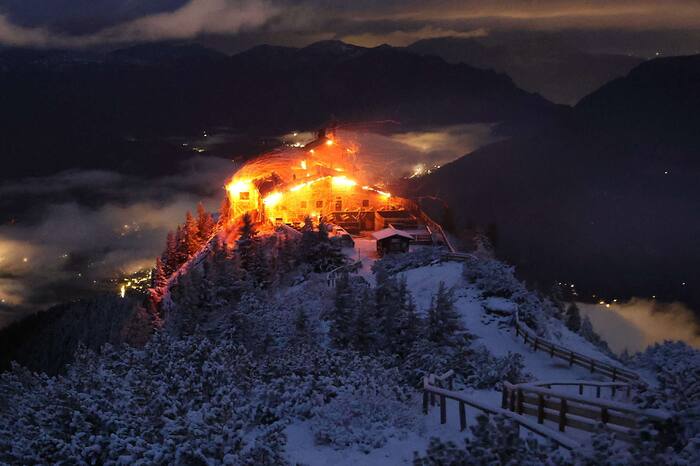
A suspect is in custody and an investigation is underway after a fire devastated the Eagle's Nest in southern Germany. When headlines break about flames tearing through the Kehlsteinhaus—the infamous mountain retreat built for Adolf Hitler—most people react with a weird mix of shock and historical curiosity. You might think a piece of dark history just went up in smoke. Honestly, the reality of what happened on that Bavarian ridge is way more complicated than a simple headline suggests.
To understand why this fire matters, you have to strip away the myths surrounding the building itself. Most tourists and casual readers confuse the Eagle's Nest with Hitler's actual residence. They aren't the same place. Not even close.
Separating the Kehlsteinhaus From the Berghof
Let's clear up the biggest misconception first. Hitler rarely visited the Eagle's Nest. Built atop the Kehlstein peak at an elevation of 1,834 meters above Berchtesgaden, the Kehlsteinhaus was a 50th birthday gift from the Nazi Party, spearheaded by Martin Bormann in 1938. Hitler was notoriously claustrophobic and terrified of heights. Taking a brass-lined elevator 124 meters straight up through solid rock wasn't his idea of a relaxing weekend. Historical records from the Dokumentation Obersalzberg confirm he visited the site fewer than twenty times.
His real headquarters was the Berghof, located further down the mountain on the Obersalzberg slope. Allied bombers largely destroyed the Berghof in April 1945, and Bavarian authorities blew up the remaining ruins in 1952 to stop it from becoming a neo-Nazi shrine.
The Kehlsteinhaus survived the war untouched. For decades, it operated as a mountain restaurant and observation deck, drawing hundreds of thousands of visitors every summer for the panoramic Alpine views. That survival is precisely why a fire there triggers such intense scrutiny from German police and historians alike.
Why Arson Investigations at Nazi Sites Carry Heavy Weight
Police detaining a suspect immediately shifts this story from an accidental structural blaze to a potential crime scene. In Germany, anything involving former Third Reich infrastructure sits on a razor's edge. Authorities don't treat it like a standard property crime.
When a fire breaks out at a site tied to Hitler, investigators look at two primary motives right away. First, political extremism from the far-right—individuals trying to create a spectacle or destroy a site they feel is being "mismanaged" by democratic authorities. Second, radical anti-fascist activism aimed at erasing physical remnants of the Nazi regime entirely. Sometimes, though, it's just reckless vandalism with zero ideological backing.
German criminal police—specifically the Kriminalpolizei—take jurisdiction over fires involving historical monuments. Forensics teams have to comb through charred timber and stone at nearly 6,000 feet of elevation, where Alpine weather complicates every step of evidence collection. Wind whips across the Kehlstein ridge constantly. Ash scatters. Accelerants evaporate faster in thin mountain air.
If you've ever followed how Bavaria manages these sites, you know the state walks a tightrope. They refuse to glorify the past, yet they refuse to erase it. Turning the Kehlsteinhaus into a commercial restaurant leased out to private operators, with proceeds going to charity, was Bavaria's compromise. Burning it down forces a conversation nobody in Munich wanted to have this year.
The Engineering Reality of the Kehlsteinhaus
To appreciate what a fire actually does to this specific building, look at how Bormann had it constructed. This isn't a wooden chalet. Over 3,000 workers labored for 13 months to blast granite and haul massive stone blocks up a treacherous four-mile mountain road.
The core structure features thick granite walls, heavy steel reinforcements, and deep-set windows designed to withstand brutal Alpine winters. A fire inside the Kehlsteinhaus doesn't flatten the stone shell. Instead, it guts the interior—the timber ceilings, the historic woodwork, the modern restaurant kitchens, and the electrical systems running through the rock shaft.
What Actually Burns Inside a Stone Fortress
- Interior Woodwork and Furniture: Much of the original larch wood paneling and bespoke furnishings remained inside the main reception room and the famous fireplace lounge. Once timber this dry catches, temperatures spike rapidly inside thick stone walls that trap heat like an oven.
- The Elevator Shaft Infrastructure: While the tunnel itself is blasted through solid granite, the mechanical systems, wiring, and brass-plated cab components are vulnerable to smoke, intense heat, and water damage from firefighting efforts.
- Roofing and Structural Timbers: Traditional Bavarian roof framing uses heavy wooden beams. Even with slate or metal exteriors, an attic fire compromises the entire upper load-bearing structure.
Water access at 1,834 meters is a logistical nightmare. Fire brigades from Berchtesgaden and surrounding valleys can't just hook up to municipal hydrants on a sheer rock face. They rely on limited high-altitude cisterns, specialized mountain vehicles navigating hairpin turns, and helicopter water drops when wind conditions allow. Every minute it takes trucks to climb that steep, narrow road gives flames more time to chew through irreplaceable historical fabric.
How Germany Deals With Dark Heritage Sites
You can't talk about the Eagle's Nest without addressing Germany's broader philosophy of Erinnerungskultur—the culture of remembrance. For eighty years, German historians and policymakers have debated what to do with the concrete and stone left behind by the Third Reich.
There are basically three approaches used across the country:
- Complete Demolition: Done with the Berghof and the Berlin Führerbunker site. The goal is simple—leave nothing for extremists to worship.
- Active Educational Reuse: Used at the Documentation Center Obersalzberg just down the hill, where exhibitions contextualize Nazi crimes right where they were planned.
- Neutralized Commercial Operation: The model used at the Eagle's Nest. Strip away the propaganda, serve Bavarian beer and sausages to hikers, and let the mountain views speak for themselves.
Critics have argued for years that operating the Eagle's Nest as a scenic café trivializes history. You see tourists snapping smiling selfies on the exact terrace where Nazi officials once paced. On the flip side, historians point out that turning the building into a mundane tourist stop stripped it of its dark mystique far better than a barbed-wire fence ever could.
A devastating fire disrupts that balance. If the interior is ruined, the Bavarian state government—which owns the property through Immobilien Freistaat Bayern—faces a massive financial and political bill. Rebuilding a Nazi-era structure with taxpayer euros is a public relations headache in Germany. Leaving a charred ruin sitting atop one of Bavaria's most famous peaks isn't an option either.
What Happens Next for Visitors and Researchers
If you were planning a trip to Berchtesgaden or researching Obersalzberg history, expect immediate closures. The Kehlstein road, which normally operates exclusively via specialized mountain buses due to the extreme gradient and narrow tunnels, will remain closed to the public while structural engineers assess rock stability and heat damage.
Heat affects granite. When stone undergoes extreme thermal stress from a prolonged fire and sudden cooling from fire hoses, micro-fractures form. Engineers have to verify that the masonry anchoring the building to the cliffside hasn't weakened before a single tourist steps back onto that terrace.
For historians, the focus shifts to documentation. Over the past decade, preservationists have digitally mapped much of the Obersalzberg complex using 3D laser scanning. Those digital archives will likely become the primary reference point for assessing what was lost versus what can be stabilized.
Watch the official statements coming out of the Traunstein public prosecutor's office and the Bavarian State Ministry of Finance over the coming weeks. Their findings on the detained suspect's background and the exact structural assessment of the Kehlsteinhaus will dictate whether the Eagle's Nest is restored as a public landmark or permanently sealed off from the mountain above Berchtesgaden.