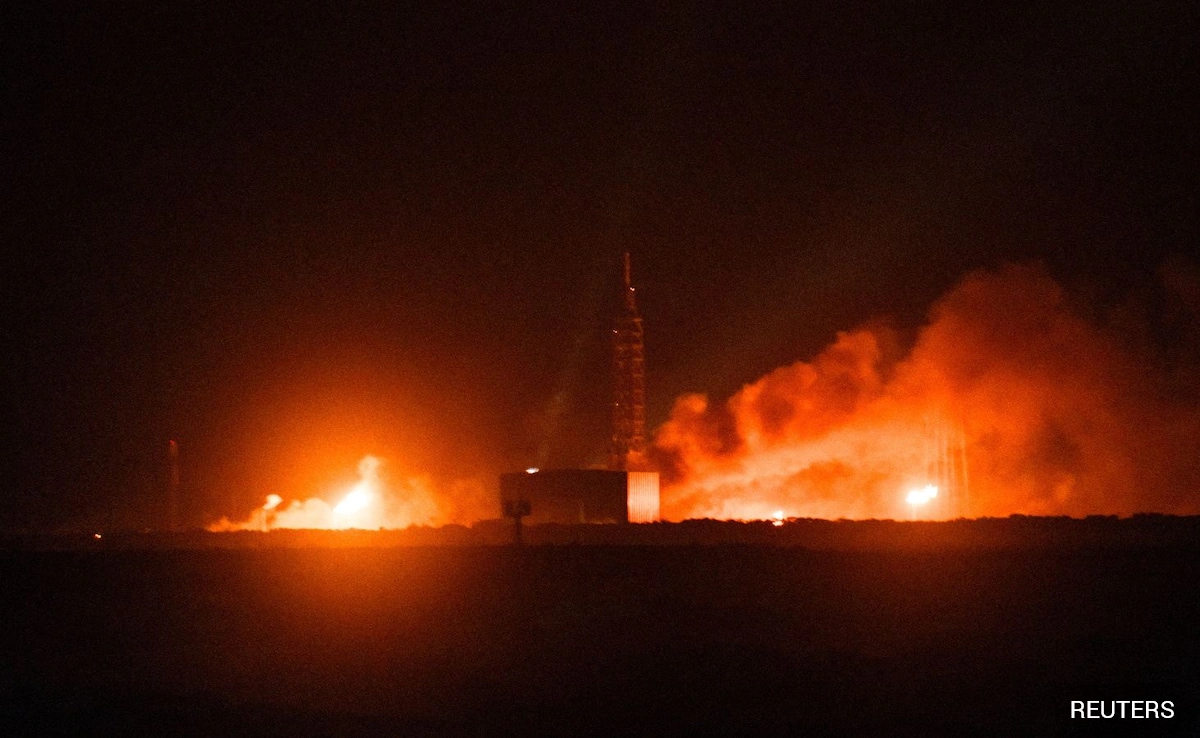
The desert near Van Horn, Texas, does not care about billionaires. It is a vast, unblinking expanse of scrub and rock, baking under a sun that punishes anything trying to rise above it. For years, this quiet patch of earth has played host to a specific kind of hubris: the belief that enough money can bend physics to the human will.
On a routine morning, the quiet shattered. Meanwhile, you can explore other events here: What Most People Get Wrong About China Longest Space Mission.
A booster rocket, stamped with the elegant feather logo of Blue Origin, roared off its pad. For a few brief moments, everything looked like the glossy promotional videos the company uses to sell the dream of civilian spaceflight. Then, the fire changed color. A sudden, violent burst of yellow and orange erupted from the engine. Automated escape systems fired instantly, blasting the capsule away from the malfunctioning booster like a seat ejected from a crashing fighter jet. The capsule drifted back to earth under parachutes, safe but scarred. The rocket booster below it was consumed by the desert.
To the casual observer watching the footage on a smartphone, it looked like a dramatic but successful test of an abort system. The capsule survived. No one was on board. To see the bigger picture, we recommend the excellent report by Ars Technica.
But out in the desert, as the smoke cleared, a different reality settled in. This wasn’t a triumphant proof of safety concepts. It was a disaster.
When a rocket explodes, the shockwaves travel far beyond the launchpad. They ripple through corporate boardrooms in Seattle, echo down the halls of Congress, and slam into the tightly budgeted timelines of NASA’s most ambitious moon-landing program in half a century. The fire in Texas didn't just destroy metal; it burned through the single most valuable currency in the modern space race.
Trust.
The Price of a Broken Promise
To understand why a single engine failure feels like a systemic heart attack, you have to look at the man who built the company. Jeff Bezos does not like to lose. His entire philosophy, honed over decades of dominating global e-commerce, is built on a concept he calls "Day 1"—the idea that a company must always maintain the urgency, hunger, and speed of a startup.
Yet, in the aerospace world, his motto has long been Gradatim Ferociter. Step by step, ferociously.
It is a beautiful sentiment on paper. It implies methodical excellence, a slow and unstoppable march toward the stars. But the space industry is no longer a gentlemanly club of academic exploration. It is a brutal, high-stakes sprint. While Blue Origin stepped methodically, competitors skipped steps, took massive risks, and built a dominant empire in orbit.
Consider the psychological weight carried by the engineers standing on the tarmac after that explosion. A rocket engine is a maddeningly complex beast. It is essentially a controlled bomb, forcing volatile chemicals through plumbing at unimaginable pressures and temperatures. When one fails, you cannot just look at the telemetry data and guess the fix. You have to pull apart every weld, every valve, every line of code.
That takes time. In the space business, time is an apex predator.
Every month a rocket sits grounded is a month spent burning through cash without a single ounce of data to show for it. For Bezos, the failure was a public bruising of a legacy he is desperate to cement. He doesn't want to be remembered simply as the man who sold everything to everyone; he wants to be the architect of humanity’s expansion into the solar system. The charred remains in the Texas dirt were a stark reminder that gravity does not care about net worth.
The Invisible Dependency
The panic, however, was not confined to Blue Origin’s headquarters. The tremors were felt acutely inside the civilian space agency that holds the keys to the future of American spaceflight.
NASA is trapped in a delicate, dangerous dance. Gone are the days of the Apollo program, when the federal government simply wrote blank checks to massive aerospace conglomerates to build machines to specification. Today, NASA is a customer. It buys rides. It awards contracts to private entities, betting the nation's geopolitical prestige on the efficiency of the free market.
It is a system built on redundancy. If one provider fails, the other steps in.
But when the fire broke out in Van Horn, that redundancy began to look like an illusion. NASA had already put an immense amount of faith—and billions of taxpayer dollars—into Blue Origin’s heavy-lift capabilities and engine manufacturing. The company wasn't just building rockets for tourism; they were contracted to build a lunar lander for the Artemis program, the grand initiative to put American boots back on the moon.
Think of NASA as a homeowner trying to build a house, relying on two separate contractors to deliver the foundation. One contractor is fast, loud, and constantly blowing up prototypes on the beach in Florida but somehow making progress. The other contractor is slow, quiet, promises total safety, and then watches their premier engine disintegrate on television.
Suddenly, the homeowner realizes they are utterly dependent on a single supply chain. If Blue Origin cannot deliver reliable engines, the entire American lunar timeline starts to slip. And in the background, a rival superpower is watching.
China does not rely on a patchwork of private billionaires to fund its lunar ambitions. The Chinese space program moves with the terrifying, synchronized rhythm of a state-directed apparatus. They are not waiting for a commercial launch provider to fix a valve issue. Every delay in the American commercial sector is a gift wrapped in gold to a geopolitical competitor racing for the strategic high ground of the lunar south pole.
The Human Toll of a Bad Day at the Office
It is easy to analyze these events through the lens of macroeconomics and global politics. We look at the stock prices, the contract values, the statements issued by public relations departments.
But if you zoom in, the true cost of an aerospace failure is borne by people who will never see their names in a headline.
Imagine an engineer who has spent the last five years of their life working eighty-hour weeks, missing birthdays and school plays, all to perfect a specific turbopump component. They have stared at blueprints until their eyes blurred. They have argued in meeting rooms until their voices went hoarse. They believed, with a fierce, almost religious devotion, that they were building the future.
Then, in a fraction of a second, a flaw they didn't catch turns their life's work into a cloud of toxic smoke.
The atmosphere inside a rocket company after a public failure is suffocating. It is a mix of grief, exhaustion, and paranoia. Every engineer begins to look over their shoulder, wondering if their subsystem was the one that brought the whole tower down. The momentum that fuels these impossible projects evaporates overnight, replaced by grueling anomaly investigations, regulatory scrutiny from the Federal Aviation Administration, and a crushing sense of defeat.
This human exhaustion is the hidden friction of space exploration. You can replace an engine. You can build another booster. But you cannot easily rebuild the fractured morale of a workforce that has just realized how incredibly difficult it is to leave this planet.
The Mirage of Easy Spaceflight
We have been spoiled by a decade of spectacular successes. We watched boosters land themselves on autonomous barges in the middle of the ocean. We watched rovers drop gently onto the surface of Mars via celestial cranes. We began to believe that spaceflight had been solved, that it was merely a matter of logistics and scaling up manufacturing.
It was a comforting lie.
The explosion reminded everyone that the line between a triumphant launch and a catastrophic failure is thinner than a sheet of paper. The physics of space travel are inherently unforgiving. To break free of Earth’s gravity, you must unleash energies so violent that they constantly threaten to tear the vessel apart from the inside out. There is no such thing as a routine launch.
Now, the industry faces an uncomfortable reckoning. The narrative that private enterprise would make space travel cheap, easy, and frequent has collided with the cold reality of rocket science.
The road ahead for Blue Origin is no longer about reaching the moon or selling tickets to wealthy adventurers. It is an internal, grueling battle to find the rot in the system. They have to prove to a skeptical public, and an even more skeptical NASA, that their step-by-step philosophy is a guarantee of safety, not an excuse for stagnation.
The fire has gone out in the Texas desert. The blackened metal has been hauled away for analysis. The sun continues to beat down on the empty launchpad, indifferent to the ambitions of the men who built it. The race will continue, because the hunger to reach the stars is too deeply ingrained in the human psyche to be stopped by a single failure. But the next time a rocket stands on that pad, the cheers of the crowd will be quieted by a collective, nervous holding of breath. Everyone now knows exactly what lies waiting just beneath the flame.