The air in the high-ceilinged government offices in Central is heavy with the scent of old paper and lukewarm coffee. Outside the glass, the city hums with its usual, relentless kinetic energy. Containers swing over the docks in Kwai Tsing. Stock tickers flash green and red across glowing screens in Sheung Wan. In the middle of it all sits a document that will dictate how the wealth, health, and daily survival of over seven million people will be managed for the foreseeable future.
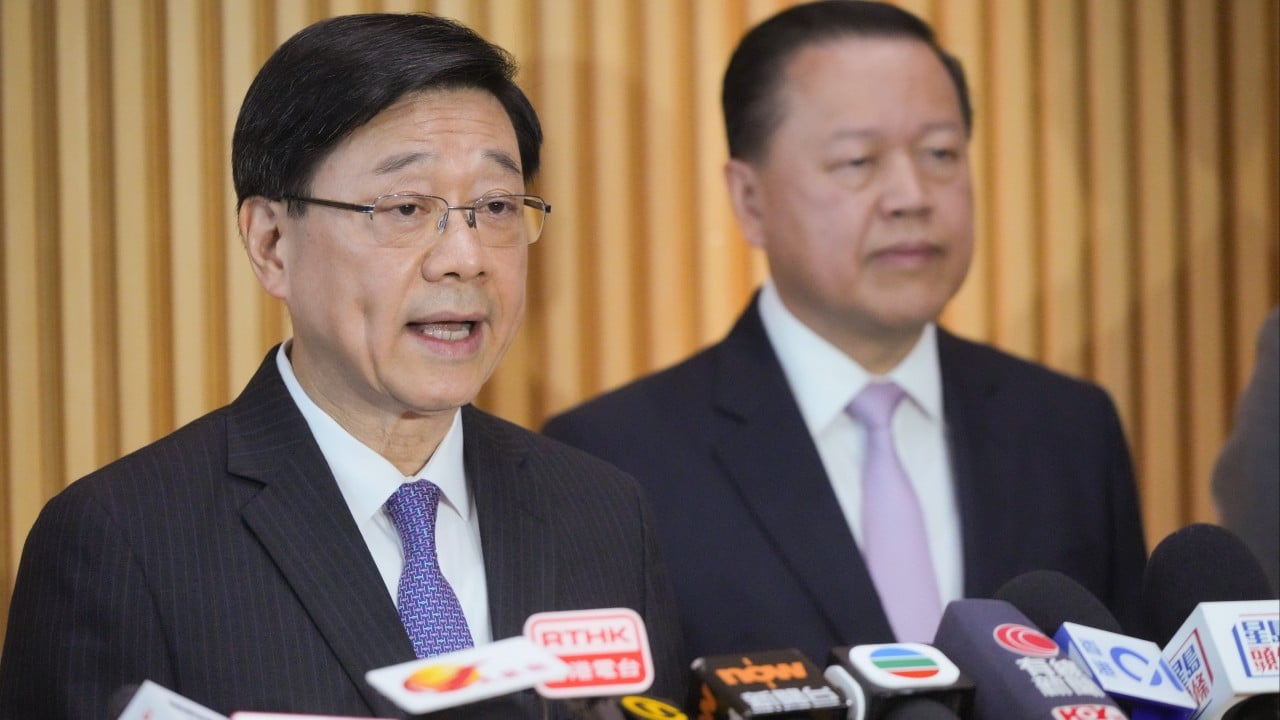
Chief Executive John Lee is preparing to open the floor. On Monday, his administration will launch the public consultation for his term’s final Policy Address.
To some, a policy address is a dry bureaucratic exercise, a laundry list of funding allocations and legislative promises bound in a glossy booklet. But look closer. Peel back the official jargon, and you find a blueprint for real lives. This final address is Lee’s closing argument. It is the moment where political legacy collides with the gritty reality of a city navigating a profound historical transition. The stakes are invisible until they hit your wallet, your housing situation, or your child’s classroom.
The Weight of the Final Hour
Every political leader faces an invisible clock. When you first take office, time feels expansive, an open field of possibilities. You make promises. You draw up grand visions.
Then, the final year arrives.
Suddenly, the open field narrows to a tight corridor. The question is no longer "What can we dream up?" but rather "What can we actually finish?" For John Lee, this final policy address is about cementing a trajectory. The first few years of his term were defined by stabilization and security, a tightening of the city’s structural rivets after years of historic turbulence. Now comes the hard part. He has to prove that the foundation he built can support a vibrant, wealthy, and livable house.
Consider the ordinary citizen trying to decode what this means on a Monday morning.
Let us call her Ms. Wong. She runs a small, multi-generational noodle shop in Sham Shui Po. She does not read government white papers. She does not care about geopolitical alignments discussed in hushed tones over dim sum in high-end hotels. Her reality is measured in the rising cost of imported flour, the dwindling foot traffic on her street, and the rent notice that arrives like an unwanted ghost at the end of every month.
For Ms. Wong, the public consultation launching this week is not an academic debate. It is a question of whether her business survives the shift into Hong Kong’s next economic chapter. When the government asks for input, they are asking people like her if the current economic safety nets are holding, or if they are fraying at the edges.
Rebuilding the Global Engine
The true challenge facing this final policy address lies in Hong Kong’s economic identity. For decades, the city operated on a simple, brilliant formula: be the indispensable bridge between East and West. It was a place where capital moved like water, friction-free and lightning-fast.
But the world changed. The bridge is still there, but the traffic looks different now.
The global financial landscape has fragmented. High interest rates have squeezed liquidity worldwide, and Hong Kong has felt that chill. The property market, long the bedrock of local wealth and government revenue, has undergone a painful correction. For an ordinary family whose primary asset is their flat, that correction is not a statistic on a chart. It is a quiet anxiety that sits at the dinner table. It is the realization that their financial cushion is thinner than it was five years ago.
This is the economic backdrop against which John Lee must write his final chapter. The administration cannot simply rely on the old tricks. They cannot just pray for a property boom or a sudden surge in traditional stock market listings.
The strategy has shifted toward technology, family offices, and wealth management for a new class of regional tycoons. The government wants to transform the city into a hub for artificial intelligence, life sciences, and green finance. They want to build the Northern Metropolis, a massive tech-driven urban center bordering Shenzhen, turning mudflats and old fields into a sprawling silicon valley of the East.
But a transition that grand takes time. Years. Decades, even.
The problem is that people live in the short term. You cannot pay tomorrow's rent with a 2035 technology vision. The policy address must bridge this gap. It needs to provide immediate oxygen to small and medium enterprises like Ms. Wong’s noodle shop while simultaneously funding the massive, long-term infrastructure projects required to keep Hong Kong competitive against rising regional rivals like Singapore or Tokyo.
The Human Geometry of the City
Beyond the glittering bank towers and the economic data lies the physical reality of how people live. Hong Kong is a marvel of vertical density, a triumph of engineering that crams millions of lives into a narrow strip of land between mountain and sea. But that density has a human cost.
Housing remains the most stubborn wound on the city’s social fabric.
Think of a young family living in a subdivided unit in Kowloon. Three people sharing a space barely larger than a parking spot. The air conditioning hums constantly to fight the oppressive summer humidity. The children do their homework on fold-out tables next to the hotplate where dinner is cooked. For them, the success of John Lee’s administration is measured in feet and inches. It is measured by the speed at which public housing estates are built and the efficiency of the queue to get into them.
The administration has made strides. They introduced "Light Public Housing" to fast-track accommodation for those trapped in the worst conditions. They created task forces to tackle the scourge of substandard subdivided flats.
But as the public consultation begins, the city will demand to know: Is it enough?
When the doors open on Monday for public feedback, expect a flood of voices from the community level. District officers, social workers, and neighborhood representatives will bring the raw, unvarnished realities of the city's poorest districts to the table. They will talk about the elderly citizens who collect cardboard to supplement their income, and the young professionals who feel priced out of the very city they call home. The policy address must show that the government is not just looking at the skyline, but looking at the pavement.
The Paradox of the Open Mic
Gathering public opinion in a city as complex as Hong Kong is a delicate art. The process of a public consultation can easily devolve into a performance if not handled with genuine rigor.
The government will hold forums. They will invite sector leaders, business chambers, academic experts, and everyday residents to voice their concerns. There will be online portals and town hall meetings. The challenge is sorting the signal from the noise. Every interest group has a megaphone, and everyone believes their specific crisis is the one that deserves immediate funding.
The developers want relief on property taxes and land premiums. The tech startups want direct grants and fewer regulatory hurdles. The social welfare groups want a stronger safety net for an aging population.
John Lee must act as the ultimate editor of these competing demands. He has a finite budget, a slowing economy, and a limited amount of political runway left in this term. Every dollar allocated to a shiny new technology park is a dollar that cannot be spent on upgrading district health centers or subsidizing transport fares for low-income workers.
This is where the true art of governance reveals itself. It is not about making everyone happy; that is an impossibility. It is about deciding which sacrifices are acceptable and which are fatal to the city's long-term health.
The Unwritten Legacy
We often judge leaders by the crises they manage or the mega-projects they inaugurate. We look at bridges, tunnels, and legislative bills passed under the midnight oil. But the most profound impact of a leader’s final policy address is often psychological. It sets the tone for what the city believes about its own future.
For a long time, Hong Kong was fueled by a fierce, almost reckless optimism. It was the belief that anyone, through sheer grit and hustle, could climb from a squatter hut to a penthouse in Mid-Levels. That narrative took some heavy hits over the last decade. The city grew older, wealthier, and more set in its ways, making upward mobility feel more like a lottery than a guarantee.
The true goal of the upcoming consultation, and the policy address that will follow it in October, is to restore that sense of possibility.
It needs to convince the international investor that Hong Kong remains the safest, most efficient place in Asia to deploy capital. It needs to convince the local graduate that their future lies here, in the lanes of Central and the tech labs of the New Territories, rather than in London, Vancouver, or Singapore. It needs to convince Ms. Wong that her shop will still be there to feed the next generation of her neighborhood.
On Monday, the official press releases will go out. The websites will log on. The microphones will be set up in briefing rooms. The bureaucracy will spin into motion, collecting thousands of pages of submissions, suggestions, and grievances.
The papers will be filed, the data will be collated, and the drafts will be written. But as the consultation begins, the real story is written in the quiet anticipation of a city waiting to see if its leaders truly understand the weight of its daily life. The architect is preparing the final blueprints, but it is the people who must live inside the structure.