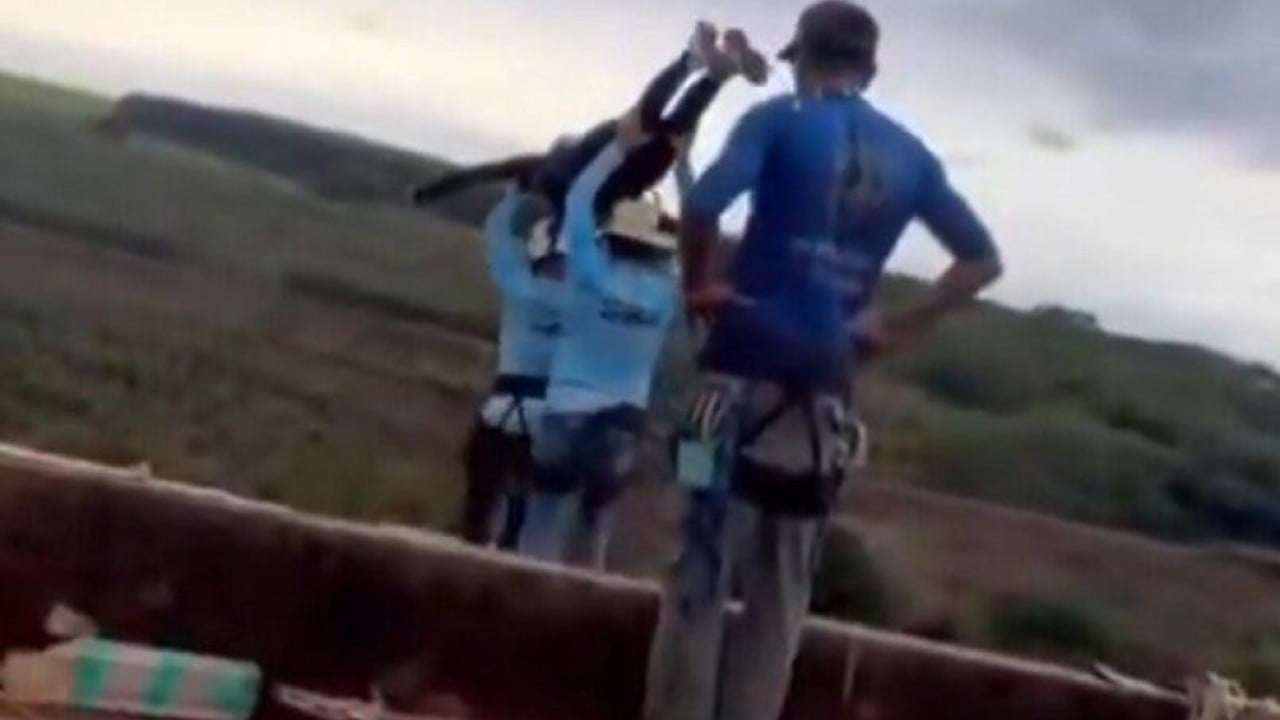
The wind over the Tietê River does not care about human error. It blows steady, cold, and indifferent to the terrors of the ground below. On a Tuesday that should have been entirely unremarkable, a 32-year-old woman named Mayara Rocha stood on the precipice of a bridge in São Paulo, her heart hammering against her ribs, looking down at a gray expanse of concrete and water. She was there for an adrenaline rush. She was there to feel alive. Instead, she became a statistic in a world that increasingly trades safety for the illusion of an extreme thrill.
We live in a culture obsessed with the edge. We scroll through video feeds of people dangling from skyscrapers by their fingertips, or leaping from cliffs with nothing but a strip of nylon strapped to their backs. We watch, mesmerized, because we want to believe that human ingenuity has finally conquered gravity. We trust the gear. We trust the instructors. We trust that the platform beneath our feet is a gateway to adventure, not a trapdoor. Recently making waves in this space: Why Global Leaders Are Cold Calling Donald Trump On His 80th Birthday.
But sometimes, the rope isn’t tied.
The Illusion of Absolute Safety
Consider the anatomy of a modern thrill. When you sign up for an adventure sport—whether it is bungee jumping, rope jumping, or skydiving—you are purchasing a highly manufactured product. The product is fear, but it is supposed to be a controlled, sterile kind of fear. You pay your money, you strap into the harness, and you surrender your survival to a stranger who assures you that the physics are foolproof. Additional insights into this topic are covered by BBC News.
The reality in the outskirts of São Paulo was starkly different.
Mayara Rocha had traveled to the regular gathering point for local thrill-seekers, a bridge known among extreme sports enthusiasts for "rope jumping"—an activity distinct from bungee jumping because it uses dynamic climbing ropes to swing the jumper horizontally rather than bouncing them vertically. It requires precise mathematical calculations. The length of the rope must be perfectly calibrated to the height of the bridge, ensuring the arc of the swing clears the ground with room to spare.
It is a game of inches. If the rope is too long, the swing becomes a impact. If the rope is omitted entirely, it ceases to be a sport. It becomes an execution.
On that afternoon, the routine broke down in the most catastrophic way imaginable. According to investigators and horrified onlookers, Mayara was secured into her body harness. The tension in the air was the familiar, intoxicating mix of dread and excitement that every jumper seeks. The instructor gave the signal. Mayara stepped out into the empty air.
She fell.
She did not swing. There was no sudden, life-saving tug of nylon stretching against weight. There was only the brutal, accelerating rush of terminal velocity, followed by the sickening thud of a human body meeting the earth. The operators had failed to attach the jump line to the bridge infrastructure before allowing her to leap. She fell over seventy feet directly onto the concrete base below the structure.
When the Guardrails Vanish
When we read reports of these tragedies, our immediate psychological defense mechanism is to look for a reason to distance ourselves. We tell ourselves that the victim must have been reckless. We assume they signed a waiver, or that they went with a rogue, back-alley operation. We do this because the alternative is too terrifying to accept: the realization that you can do everything right, follow every instruction, pay the full price, and still be failed by the people you trusted with your life.
The investigation into Mayara’s death quickly pulled back the curtain on a chaotic, unregulated subculture of extreme tourism that operates in the shadows of major cities worldwide. This wasn't an isolated case of a faulty piece of equipment. It was a systemic failure of oversight.
- The Lack of Certification: The operators on the bridge that day lacked the formal municipal permits required to run a commercial enterprise on public infrastructure.
- The Absence of Redundancy: In professional aviation or industrial climbing, every critical system has a backup. If Hook A fails, Hook B catches. In the unregulated rope jumping circles of São Paulo's periphery, the only redundancy was the hope that someone noticed a mistake before the jump.
- The Normalization of Deviance: A term coined by NASA scientists after the Challenger disaster, this refers to the tendency for human beings to cut corners over time because "nothing bad happened the last ten times we did it." The operators had likely skipped minor safety checks for months. On Tuesday, they skipped the only check that mattered.
Imagine the silence that followed the crash. The sudden, suffocating realization among the crew that the rope was still coiled on the deck of the bridge, pristine and unused, while the woman who had trusted them lay motionless below. Emergency services rushed to the scene, but some impacts leave no room for medicine. Mayara was pronounced dead before she could be stabilized.
The Human Cost Hidden in the Headlines
The news cycle treats these events like anomalies, fleeting moments of dark curiosity sandwiched between political updates and weather forecasts. The headline reads objectively: Brazilian woman killed after being thrown off bridge without rope is buried in Sao Paulo. It tells you the what. It completely misses the who.
A few days after the plunge, a cemetery in the sprawling metropolis of São Paulo became the focal point of an agonizing reality. Family members, friends, and neighbors gathered under the heavy Brazilian sun to bury a woman whose life was cut short by a moment of unimaginable negligence. The grief at a funeral for an extreme sports victim is laced with a specific, toxic kind of anger. It is not the quiet acceptance that comes with a long illness, nor is it the shock of a random act of violence. It is the burning, agonizing knowledge that this death was entirely preventable.
A single glance at the harness could have changed everything. A simple two-second tug on the primary line would have revealed the truth.
The people who gathered around Mayara’s casket were left to wrestle with the senselessness of it all. How do you reconcile the vibrant, adventurous woman who loved life so much that she wanted to fly, with the cold finality of a plot of dirt in a São Paulo cemetery?
The Price of Admission
We have to ask ourselves what we are actually searching for when we step onto those ledges. The modern world is profoundly safe, ordered, and predictable for the average city dweller. We sit in climate-controlled rooms, staring at glowing rectangles, navigating lives that are buffered by algorithms and safety regulations. This predictability breeds a strange kind of numbness. We seek out the edge because we want to shock our nervous systems back into awareness. We want to feel the raw, primal rush of survival.
But the industry that caters to this desire has grown faster than the laws designed to govern it. Around the world, adventure tourism is a multi-billion-dollar market, often operating in a legal gray zone where local police don't know who is responsible for inspecting a harness, and city councils don't know who authorized a jump from a public overpass.
The next time you see an advertisement for a cheap thrill, or a social media post showcasing an unregulated jump in a scenic locale, look past the beautiful editing. Look past the adrenaline.
Think of the bridge over the Tietê River. Think of the rope left lying on the concrete, unattached, while a young woman stepped out into nothingness, believing until the very last second that someone had her back.